
In Portland, Maine the seasonal timing is not simply a planning detail but can easily affect how smoothly your pickleball court is built and how well it performs in the long-term. With Maine’s cold, snowy winters and relatively short, mild summers, with consistent precipitation throughout the year, how well you plan for the changing seasons is extremely important.
In this guide by Pine State Courts, we’ll discuss in detail why seasonal planning matters and the expert tips for building a high performing and durable pickleball court in Portland, ME.
Why Seasonal Planning Matters for Pickleball Court Construction
Understanding how seasonal fluctuations impact the court construction timeline and its durability and performance is important before planning any project.
Here’s what smart seasonal planning helps you manage:
Surface performance
Constructing your court in the right season ensures that the asphalt and acrylic coatings are cured properly and you get a smooth and consistent playing surface.
Fewer construction delays
By avoiding peak rain or freeze periods you can keep your construction project moving right on track.
Stronger, long-lasting foundations
Building your court post-winter season when the ground is stable, reduces its risk of cracking, shifting, or premature wear.
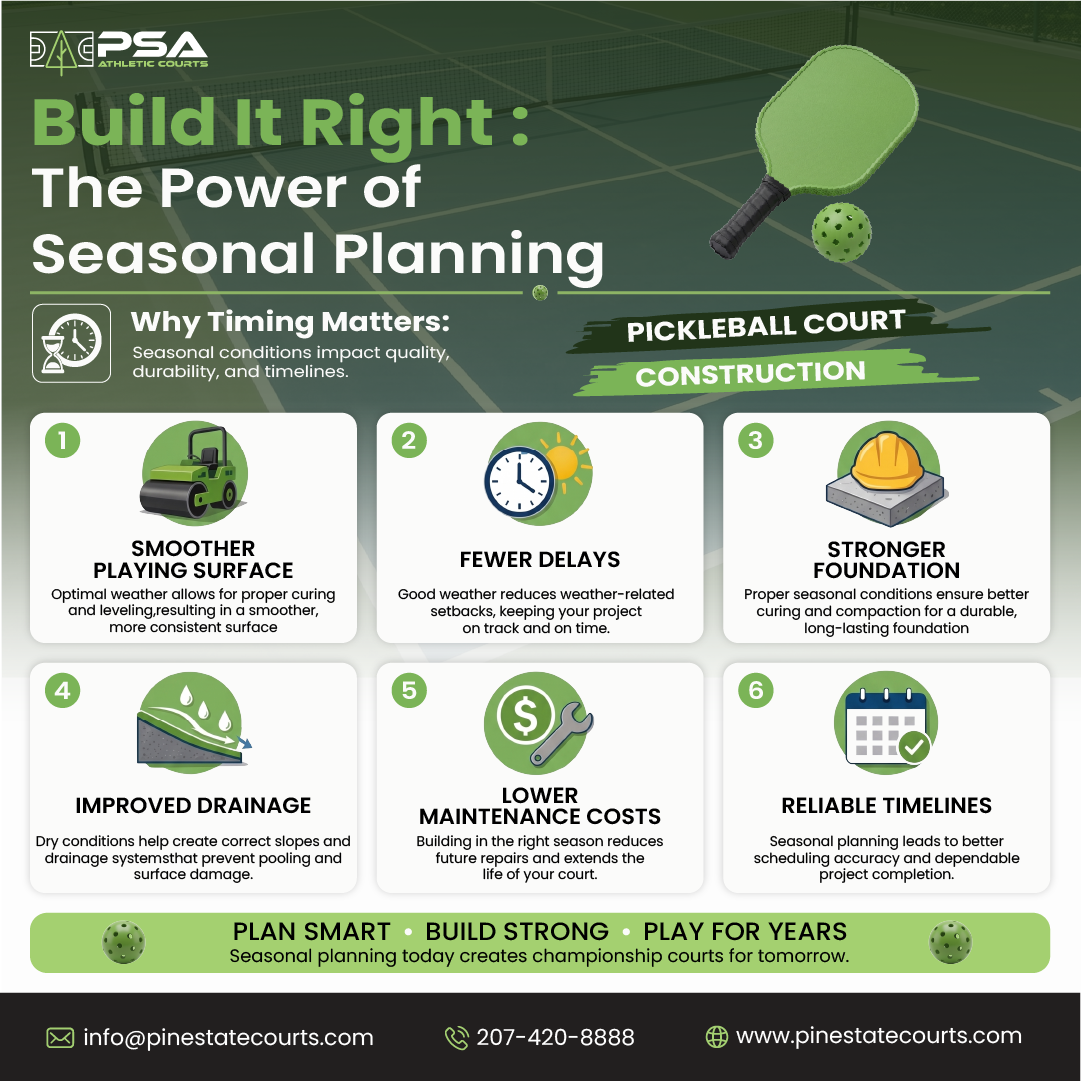
Better drainage outcomes
Dry weather conditions during installation make it easier to grade and install proper drainage systems.
Lower long-term maintenance costs
Getting the court built right the first time means fewer repairs caused by weather-related issues.
More predictable project timelines
Working in the ideal seasonal window helps contractors to plan efficiently and deliver your court on schedule.
Working with an expert pickleball court designer from the beginning of the project ensures that you protect your investment from not only costly rework later but it performs ideally for years too.
Seasonal Tips for Building Durable Pickleball Courts in Portland, ME
The humid continental climate of Portland, ME comes with its own sets of challenges, from construction delays and drainage issues to premature cracking and structural failures. If your pickleball court construction is not planned properly it can cost you significantly.
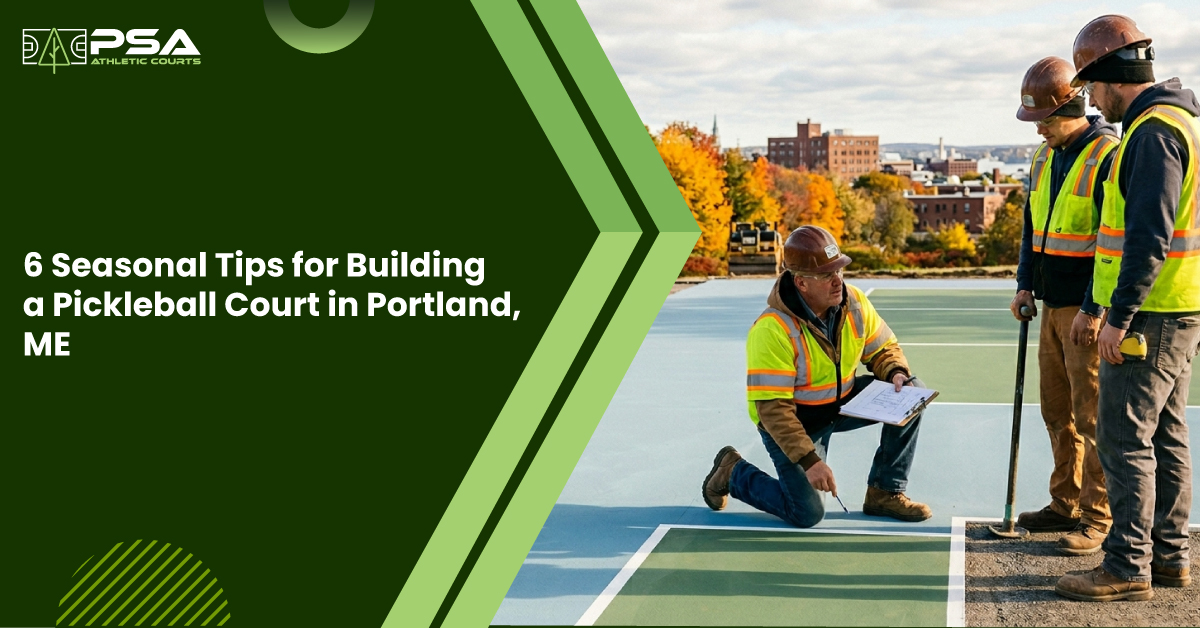
Here’s a compilation of six expert seasonal tips by the construction experts at Pine State Courts to help you plan your construction efficiently:
Tip 1: Plan Your Construction during Late Spring to Early Fall
The best time to build a pickleball court in Portland is late Spring to early Fall, starting from late May through September. This timeline is the most reliable as the temperature is warm enough for proper curing and there’s not much risk of frost or excessive moisture.
By constructing your court during this time, you’ll get the best surface quality and avoid most weather-related delays.
Not sure what the correct court dimensions are? Check out this detailed guide on pickleball court size before you finalize the layout of your court.
Tip 2: Prepare for Portland’s Freeze-Thaw Cycles
Winter in Maine brings with it repeated freeze and thaw cycles, which expand and contract the ground beneath your court. Without proper base preparation and materials, this leads to cracks and surface damage over time.
Designing your pickleball court construction with these cycles in mind, especially with a well-compacted base and flexible coatings can make a huge difference in the durability of your court.
If you are wondering which surface is best for pickleball courts, check out our guide on pickleball court surfacing.
Tip 3: Schedule Your Site Preparation before Winter Ends
If you’re aiming for a spring or early summer build, start your groundwork planning in late winter. You should get permits, design approvals, and schedule a reliable contractor before the ground fully thaws.
This ensures that you’re ready to build your court as soon as the weather conditions improve. Waiting until the peak season will push back your project timeline significantly.
Planning to build a larger facility? This complete construction guide for parks and sports facilities can help you make smart decisions so you can boost your property’s value.
Tip 4: Consider Drainage and Rainfall Patterns
Portland receives steady rainfall throughout the year, so compromising on drainage isn’t advised. Make sure that your court has proper grading, slope design, and drainage systems in place to prevent water pooling.
These drainage issues won’t just affect the court surface but often spread to the courts’ foundation, weakening the court base and causing structural failures. If you don’t get it right from the beginning, it can even prompt the reconstruction of your entire court.
Tip 5: Book Contractors in the Off-Season
The best contractors are often booked solid once the weather warms up. Reaching out to pickleball court construction companies in fall or winter gives you more flexibility and better scheduling options.
While many property owners start with a search like ‘the best pickleball court construction near me,’ choosing the right partner often comes down to their local experience and understanding of seasonal challenges. Getting a contract in advance will also ensure that your project is first in line when the construction season begins.
Tip 6: Plan Out Court Maintenance based on Seasonal Changes
When it comes to ensuring that your court remains durable in Portland weather, it’s not just the court installation that matters but its maintenance is vital too. Make regular inspections after winter, repair surface cracks on time, and resurfacing the court when required helps it to withstand Maine’s climate.
Such careful planning for court maintenance ensures that your investment continues to perform season after season.
If you already own a court, check out our pickleball court resurfacing guide to learn how to extend its lifespan.
Estimated Timeline for Building a Pickleball Court in Portland, ME
While every construction project is a little different, most pickleball courts follow a predictable timeline, especially when the planning for construction is done around the right season.
Planning & Design (2-4 weeks)
This first phase of your construction includes evaluating the site evaluation, planning court layout, getting permits, and selecting surface materials. By starting this phase in late winter or early spring, you’ll be ready to build as soon as the weather conditions improve.
Site Preparation (1-2 weeks)
Next comes excavating the site and grading it to ensure a levelled surface with a slight slope of around 1%. This is important to ensure proper drainage and is usually done when the ground has thawed and dried properly.
Base Installation (1-2 weeks)
This step involves installing and compacting the stone or gravel base, followed by adding asphalt or concrete slab. Proper curing time is crucial here for durability of the surface and is completely weather-dependent.
Planning a new pickleball court? Contact Pine State Courts today for expert guidance and a customized project estimate
Surface Coating & Striping (1-2 weeks)
Acrylic surface coatings are applied next, followed by line markings. Doing this in warm and dry conditions ensures that your pickleball court has a smooth and durable finish.
Final Touches (a few days)
The final touch ups to the pickleball court includes installing nets, fencing (if included), and final inspections to ensure the court is ready for play.
This makes the total estimated timeline for pickleball construction to be 4-8 weeks. This is assuming you meet favorable weather and a well-coordinated schedule. Delays are very common in construction projects that start too early in spring or run too late into fall.
Cost Considerations by Season
By now you know how important the seasonal timing of your construction project is. A major factor that is affected by this is the overall cost of your pickleball court.
Here’s how the pickleball court construction cost varies based on seasons:
Peak Season (Late Spring-Summer)
The demand is the highest in this season which means limited contractor availability and less flexibility on pricing. However, you benefit a lot from the optimal construction conditions and reduce the risk of costly mistakes or rework.
Shoulder Season (Early Spring-Early Fall)
The construction costs may be more flexible in this season but weather variability can introduce delays. If conditions cooperate, this can be a smart balance between cost and timing.
Off-Season (Late Fall-Winter)
You might find better pricing or availability when you book ahead in this season but the actual construction is usually not feasible during winter in Maine. What you can gain here is locking in a contractor early for the next build season.
Weather-Related Costs
Poor timing can lead to hidden expenses like regrading due to rain damage, surface repairs from improper curing, or drainage fixes. These can quickly outweigh any upfront savings you might have made.
Takeaway
Constructing a durable pickleball court in Portland depends as much on seasonal timing as it does on the court design and surface materials. The region’s seasonal shifts from frozen winters to humid summers create a narrow but reliable timeline for construction.
By understanding when to build, how weather impacts each phase, and what to expect in terms of timeline and cost, you get a court that not only looks great on day one but continues to perform for years.
At Pine State Courts, through our expertise of building courts in Portland, Maine we can help you navigate everything from seasonal timing to long-term maintenance so your court holds up, season after season.
Frequently Asked Questions
1. What is the best time of year to build a pickleball court in Portland, ME?
The best time of year to build a pickleball court in Portland, ME is the late spring to early fall, starting from May to September end.
2. How long does it take to build a pickleball court?
Building a pickleball court usually takes around 4 to 8 weeks. This timeline varies depending on the size of court, existing weather conditions, and the extent of site preparation required.
3. How do freeze-thaw cycles affect pickleball courts?
Freeze-thaw cycles affect pickleball courts as it leads to widening to minor surface cracks due to cyclical expansion and contraction. This ultimately weakens the court’s integrity and leads to structural failures.
4. Do I need permits to build a pickleball court in Portland, ME?
Yes, you do need a building permit to construct a pickleball court in Portland, ME. You may also need to consider zoning setbacks, noise regulation, and water runoff depending on your location.
5. Can I build a backyard pickleball court on uneven land?
Yes, you can build a backyard pickleball court on uneven land but before beginning construction you need to level and grade it to a slope of 1% to ensure proper drainage. This site preparation increases your overall construction costs.
6. Is drainage important when building a pickleball court?
Yes, drainage is very important when building a pickleball court as any waterpooling issues impacts both the safety of players and durability of your court. Water seeping into the court surface can eventually lead to structural failure with freeze-thaw cycles.
DOWNLOAD OUR FREE GUIDE
Ready to build your dream court?
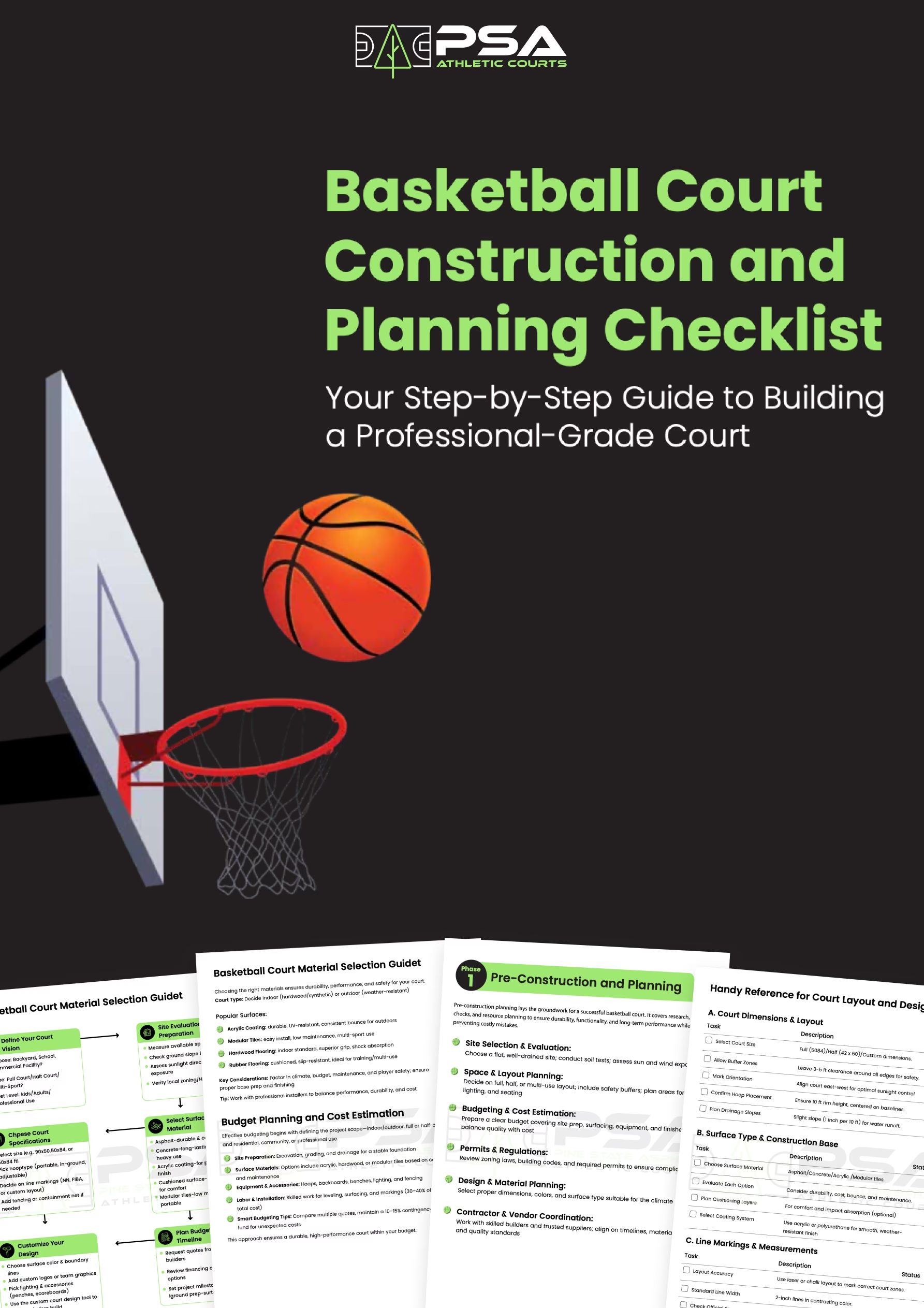
Download our FREE Basketball Court Construction & Planning Checklist and get the step-by-step roadmap to building a professional-grade court—from budget planning to final touches.
No guesswork, just results.