

Many sports facilities are racing to keep up with the growing popularity of pickleball, either by building new pickleball courts or converting their existing tennis courts into one.
But in this rush to meet the demand, construction projects often move forward without proper planning. This leads to issues like poor drainage, surface cracks, incorrect dimensions, or courts that don’t meet player expectations.
These mistakes don’t just affect the quality of play but also lead to costly repairs, safety concerns, and lost usage of your park or facility over time.
The difference between a court that lasts over 10 years and one that needs repairs in just 2-3 years often comes down to getting the fundamentals right and that is exactly what this Pine State Courts’ guide will help you get right.
We’ll break down the 11 essential pickleball court construction guidelines to help you build a durable, high-performance court that stands the test of time.
1. Evaluate Park Space before Starting Pickleball Court Construction
Before the court construction begins, the biggest mistake most facilities make is underestimating the space they have. Find out how big a pickleball court should be for recreational or professional play. Space planning doesn’t just involve planning for how big a pickleball court is but also requires consideration for other things like:
- Player movement and safety zones
- Space for the spectators
- Noise impact on the surrounding areas
- Future potential for expansion
Getting space planning right is essential as mistakes here often lead to overcrowded courts or costly redesigns later.
2. Work With an Experienced Pickleball Court Builder for Better Planning
Not all court builders understand the specific requirements of pickleball courts. That’s why you need a contractor who specializes in building pickleball courts or has prior experience of building one.
Such an experienced builder ensures that your court has:
- Correct court dimensions and spacing
- Properly prepared court base
- Long-term durability in your climate
- Adherence to your local zoning or HOA guidelines
So, whether you are planning on building a new court or turning your existing court, choosing the right pickleball court builder is one of the most important decisions for this project.
Not sure where to start? Talk to our team before you finalize your court plans.
3. Design Multi-Court Layouts for High-Traffic Sports Facilities
If your facility expects regular usage, building a single court won’t be enough. Instead of building separate courts for each sport, it is wise to invest in a multi-court layout. Expert pickleball court designers can help you build smart court layouts that:
- Maximize the utility of your space
- Improve the influx of players
- Reduce wait times
- Increase the overall usage of your court
Well-designed layouts that offer space for playing multiple sports can turn your facility into a community hub.
4. Build a Stable Foundation for Long-Lasting Pickleball Court Surfacing
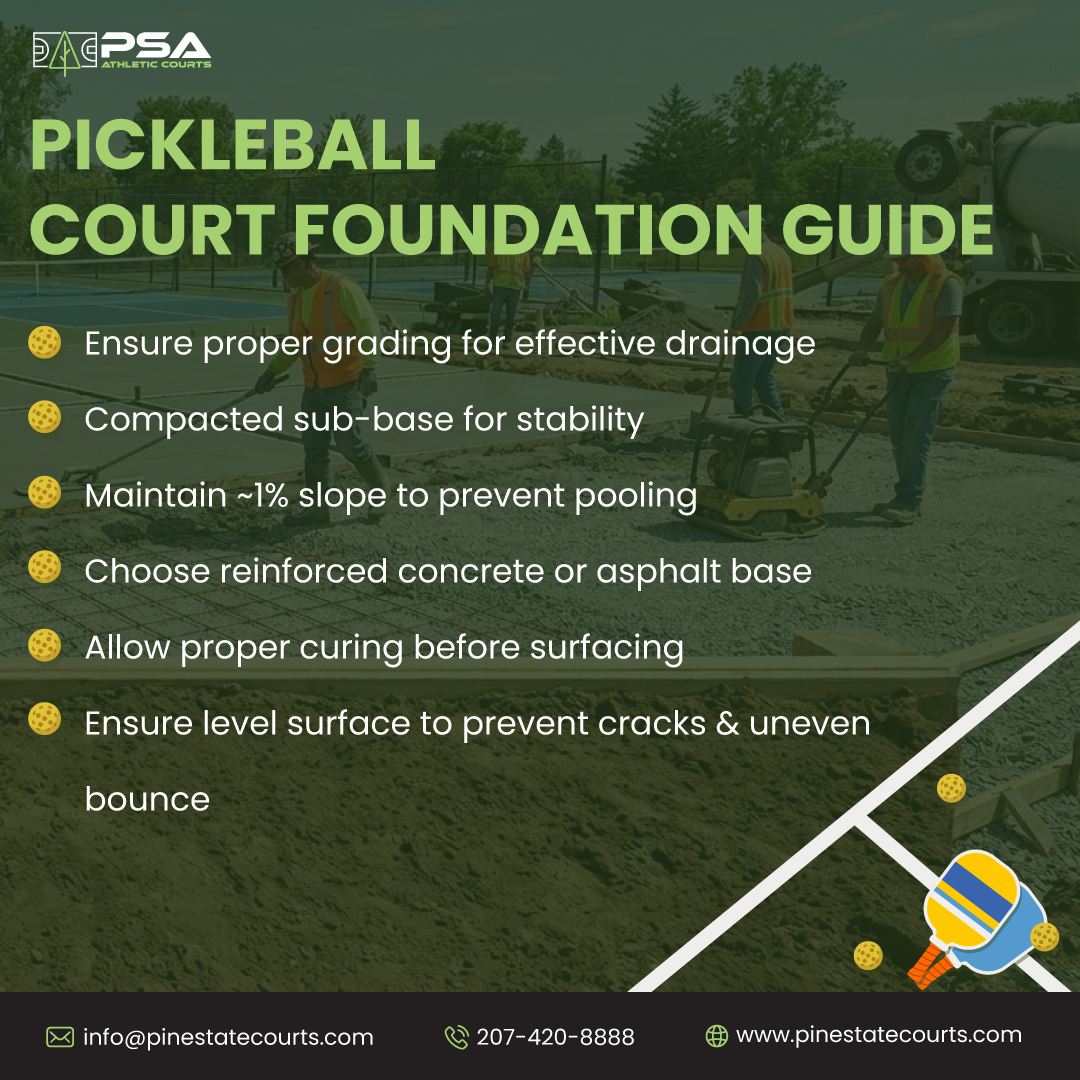
A court is only as strong as the foundation it is built upon. Base preparation is another critical part of pickleball court construction, without it, the court surface will be prone to:
- Cracks appearing sooner
- Surface becoming uneven
- Birdbaths forming after rains
- Frequent and expensive repairs
A strong foundation starts with the right plan - get expert guidance from Pine State Courts before you begin your construction project.
5. Select Weather-Resistant Pickleball Court Surfacing Systems
Outdoor pickleball courts face constant exposure to external elements like the Sun, rain, and temperature changes. These along with high-traffic on the court deteriorate the court faster if proper surfacing systems aren’t used.
Choosing the right surface system helps to:
- Prevent premature wear
- Maintain consistent play quality
- Ensure safety of players
- Reduce long-term maintenance costs
The wrong surface choice can significantly shorten your court’s lifespan, check out our pickleball court surfacing guide to know what the right choice of material is.
6. Incorporate Proper Slope and Drainage in Pickleball Court Construction
Drainage is one of the most overlooked and the most expensive mistakes you can make in court construction. Your court should be built with a slight slope (typically around 1%) to ensure proper drainage.
Without this you will face several problems like:
- Water collecting on the court surface
- Surface cracks develop faster
- Reduced playability after rain
- Compromised safety of the players
- The surface can also deteriorate quickly due to algae or mold growth
Even a well-built court can fail early if drainage isn’t handled correctly from the start.
7. Use High-Visibility Court Colors and Line Markings
Using high visibility colors and line markings isn’t just important for a court that looks great but it also impacts the player experience directly.
Poor choice of color or faded lines on the court can:
- Make gameplay confusing
- Reduce accuracy during play
- Lower overall user satisfaction
- Impact player safety
- Reduce strategic play
High-contrast colors and precise line markings ensure your court looks professional and offers an enjoyable playing experience.
8. Install Perimeter Fencing for Safety and Ball Control
Installing fences shouldn’t be an afterthought, it is essential to consider during construction to ensure the safe functioning of your court. Fencing also makes your court look more professional.
Without proper fencing:
- Balls will constantly leave the court
- Games are often interrupted
- Safety risks increase for spectators
- Players don’t know the proper boundary of the court
A well-designed perimeter keeps the play contained and improves the overall court usability.
9. Add LED Lighting Systems for Extended Play Hours
If your court doesn’t have an appropriate lighting system or lacks one, it limits the play to only daylight hours. This leads to an underutilization of your facility, impacting your ROI.
LED lighting systems are this important to:
- Extend the usable hours of the court
- Increase bookings and foot traffic
- Improve player safety during evening play
- Ensure energy savings when compared to other options like metal halide lamps.
For many facilities, lighting is what turns a court from a daytime asset into a revenue-generating one. Check out our guide on the future outlook for pickleball courts to learn more such solutions to make your facility stand out from the rest.
10. Include Seating, Shade, and Player Amenities
A great playing surface attracts players but it’s the overall experience you offer that keeps them coming back.
Add amenities to your pickleball court like:
- Benches and seating
- Shade structures
- Rest areas
- Places for refreshment
These add-ons will enhance comfort, encourage longer stays, and create a more welcoming environment for players and spectators.
Explore 5 expert strategies for designing and building a premium pickleball court in Portlands.
11. Plan Periodic Pickleball Court Surfacing to Maintain Court Quality
Skipping maintenance is one of the most common reasons courts fail earlier than expected. That’s why pickleball court resurfacing and repairs become important to ensure consistent play quality.
Without this periodic resurfacing:
- Your court surfaces wear out faster
- The play quality declines gradually
- Repair costs increase over time
- Minor cracks escalate to foundational issues
- Improper drainage compromises the court base
Planning resurfacing every 4 to 8 years helps you protect your investment and avoid costly repairs.
Closing Thoughts
From planning the court layout, surfacing considerations, lighting, fencing, base preparation, and multi-court layouts to periodic resurfacing, each tiny detail has its own role to play in ensuring you have a great playing surface.
The difference between a court that performs for years and one that starts failing early comes down to getting these details right from the start.
If you’re planning a pickleball court project, the smartest first step is getting expert input before your construction process begins.
Pine State Courts helps parks, schools, and sports facilities design and build high-performance courts that last. From planning and layout to construction and resurfacing, our team ensures every detail is done right.
Schedule a free consultation to plan your project and avoid costly mistakes down the line.
Frequently Asked Questions
1. What is the ideal surface for pickleball court construction?
An asphalt or concrete surface topped with an acrylic coating is ideal for pickleball court construction. It offers a durable surface with consistent ball bounce, and great traction.
Other surfaces like modular tiles support versatility, shock absorption, and efficient drainage.
2. Why hire a professional pickleball court builder?
Hiring a professional pickleball court builder is important to ensure:
- Proper court layout and dimensions
- Long-lasting and safe playing surface
- A professional court that performs well
- Adherence to local zoning and HOA guidelines
- The court can withstand extreme weather
3. How often should pickleball court surfacing be redone?
Pickleball surfaces should be generally redone every 5 to 8 years while courts that have high-traffic require resurfacing much sooner - every 3 to 5 years.
This ensures that your court remains in great shape for years and offers a safe and consistent playing experience.
4. What maintenance is required after pickleball court construction?
Pickleball courts require regular maintenance post-construction. This includes periodic cleaning, regular inspections, and fixing any cracks or drainage issues as they arise
5. How long does pickleball court construction take?
Constructing a pickleball court usually takes around 4 to 8 weeks to complete. This time however depends on the site preparation required, existing weather conditions, and the curing time of the surface you choose.
DOWNLOAD OUR FREE GUIDE
Ready to build your dream court?
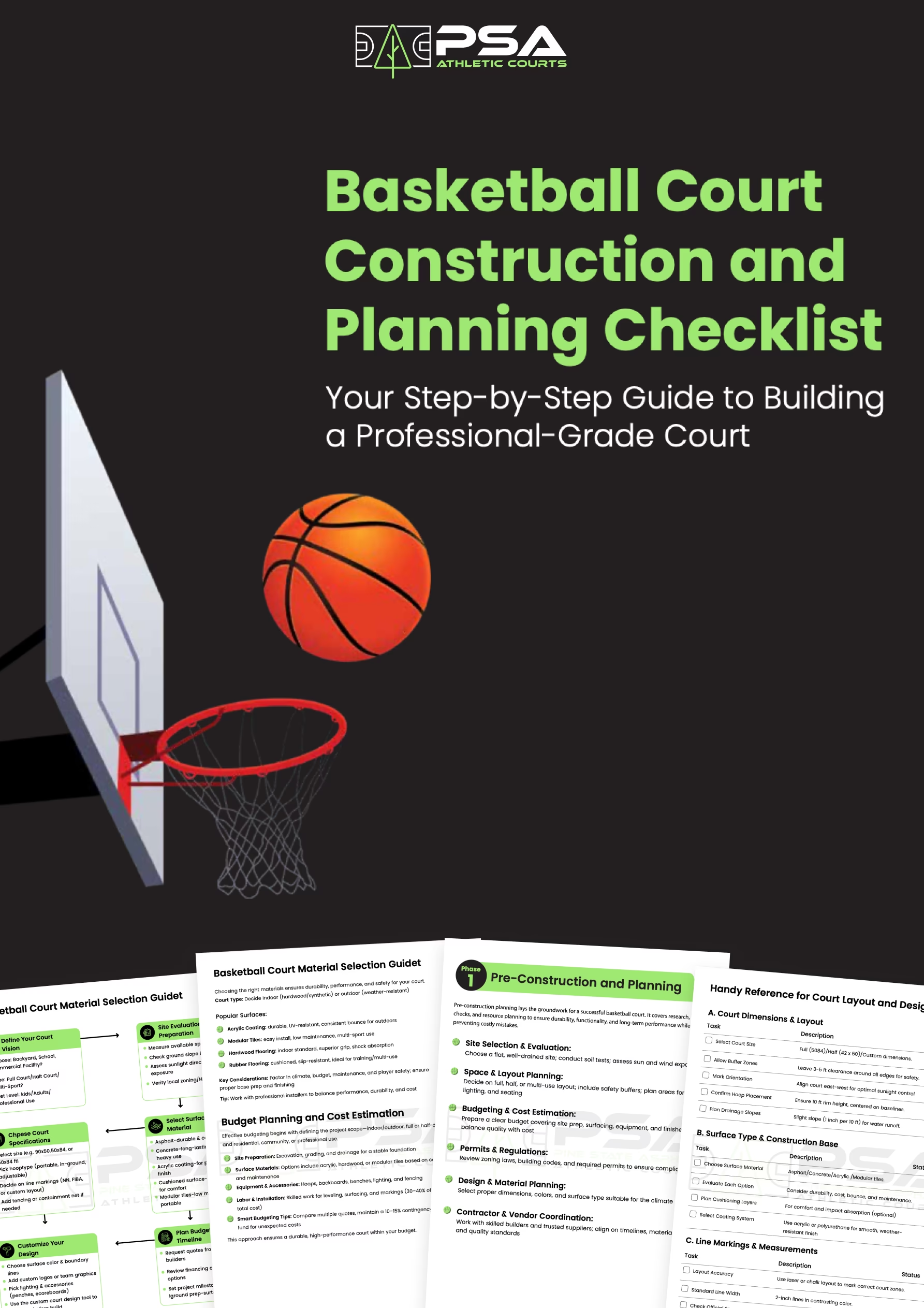
Download our FREE Basketball Court Construction & Planning Checklist and get the step-by-step roadmap to building a professional-grade court—from budget planning to final touches.
No guesswork, just results.