
.jpg)
As pickleball continues to surge in popularity across Portland, Maine and throughout New England, more property owners are moving beyond searching for “the best pickleball courts near me” and investing in private courts of their own. But building a pickleball court in the Northeast comes with unique challenges — including freeze-thaw cycles, heavy snowfall, drainage demands, and short construction seasons.
The rains and temperature shifts mean that a standard approach for pickleball courts construction often leads to premature cracking or drainage issues. At Pine State Courts, we’ve seen exactly what the Maine elements can do to a subpar build.
That’s why we’ve narrowed down the five non-negotiable strategies that separate a DIY disaster from a professional, high-performance court that stays play-ready all year round. Check our expert guide to know the five strategies to build such high-quality pickleball courts in Portland.
Strategy 1: Start with a Site Assessment and Expert Planning
The first expert tip from an expert pickleball court designer is to formulate a definite plan for the site. This begins with evaluating the soil and the natural slope of your property. In Portland, the soil composition varies significantly, and the region’s high rainfall requires precise engineering.
Here’s what you should consider:
Advanced Drainage
To prevent standing water, your pickleball court must have a slight, consistent slope (typically 1%). Also assess the need for perimeter drains to move water away from your court’s sub-base, this prevents the foundation from shifting over time.
Base Stability
Whether you use asphalt or concrete, your sub-base must be compacted correctly. Consult your local court builder to evaluate the soil, they will determine the appropriate depth of crushed stone needed to provide a stable foundation that’s frost-resistant too.
Court orientation
To avoid blinding the players with the Sun, it is always recommended to build your Portland pickleball court in a North-South orientation.
Strategy 2: Choose the Right Court Surface for Longevity and Play
In addition to the player’s skill, it is the court surface that decides whether a game will be won or lost. For a Portland pickleball court, you need a court material that offers both great traction and weather resistance.
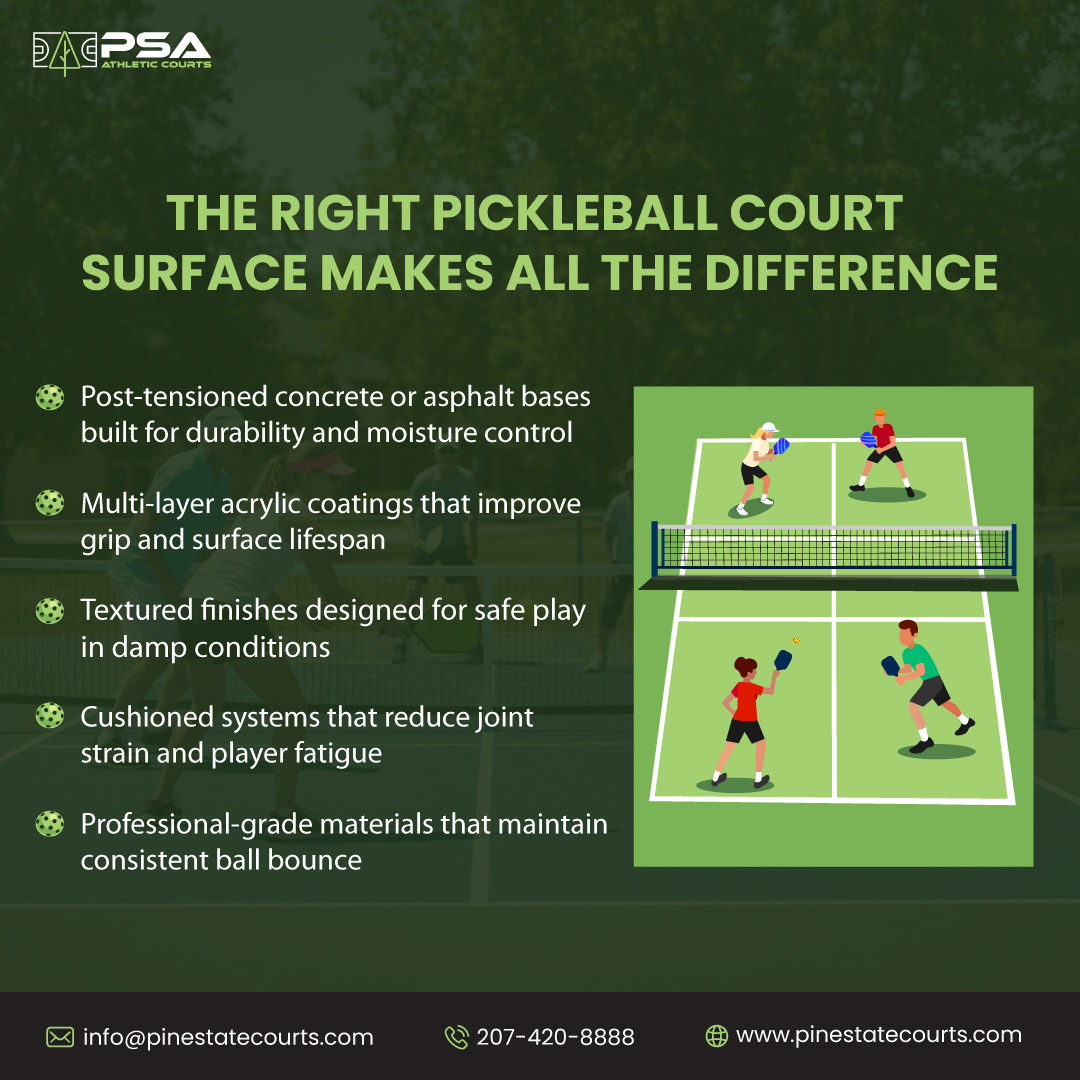
Most high-quality courts use either post-tensioned concrete or asphalt base for pickleball. Adding multiple layers of acrylic coatings on top don’t just add color but provide the necessary texture (grit) for traction in damp conditions. For professional-grade courts, an additional cushioned layer helps to reduce the physical impact on players' joints.
Check out our guide on pickleball court surfacing for a deeper insight into choosing the right surface.
Strategy 3: Stick to Official Dimensions and Smart Layouts
While you may be tempted to save space, a high-quality court must adhere to official USA Pickleball (USAP) dimensions. The standard playing area is 20 feet x 44 feet, but the total recommended footprint is 30 feet x 60 feet (or better yet 32 feet by 64 feet).
Providing this extra "out-of-bounds" space is essential for ensuring player safety and allowing room to move without hitting fences or walls. A smart pickleball court layout also takes into account the "non-volley zone" (the Kitchen) and service lines with 100% accuracy. These precise measurements ensure that your players develop skills that are transferable to tournament play.
Strategy 4: Use High-Quality Equipment and Accessories
The quality of court equipment and accessories you use, define the premiumness of your court. Ensure you use permanent, professional-grade hardware for your professional court. Also, all metal components should be rust-resistant and designed for long-term outdoor exposure in Portland.
- Net Systems: Use heavy-duty, in-ground steel posts that stay at the regulation height of 34 inches at the center and do not sag over time like the portable nets.
- Fencing: Chain-link fencing is the standard, but it must be coated to prevent corrosion.
- Lighting: If you plan to play during shorter winter days, LED lighting is a necessary addition. Modern LED systems are highly efficient and can be directed to avoid light pollution in neighboring yards.
Contact Pine State Courts to work with trusted pickleball court construction experts. Get the perfect fit for your facility and book a site visit today.
Strategy 5: Plan for Ongoing Maintenance and Court Care
Even the best-built courts in the world require a little care and attention but especially so if they are built in the land of moss and Douglas Firs. So, it is important that you plan for ongoing maintenance in advance, it is also wise to consult a professional court builder to help you through it.
Here’s a few tips on court care that you should follow:
- Moisture Management: Moss can build up quickly in shaded areas. Regularly remove the organic debris and use a soft-wash technique instead of a high-pressure power washing to prevent the surface from becoming slippery or stained.
- Surface Inspection: We recommend an annual check for small "spider cracks." Addressing minor issues early prevents water from reaching the base, which is the most common cause of major structural failure.
- Resurface regularly: Your court will stay in top shape as long as it is cleaned regularly, scheduling pickleball court resurfacing at regular intervals further supports this.
Check out our guide on outdoor pickleball courts to know the latest trends in pickleball court construction and its future outlook.
Why Working with a Local Pickleball Court Builder Matters?
Building a pickleball court in Portland requires navigating the specific local variables, from soil expansion to municipal permitting and stormwater codes. A local builder understands how to engineer drainage and surfacing specifically for Portland's unique weather patterns that national contractors often overlook. Choosing a team like Pine State Courts ensures your project is handled by experts who understand the local landscape and can also help property owners determine when to resurface a pickleball court for optimal playability and longevity.
If you too want to make the switch from searching “pickleball courts near me” to building your own professional-grade court, contact our team to get started today.
Conclusion
From the site prep, ensuring correct dimensions and layout, to choosing the right surface and equipment for quality performance and player safety, there’s a lot that you must consider before building a pickleball court in Portland. This initial planning and the subsequent set up could very well be the difference between a court that’s subpar and one that performs exceptionally well.
At Pine State Courts, we focus on building pickleball courts that withstand Maine's environment. If you are planning to build a professional-grade, long-lasting playing surface for your facility, contact us for a site visit today.
Frequently Asked Questions
1. Which surface is best for pickleball courts in Portland?
The best surface for pickleball courts in Portland is a concrete base topped with layers of acrylic coatings. This surface provides great durability and traction for players, you can also add a cushioned layer for enhancing player safety.
2. How much does it cost to build a high-quality pickleball court in Portland?
The cost of building a high-quality pickleball court in Portland ranges from $25, 000 to $80, 000. This cost depends a lot on how much site prep is needed, the surfacing material you choose, whether you add any cushioned layers or additional customizations, etc.
3. Can I hire professionals to handle the entire court construction process?
Yes, you can hire professionals to handle the entire court construction process from initial site assessment, court design to adding the finishing touches. Consulting professionals right from the very beginning to the completion of your project ensures you get a high-performing court that’s aligned to your facility’s requirements. Many professional court builders like Pine State Courts also offer ongoing maintenance and resurfacing solutions.
4. How often should pickleball courts be maintained?
Pickleball courts need regular maintenance this includes cleaning the court daily/ weekly to remove any debris or dirt to professional pickleball resurfacing (every 3 to 5 years for asphalt/ concrete court and every 5 to 7 years for cushioned surfaces.)
5. Can pickleball courts be built outdoors in Portland’s rainy climate?
Yes, pickleball courts can be built outdoors in Portland’s rainy climate but it requires specific considerations during construction. This includes a high-quality drainage system, weather resistant surfacing, and regular maintenance. Ensure the weather’s dry for several consecutive days before you start this project.
6. Are there eco-friendly options for pickleball courts?
Yes, there are eco-friendly options for pickleball courts. These include using sustainable materials like recycled rubber or plastic tiles, permeable surfaces for water drainage, and converting your old tennis courts to pickleball courts rather than building new ones.
7. Can I add amenities to my pickleball court facility?
Yes, adding amenities like comfortable seating, shade structures, water stations, LED lighting for evening play, and locker rooms, etc. can add to the comfort of both players and spectators. This retains your existing members and attracts new members, subsequently boosting your revenue and the value of your property.
8. Are there permits required to build pickleball courts in Portland?
Yes, if you are building a pickleball court in a residential area in Portland then you need the building, zoning, and construction permit. In case you are building one in a park then you need to obtain specialized permits from Portland Parks & Recreation (PP&R).
DOWNLOAD OUR FREE GUIDE
Ready to build your dream court?
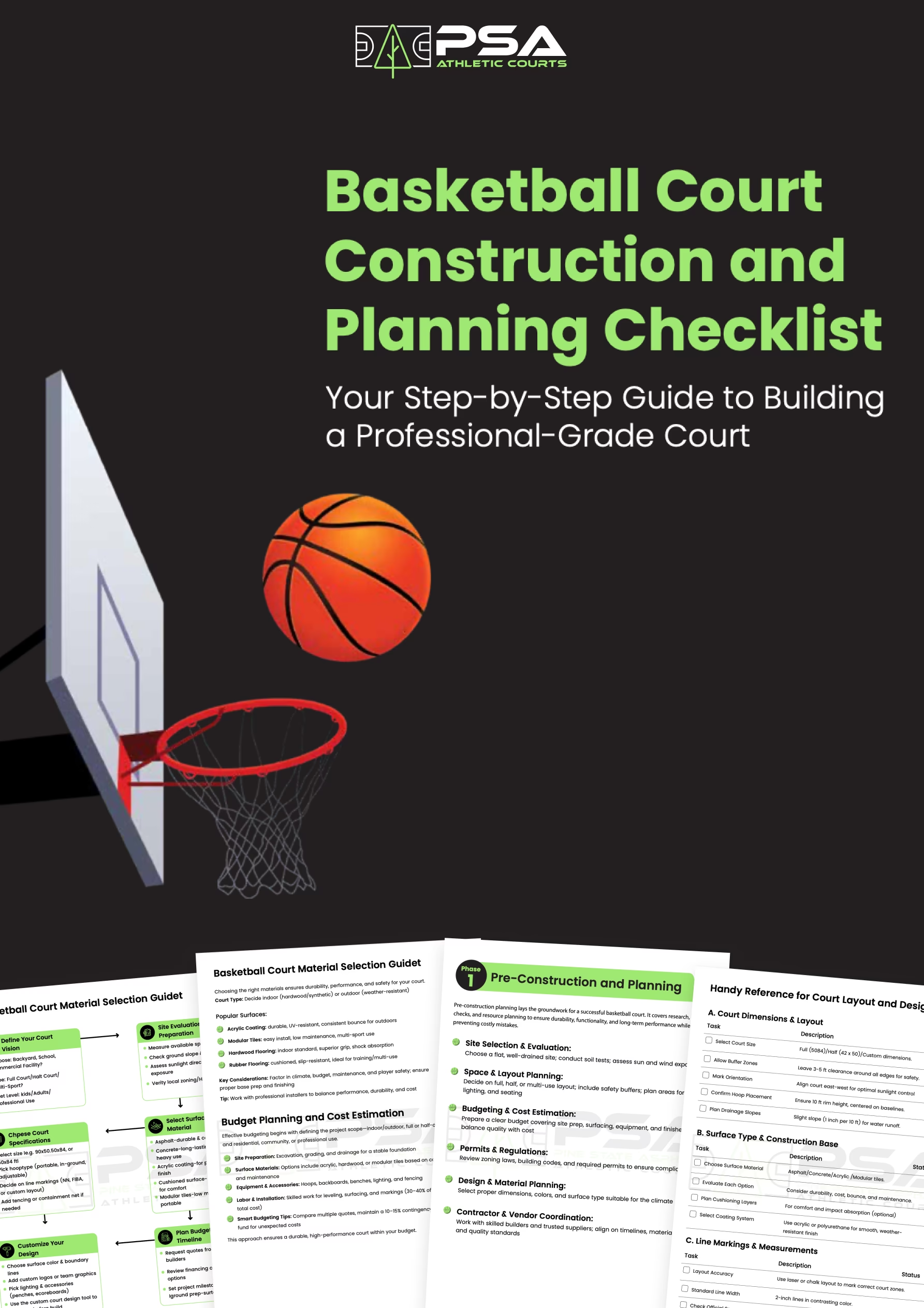
Download our FREE Basketball Court Construction & Planning Checklist and get the step-by-step roadmap to building a professional-grade court—from budget planning to final touches.
No guesswork, just results.