

Building a tennis court is not just about selecting the right site and installing a court surface on it. You need to plan everything from the site, drainage, base construction, court orientation, and fencing to lighting and court dimensions.
This is particularly important for tennis court construction in areas where freezing temperatures, snow, moisture, and repeated freeze-thaw cycles can put significant stress on outdoor courts. With a clear plan in place for tennis court design and construction, you get durable and long-lasting performance.
In this tennis court installation checklist by Pine State Courts, we’ll discuss some major factors that you should consider before building your court.
1. Evaluate the Site and Available Space
The first step is determining whether your property can accommodate the tennis court. You need an area of around 7,200 square feet for this which will include the playing field (78 ft by 36 ft) and still have additional room for player movement and safety.
Besides this, you should also consider slopes, trees, buildings, property boundaries, utilities, and construction access. Your site may accordingly need clearing, grading, excavation, or other preparations before the court base can be constructed. It is wise to get a professional site evaluation from a tennis court designer to identify potential issues before the construction begins.
2. Check Drainage and Ground Conditions
Water standing continuously on the court can contribute to surface deterioration, cracking, and movement. That’s why before construction, it is important to evaluate soil conditions, existing grades, groundwater, and how water moves across the property.
Your tennis court design may accordingly require grading or other drainage measures to direct water away from the playing surface. This is especially important in areas like Maine, where seasonal freeze-thaw cycles affect outdoor courts. Addressing drainage and subgrade conditions early is also crucial to reduce future maintenance and repair problems.
Check our guide to Tennis Court Repair in Maine to learn more about the problems tennis courts in Maine face and their possible solutions.
3. Choose the Right Court Surface
The surface you choose for your tennis court affects how well the court plays, how much maintenance it requires, and how it performs over time. While acrylic hard courts are a common choice for outdoor tennis facilities, you can also choose other surface systems like modular tiles and cushioned athletic flooring depending on your project.
Consider factors such as playing speed, player comfort, climate, expected usage, maintenance requirements, and budget while making this choice. The underlying base and surface system should also be designed to work together. Your tennis court builder can help you with this and recommend a suitable surface based on your property's conditions and how the court will be used.
4. Plan for Court Orientation
The orientation of your court can affect visibility and playing comfort, particularly when the Sun is low in the morning or evening. To reduce this Sun glare, outdoor tennis courts are generally oriented in North-South direction.
You should also consider existing buildings, trees, slopes, wind exposure, neighboring properties, and potential shadows across the court while planning court orientation. A professional site assessment can help you balance these factors and determine the most practical orientation for your space.
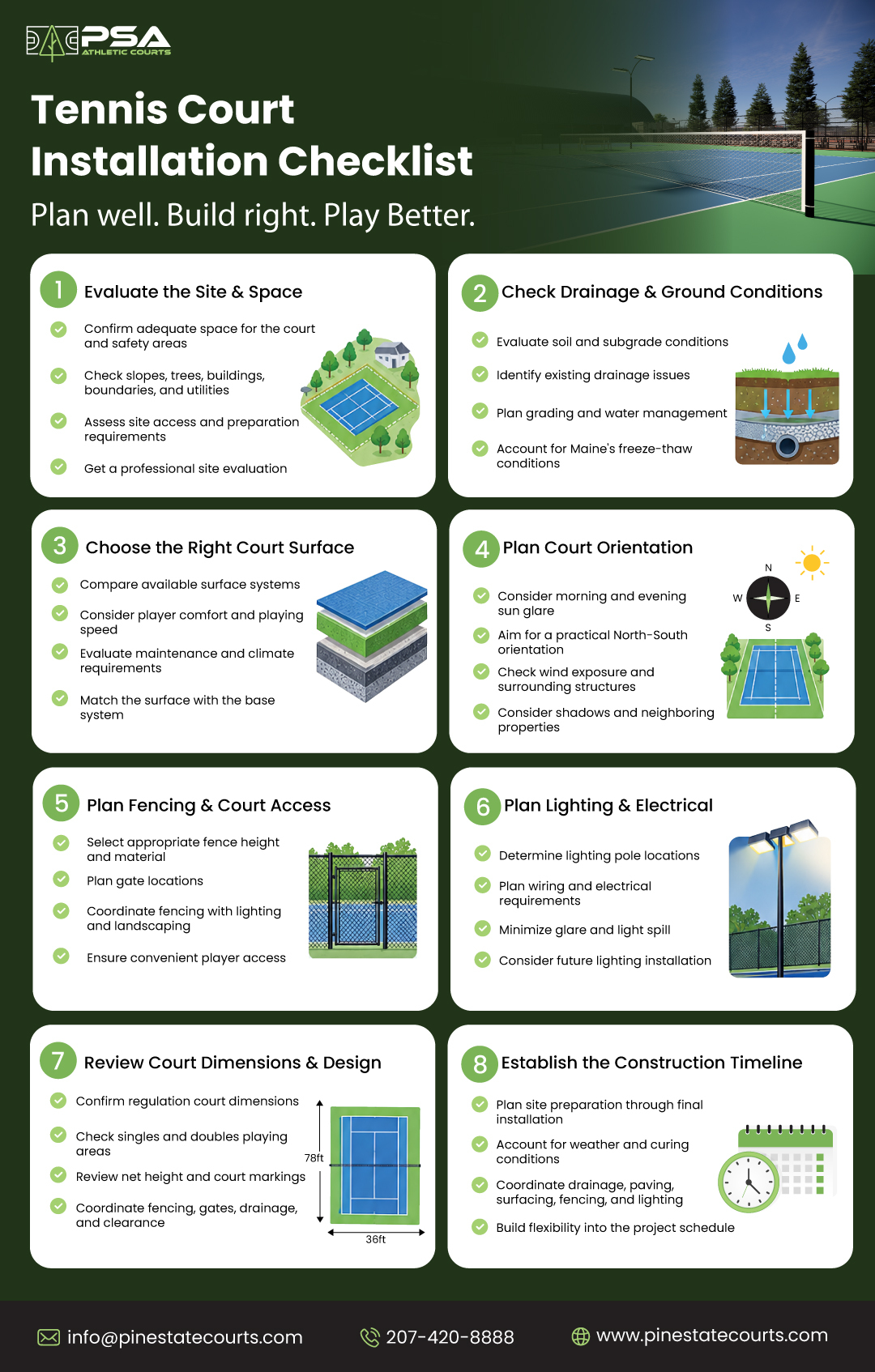
5. Consider Fencing and Court Access
Fencing the tennis court helps to contain balls, define the playing area, improve safety, and control access. Before construction, you should decide on the fence height (10 feet for recreational and 12 feet for professional play), material, gate locations, and how the enclosure will work with the rest of the property.
You should also consider how the fence will interact with lighting poles, landscaping, walkways, and neighboring areas. Planning these details along with the tennis court design and layout can help you prevent access problems and unnecessary modifications later.
If you’re noticing faded lines or uneven areas on your existing court, you can check our Tennis Court Repair and Resurfacing Guide to learn what your court needs.
6. Plan Lighting and Electrical Requirements
If you plan to use the court after dark, you should address lighting and electrical requirements during the initial design itself. This includes planning for the location of lighting poles, electrical service, wiring routes, fixtures, controls, and access for future maintenance.
Lighting should be placed to provide consistent visibility across the playing area while limiting glare for players and unnecessary light spill toward nearby properties. Even if lighting is not part of your initial project, you should still plan for possible future installation. An early coordination between your tennis court builder and electrical professionals can make this installation more straightforward.
7. Review Tennis Court Dimensions and Design Details
Getting the tennis court dimensions right is essential but the layout of the court involves more than just the playing field. While the length remains constant at 78 feet, a regulation court is 27 feet wide for singles and 36 feet wide for doubles. It also has specific requirements for net height, markings, and surrounding clearance.
The location of your fence, net posts, gates, and drainage slope should also be considered during the design stage. Reviewing these details before construction helps ensure that the finished court provides the required playing area without creating conflicts with fencing, access, or other site features.
8. Establish a Construction Timeline
Tennis court construction involves several stages, including site preparation, drainage, base construction, paving, surfacing, fencing, lighting, and finishing. These stages need to be properly sequenced, and some of this work depends on suitable weather and curing conditions.
This is particularly important in areas where rain, cold temperatures, and seasonal weather can affect outdoor construction and surface application. So, before the construction work begins, discuss the expected schedule, weather contingencies, and other factors that could affect its completion with your builder. Leave some room for flexibility in the timeline so that each stage is completed under appropriate conditions rather than rushing your work to meet a fixed date.
For deeper insights into timely repair and maintenance, check our guide to tennis court resurfacing Bangor.
Final Takeaways
A tennis court installation starts well before the first layer of asphalt or surface coating goes down. The quality of site preparation, drainage system, foundation, grading, and layout can all have a major influence on how your finished court will perform over time.
These considerations become even more important because an outdoor court needs to withstand external elements like intense heat, UV exposure, snow, moisture, and repeated freeze-thaw cycles. You should also plan your tennis court design and construction as a complete system so it is easier to coordinate fencing, lighting, access, drainage, and maintenance from the beginning.
Get in touch with a tennis court builder in time to evaluate these details before construction. This can help you avoid costly changes later and create a court that is built around the way it will actually be used.
Work with Pine State Courts for Tennis Court Construction
At Pine State Courts, we understand that a successful tennis court project requires careful planning for the site, base, drainage, dimensions, surface system, and other finishing details. That’s why we work with you from the initial site evaluation through construction and finishing, to build a court that suits your property, local conditions, and its intended use.
We’ve worked with professional facility owners, educational institutions, community centers, and homeowners for decades for tennis court construction. Not only this, we also offer our ongoing services for tennis court maintenance, repair, and resurfacing so your court performs well for your years to come. If you're planning a new tennis court, you can contact Pine State Courts for a free consultation and quote.
Frequently Asked Questions
1. What should I consider before starting tennis court installation?
Before starting with tennis court installation, you should check your local zoning laws and HOAs to confirm that construction is permitted. Also, check your site for proper size and layout, grading, and drainage.
2. How much space is needed for a tennis court installation?
You need a space of 120 feet by 60 feet (7,200 square feet) for tennis court installation which includes the playing field (78 feet by 36 feet) and additional area for player movement and safety.
3. What type of surface is best for a tennis court?
For outdoor tennis courts, acrylic hard courts are generally considered best for their versatility, durability, and low maintenance. You can also choose between grass, clay, modular tiles, and cushioned athletic flooring depending on your playing requirements.
4. Why is drainage important for tennis court construction?
Drainage is important for tennis court construction as standing water on the court can lead to surface deterioration, cracking, and damage the court’s foundation over time.
5. Does tennis court orientation matter during installation?
Yes, the orientation of a tennis court matters during installation as it can affect the visibility and playing comfort. It is recommended to orient courts in North-South direction to prevent Sun glare.
6. Do tennis courts need fencing?
Yes, tennis courts need fencing to contain balls, ensure player safety and smooth gameplay.
7. Should lighting be planned before tennis court construction begins?
Yes, lighting should be planned before the tennis court construction begins to ensure there’s consistent visibility across the playing area and limiting glare for players.
8. Can an existing tennis court be resurfaced instead of rebuilt?
Yes, an existing tennis court can be resurfaced instead of rebuilt if the court has limited surface wear and the underlying base is structurally sound and stable.
9. Why should I work with a professional tennis court contractor?
You should work with a professional tennis court builder as they ensure that your court is built with precise slope, proper drainage, and regulation standards. An early collaboration also helps to prevent costly repairs and safety hazards.
DOWNLOAD OUR FREE GUIDE
Ready to build your dream court?
Download our FREE Basketball Court Construction & Planning Checklist and get the step-by-step roadmap to building a professional-grade court—from budget planning to final touches.
No guesswork, just results.