
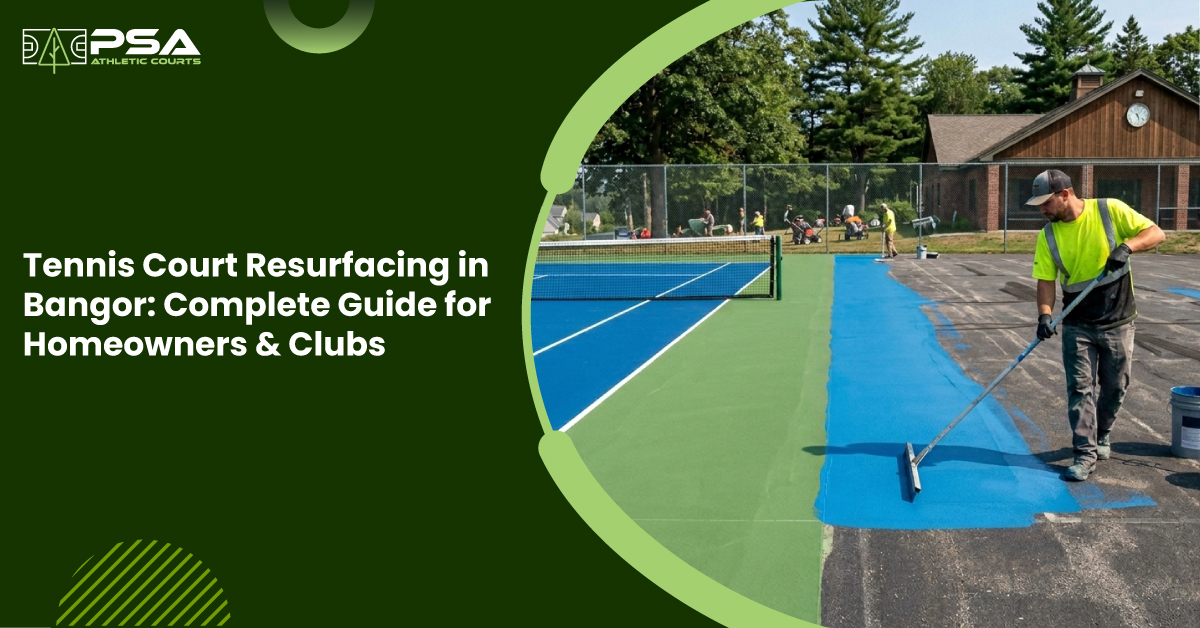
The long winters, snow accumulation, and repeated freeze-thaw cycles in Bangor can take a toll on your tennis court surfaces if not maintained properly. Whether you manage a residential backyard court, a school facility, club, or recreational space, tennis court resurfacing is essential to ensure safety, playability, and long-term durability in Eastern Maine’s climate.
This guide by Pine State Courts will discuss all about tennis court resurfacing in Bangor to help you protect both your court and your financial investment.
But before we go into the details about tennis court resurfacing let’s first confirm whether or not your court needs it.
Quick Self-Assessment: Does Your Tennis Court Need Resurfacing?
- There are several uneven spots on the court surface.
- The court faces consistent waterpooling issues after it rains.
- The cracks on your court keep coming back even after you’ve patched them.
- There are faded line markings on the court.
- Players frequently slip while playing.
- The court has lost its traction and ball bounce.
If your court is showing these signs then it’s time to consider repairing your tennis court. Doing this will not only fix these issues but also enhance the longevity of your court.
What’s Really Happening Beneath the Surface
You know the signs of damage but you must be wondering what exactly is happening beneath the surface and why resurfacing is crucial here.
It all starts with the minor cracks you see on the court surface, here’s what happens further:
- The surface cracks trap dirt and debris, making the court surface uneven. Water also starts to seep inside, washing away the surface, causing it to loosen and crack further.
- With heat this trapped moisture dries and turns to vapor, forcing the acrylic layers up, leading to delamination.
- During winters, this water freezes and expands, widening the cracks further and turning them into major fissures.
- In case, the soil beneath your court is not compacted properly, it begins to shift with time due to moisture expansion or frost heave. This further leads to structural cracking and forms uneven depressions on the court surface.
- The sub-surface debris and moisture can also encourage algae, mold, or roots to grow, weakening your concrete/asphalt surface.
All of these events eventually damage the court beyond repair and necessitate complete court reconstruction if not addressed in time with resurfacing.
What are the Common Resurfacing Options for Tennis Courts
From our previous discussion, it’s clear that the major structural issues start from a damaged court surface. If you address this, it will both fix these issues and prevent your court from deteriorating further.
Let’s discuss the different surfaces that you can use for resurfacing your tennis court in Bangor:
1. Standard Acrylic Coating
It is the most commonly used surface that involves filling in the cracks with an acrylic resurfacer and then adding color coatings. It is a durable option with low maintenance needs.

2. Cushioned Performance Systems
It involves adding a rubberized material in layers below the acrylic surface of your tennis court. It improves player’s comfort and enhances their safety, it also reduces the pressure on players’ joints during competitive play.
3. Polyurethane Coatings
Polyurethane coatings is yet another durable option for resurfacing tennis courts in Bangor. It is suitable for the Eastern Maine region because of its high flexibility which allows it to expand and contract easily with temperature fluctuations without cracking.
4. Color & Custom Finish Options
You can also customize your tennis court surface by adding custom color coatings or logos. By changing the concentration of sand in your acrylic surfaces, you can make the pace faster or slower. Heat-reflective coatings are also beneficial to reduce the courts’ temperature by 20-30%.
If you are wondering what the right surface option is for Bangor , contact the tennis court builders at Pine State Courts to make an informed choice.
The Resurfacing Timeline: What to Expect Week-by-Week
Tennis court resurfacing usually takes 1-2 weeks to complete depending on the extent of work required and the weather conditions. Here’s a week-by-week breakdown so you know what to expect when you are resurfacing in the Eastern Maine region:
Week 1- Site Preparation and Crack Repair
- The first week begins with the basic steps of cleaning the court surface and inspecting it to check the extent of damage.
- Next comes, repairing the cracks with a crack filler and leveling any depressions in the court surface.
- A base coat of acrylic resurfacer is then added to get a smooth surface that’s primed for color coatings.
Week 2 - Coating and Finishing
- Week 2 involves adding 2-3 layers of acrylic paint, allowing each coat to dry out completely before applying the next.
- If you need to install the cushioning it is added before the color coatings are applied.
- Next comes taping and painting the line markings. The court is left undisturbed for full curing which can take 24-48 hours.
- Final inspections are made and net systems and other accessories are added finally to complete the court.
This timeline can shift to three weeks, if:
- There's rain or humidity that prolongs the drying time.
- There are severe cracks or base damage.
- Your facility has large or multiple courts.
- You want custom coatings or cushioned systems.
Instead of rushing the process, allow your court proper time for repair and curing so it has better adhesion, longer surface life, and requires fewer repairs over time.
If you are wondering when’s the right time to resurface your tennis court, check out our guide.
Indoor vs Outdoor Courts: What Changes?
When clients ask this question to tennis court designers, they’re usually thinking about surface type but the real difference goes deeper. You should also consider environmental stress, repair strategy, and scheduling discipline.
Here’s how indoor and outdoor surfaces compare in terms of tennis court construction planning and resurfacing in Eastern Maine:
Outdoor Tennis Courts
When it comes to the construction and repair of outdoor tennis courts durability comes first because if you cut corners, winter will expose it fast.
Construction considerations -
- Repeated freezing and thawing (major issue in Maine)
- Rain, humidity, and drainage issues
- UV exposure (fading & surface breakdown)
- Organic growth (moss, algae)
Resurfacing considerations -
- Heavier crack repair systems are often required
- More aggressive cleaning and prep
- Weather-dependent scheduling (biggest variable)
- Longer curing windows
- The typical resurfacing cycle for outdoor courts is every 4-8 years (sometimes sooner in harsh climates).
Indoor Tennis Courts
When it comes to indoor tennis courts, they are built for performance and feel because they don’t have to struggle for survival against the external elements.
Construction considerations -
- Higher usage (clubs, schools, year-round play)
- Traction and ball bounce for performance
- Shock-absorbing surface coatings
- Adequate lighting and ventilation
- Sound absorbing materials for noise
Resurfacing considerations -
- Minimal structural cracking
- Faster, more predictable timelines
- Greater focus on playability and consistency
- Less intensive prep work
- Typical resurfacing cycle for indoor courts is every 5-10 years (depending on usage)
If you are wondering how much resurfacing a tennis court will cost you, check out our informative guide on the same.
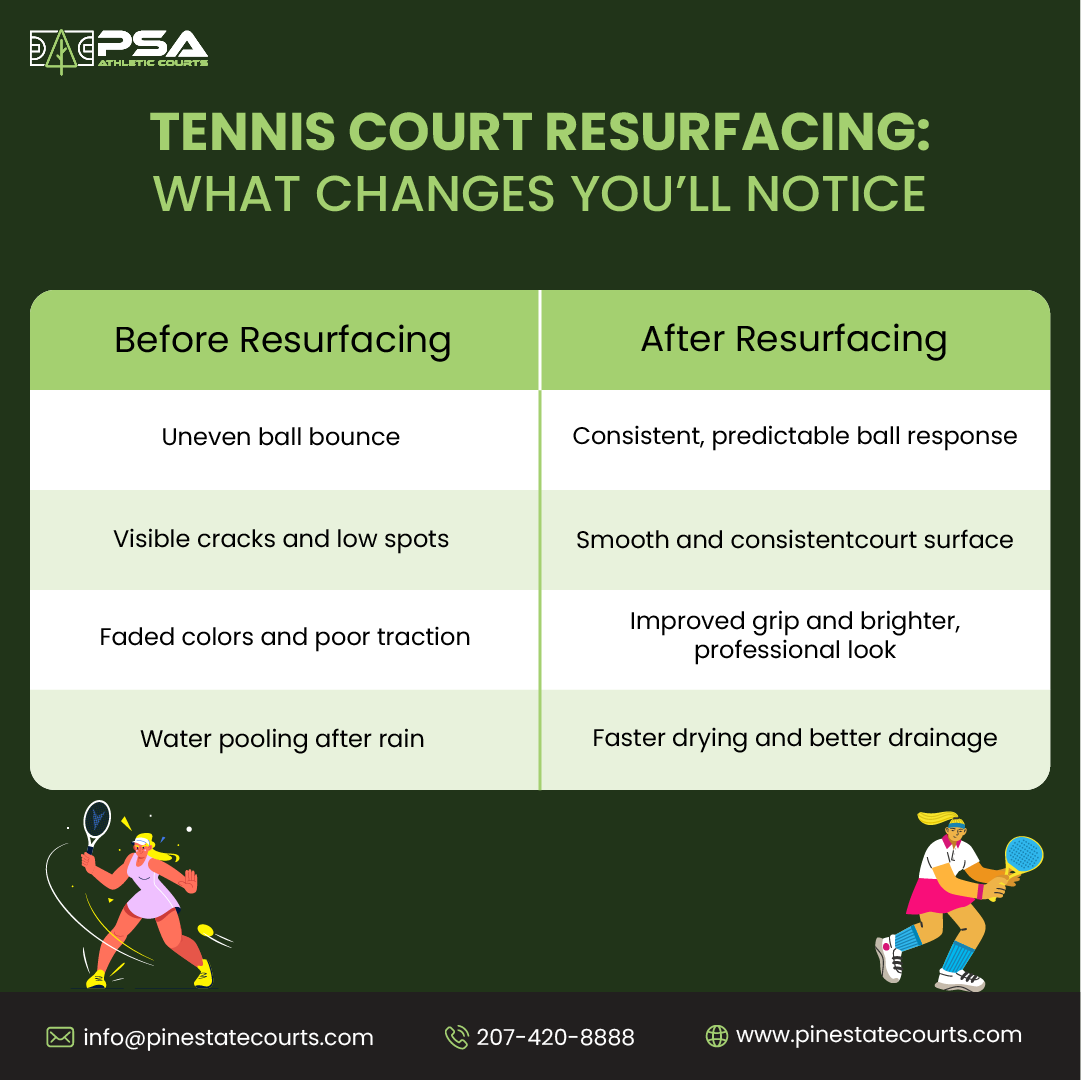
Before & After: What Improvements You’ll Notice
After resurfacing one of the most prominent changes you’ll notice is in the performance of your court. Your players will no longer struggle with traction, slipping while playing, and constant birdbaths after rain.
How to Choose a Reliable Tennis Court Contractor in Bangor
When it comes to resurfacing a professional tennis court in Bangor, the contractor or tennis court construction company you choose will directly impact your court’s performance and its durability. That’s why it’s best to take this decision wisely and compare different contractors before choosing one.
Here’s what you should consider when you are searching for a tennis court contractor in Eastern Maine:
1. Experience of working around the local climate
Your contractor should understand the extent of damage freeze-thaw cycles can cause to tennis courts in the Eastern Maine region.
2. Should have a repair-first approach
Discuss their tennis court repair process, if they jump straight to applying coatings without addressing cracks or drainage issues then they’re clearly not reliable.
3. They don’t give clear, realistic timelines
If anyone promises a 3-5 day completion for outdoor courts in Maine then they don’t have the local expertise.
4. Check if they have a proven track record
Ask for their before/after photos, local project references, and what similar facilities they’ve worked on (schools, clubs, residential projects etc.)
Pro Tips to Extend Your Court Life
While resurfacing addresses the damage to the court, maintaining it after resurfacing ensures the court remains playable for years. Here are some simple maintenance tips by the expert tennis court builders at Pine State Courts:
- Keep your court clean by removing debris regularly.
- Manage water by clearing drainage paths and addressing puddles early.
- Fix small issues early as hairline cracks spread quickly after winters.
- Use proper court equipment including tennis-friendly rollers and nets.
- Avoid dragging heavy objects on the court.
- Schedule regular inspections, a quick annual check can prevent major repairs later.
Final Takeaway
When it comes to resurfacing a tennis court, especially in Bangor, Maine, it is important to factor in the harsh winters, freeze-thaw cycles, and drainage.
From standard acrylic coating and cushioned performance systems to polyurethane coatings and colors and custom finishing, each surfacing offers its own unique features for the court’s performance and its durability.
Getting a local professional is important to navigate the resurfacing and maintenance challenges in the Bangor area. At Pine State Courts, we have worked with both professional clubs and residential/ backyard tennis court projects. We offer tailored service to meet your tennis court construction, resurfacing, and maintenance needs.
Frequently Asked Questions
1. What is the ideal season for tennis court resurfacing in Bangor?
The best time of the year to resurface a tennis court in Bangor, Maine is late spring or early fall. During this time you can avoid the extreme heat of mid-summer and freezing conditions of winter that are unfavourable for resurfacing in the Eastern Maine Region.
2. How much time does a tennis court resurfacing project usually take in Bangor?
Tennis court resurfacing projects in Bangor usually take 3-7 days of active work. However, if your court requires extensive repairs or there’s unfavourable weather, this timeline can shift further to over 10 days.
3. Is tennis court resurfacing different for indoor and outdoor?
Yes, tennis court resurfacing is different for indoor and outdoor courts as both have different requirements for weather exposure, base preparation, and material longevity. Outdoor tennis courts require durable materials that can withstand the external environments and indoor courts require consideration for consistent texture and longevity (due to all-round use).
4.Can I change the color of my tennis court during resurfacing?
Yes, you can change the color of your tennis court during resurfacing when the acrylic coatings are applied to the court.
5. What factors affect how long a resurfaced court lasts?
The factors that affect how long a resurfaced court lasts are:
- The quality of materials used.
- The extent of court usage.
- How well maintained the court is.
- Exposure to external elements.
6. Do tennis courts in Bangor require resurfacing more frequently because of the local climate?
Yes, tennis courts in Bangor need resurfacing more frequently as compared to other warmer regions because of its repeated freezing and thawing and snow and ice accumulation in winters. These conditions accelerate the damage caused to the court surface if not addressed promptly.
7. How can Bangor’s winter weather impact tennis court surfaces?
During winters, when the water penetrates the tennis court surface, it freezes and expands, widening the minor cracks further to form major fissures. This freezing temperature makes the acrylic surface brittle and causes delamination, the accumulated ice can further lead to mold growth.
8. Are drainage problems a common issue for tennis courts in Bangor?
Yes, drainage issues generally arise in tennis courts in Bangor as the freeze-thaw cycles lead to an uneven surface that forms birdbaths when it rains. The annual precipitation and snowmelt also add to the structural damage if there’s any clogging issues.
9. Should tennis courts in Bangor be inspected after the winter season?
Yes, it is necessary to inspect the court after winter in Bangor due to the snow accumulation and freeze-thaw cycle. This can cause cracks, shifting, and drainage issues in a tennis court.
10. Are local contractors in Bangor better for resurfacing projects?
Yes, local contractors in Bangor are better for resurfacing projects as they know the local landscape, weather patterns, and site accessibility issues. Having a contractor with local references also proves to be helpful for trust-building and checking prior projects.
DOWNLOAD OUR FREE GUIDE
Ready to build your dream court?
Download our FREE Basketball Court Construction & Planning Checklist and get the step-by-step roadmap to building a professional-grade court—from budget planning to final touches.
No guesswork, just results.