

Planning for tennis court construction sounds pretty simple, just know the court dimensions and contact a builder. But in reality this is not enough, you need more than just the knowledge of how big a tennis court is. You need to plan your space for safe play, proper drainage, or any future upgrades.
This is why working with expert tennis court builders is important to maximize your space’s utility and your facility’s ROI. In this Pine State Courts’ guide, we’ll walk you through the exact tennis court dimensions and the related space calculations.
We’ll also go into some important planning factors so you can make informed decisions before starting your project.
Standard Tennis Court Dimensions
As per ITF (international Tennis Federation) guidelines, a standard tennis court dimensions should be 78 feet long and 36 feet wide. These dimensions are of a doubles tennis court, for a singles court, the length remains the same while the width reduces to 27 feet.
This means:
- If you want to build a singles tennis court you need a playing field of 78 ft X 27 ft or 2106 sq ft.
- For building a doubles tennis court you need a playing field of 78 ft X 36 ft or 2808 sq ft.
However, these measurements only represent the playing surface and do not include the additional space required for safe movement of players around the court.
Let’s discuss this further.
Total Space Required (Including Safety Margins)
Expert tennis court designers suggest leaving extra space around the court to play it safely. This is essential because players frequently move beyond the baselines and sidelines during rallies, especially during competitive play.
This extra space would account for:
- Run-off space behind baselines
- Side clearance for player movement
- Room for fencing and access areas
ITF’s guidelines suggest that courts built for international competitions should have a minimum distance of 21 feet between the baselines and the backstops. For sidelines and sidestops, it should be 12 feet.
So, to build a full tennis court with proper safety margins you need a space which is 120 feet long × 60 feet wide or around 7,200 sq ft space on your property.
For recreational and club play, this size is reduced to 114 ft by 56 ft, i.e., around 6,400 sq ft.
Space Needed for Different Court Types
Besides the full court for doubles play and a singles court, there are many other tennis court layouts too. Let’s discuss each tennis court type and the respective spaces they require:
Full-Size Tennis Court
- Full size courts are commonly used for schools, clubs, and sports facilities.
- They are ideal for competitive matches and tournaments.
- They follow the official dimensions.
- They require around 7,000+ sq ft space.
Recreational / Club Court
- These courts have a slightly reduced footprint for casual play.
- They maintain good playability with less space requirements.
- Requires around 6,400–6,500 sq ft.
Residential Backyard Court
- Backyard tennis courts offer excellent functionality without requiring a full-size layout.
- They are designed for recreational play and family use.
- They are often modified slightly to fit the yard space available.
- They require a space of around 3,000 to 5,000 sq ft.
Compact / Practice Court
- Compact courts are best for building courts in limited spaces.
- They are best for training and casual play.
- Requires around 2,000 to 3,500 sq ft space.
If you’re still deciding what size court makes sense for your space, contact Pine State Courts to get a professional layout plan.
Tennis Court Size Breakdown
Let’s sum up what you know so far about the size of a tennis court through a simple table.

Why Proper Dimensions Matter
Choosing the right tennis court size is important not just to get the court layout right but it also affects the player’s safety, their performance, and long-term durability of your court. Let’s discuss this further:
Ensuring safety of players
Planning adequate run-off space around the court allows the players to move freely without risking collisions with fences or surrounding structures. This is important to ensure players perform well along with their safety.
The quality of gameplay
A tennis court built with proper dimensions ensures players have a realistic shot placement, they move confidently on the court, and ensures an overall enjoyable playing experience.
Durability and maintenance of the court
Well-planned courts with proper considerations for spacing and drainage usually last for over a decade without requiring frequent repairs. Such courts also maintain this surface quality over time.
Considering these factors while building your tennis court is important as ignoring them will only lead to costly repairs later.
Cost Impact Based on Tennis Court Size
The size of a tennis court plays a major role in the overall cost of construction. Larger courts require more excavation, base material, paving, and surfacing, along with increased needs for fencing, lighting, and drainage.
That said, cost isn’t driven by size alone.
Site conditions, layout, access, and overall project complexity can have just as much if not more impact on the final investment. Factors like slope, soil quality, drainage requirements, and how the court ties into the surrounding area all play a role.
Additional factors that influence cost include the extent of site preparation, the type of surface system selected, and the region where the court is being built.
Contact us today to bring your dream court to life !
In climates like Maine, freeze-thaw cycles add another layer of consideration. Proper base construction, drainage, and material selection are critical to ensure the court holds up over time and performs the way it should.
Every project is different, which is why we evaluate each site individually and design courts around long-term durability and performance and not just dimensions.
Choosing the Right Tennis Court Builders
By now it’s clear that designing and building a tennis court requires more than just getting the measurements right. You need professional court builders to ensure long-term performance of your court.
They will consider multiple factors like:
- Site layout and grading
- Drainage design
- Surface selection
- Proper court orientation
- Climatic conditions in your area
A well-designed court not only performs better but also lasts longer with minimal maintenance, including tennis court resurfacing.
Working with experienced tennis court builders ensures your court is designed for both performance and long-term durability. Contact Pine State Courts to book your site evaluation.
Common Tennis Court Construction Mistakes to Avoid
Even the most well-planned projects can run into problems if certain key details are overlooked during construction. For building tennis courts, it is important to avoid the following common mistakes so you don’t end up with a court that doesn’t perform well or needs frequent repairs.
Not leaving enough space
A court that fits too tightly into your property can create safety risks for both players and spectators. It also limits the gameplay.
Ignoring drainage
Poor drainage can lead to water pooling issues which makes the court slippery (safety risk) and causes surface damage over time. This impacts both performance and safety of players.
Choosing the wrong surface
Different surfaces impact playability, comfort, and maintenance requirements. Check out our guide for a detailed breakdown of the different tennis court surfaces.
Poor lighting placement
Improper placement of lighting can create uneven visibility, especially for evening play.
Final Thoughts
Constructing a tennis court requires more than just the answer to “How big is a tennis court?”. Besides the standard dimensions of 78 feet by 36 feet, you need to account for safe movement of players and a space for spectators.
You also need to factor in any future upgrades. So, whether you’re building a backyard court or a full-scale facility, thoughtful planning before construction ensures you get better performance, safety, and durability.
At Pine State Courts, every court we build is designed with these factors in mind, so your court delivers lasting value and an exceptional playing experience.
Frequently Asked Questions
1. How big is a tennis court in feet?
A tennis court should be 120 feet by 60 feet. This size includes the playing field and some extra surrounding space for safe movement of players.
2. How big is a tennis court in square feet?
A tennis court requires a playing field of 2808 sq ft. for doubles court and 2106 sq ft for singles court. For safety considerations, a full court should be built in a space of around 7200 sq ft.
3. How big is a professional tennis court?
A professional tennis court is 78 feet by 36 feet for doubles play and 78 feet by 27 feet for singles play. The net has a height of 3.5 feet at the posts and 3 feet at the center.
4. What is the fastest surface on a tennis court?
Natural grass is the fastest surface in a tennis court due to low friction. It is used at Wimbledon and favors aggressive serve and volley players.
5. How much room do you need for a tennis court?
To build a professional court you need around 7,200 sq ft space, for recreational play it should be around 6,000 sq ft.
6. How big is a high school tennis court?
A school tennis court follows the standard dimensions of 78 feet by 36 feet for doubles play and 78 feet by 27 feet for singles play. The net height should be 3.5 ft at the posts and 3 feet at the center. Such a court requires an area of around 7,200 sq ft.
7. How much does it cost to build a high school tennis court?
- Building a high school tennis court involves more than just the playing surface. Projects typically include site work, base construction, paving, surfacing, fencing, and lighting.
- The overall investment can vary depending on site conditions, layout, number of courts, and the level of finishes.
- For schools and municipalities, durability and playability are key, especially in climates with freeze-thaw cycles. Proper construction and materials make all the difference in long-term performance.
DOWNLOAD OUR FREE GUIDE
Ready to build your dream court?
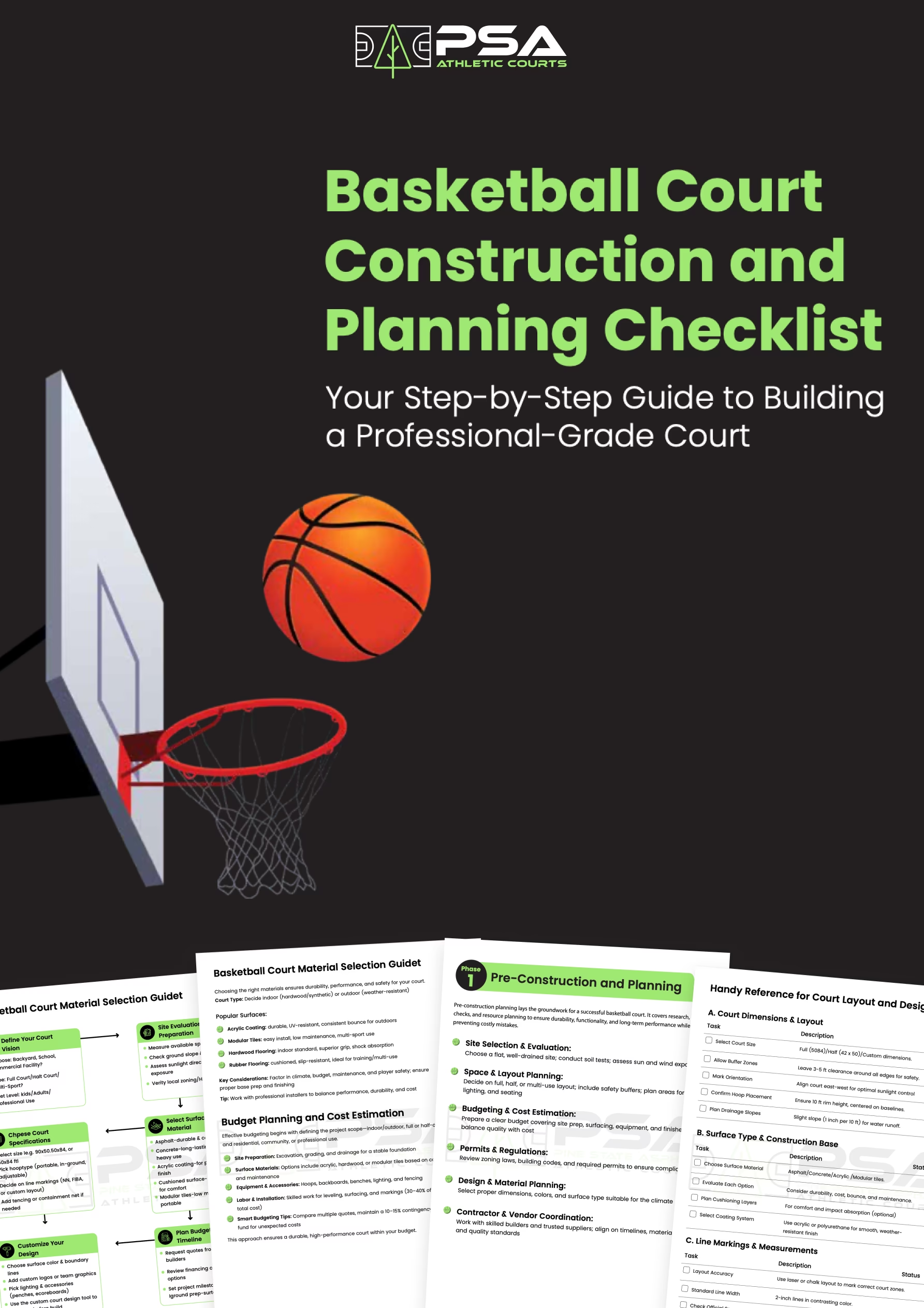
Download our FREE Basketball Court Construction & Planning Checklist and get the step-by-step roadmap to building a professional-grade court—from budget planning to final touches.
No guesswork, just results.