

Beyond pickleball, another sport that is gaining popularity worldwide is padel. This sport is no longer just a European trend but has become one of the fastest-growing racket sports in the world.
With more than 35 million players globally, clubs, schools, recreation centers, and even homeowners across the U.S. are beginning to invest in padel court construction as its demand continues to rise.
In this guide by Pine State Courts, we will discuss the entire process of padel court construction, its official dimensions, the surface materials that you should consider, and the common mistakes that you must avoid in your construction.
What Is Padel?
Padel is a fast-paced racket sport that combines elements of tennis and squash. It originated in Mexico in 1969 and later gained popularity in countries like Spain and Argentina before expanding across Europe and the U.S.
The sport is especially appealing because it is easy for beginners to learn, highly social, and suitable for players of different age groups and skill levels. Unlike tennis, padel is typically played in doubles on a smaller enclosed court, making it a much more engaging experience.
Why Schools, Clubs & Homeowners Are Investing in Padel Courts
The rising popularity of the sport among schools, clubs, and homeowners is also driven by its accessibility and efficient use of space.
A padel court requires less area than a traditional tennis court, it is a practical addition for facilities who want to maximize their recreational value without requiring large-scale expansion of property.
Its smaller build is also favourable for homeowners as it can easily fit in their backyard. For schools and community facilities, padel courts provide an inclusive experience that encourages participation, teamwork, and physical activity among students and members of all ages.
Official Padel Court Size & Dimensions
The International Padel Federation (FIP) has laid out guidelines for the official dimensions of a standard doubles padel court.

- The standard padel court size is 65.6 ft in length and a width of 32.8 ft with a tolerance of 0.5%. The court is enclosed by tempered glass walls and metal mesh fencing.
- A net is placed at a height of 3 ft at the posts and 2.9 ft in the center, dividing the court into two equal halves.
- The service lines are positioned parallel to the net at a distance of 22.8 ft.
- A central perpendicular line divides the area between the net and service line into two equal service boxes.
- The back walls are 13.1 ft high with the lower 9.9 ft made of glass and the top 3.3 ft is metal mesh.
- The FIP allows variations for side walls but most padel courts have a stepped down structure with the first 6.6 ft from the back wall being 13.1 ft high (9.9 ft glass + 3.3 metal mesh). The remaining section drops to 9.9 ft (either all glass or a mix of glass and mesh).
Types of Padel Courts
While the standard padel court size remains the same for all courts (65.6 x 32.8 ft), padel courts can be divided into different types based on the structural design of walls, the environment they are built in, and the number of players.
Let’s discuss each of these padel courts briefly.
Based on the wall design:
Standard Padel Courts
Standard courts feature tempered glass walls combined with metal mesh panels and visible structural framing. These courts are cost-effective, durable, and widely used for recreational and community installations.
Panoramic Padel Courts
Panoramic courts use larger glass panels with minimal structural obstruction to create better visibility for spectators and broadcasts. These courts are popular in premium clubs and professional tournament venues because of their modern appearance and enhanced viewing experience.
Full Panoramic Courts
Full panoramic courts eliminate corner posts almost entirely, creating a seamless 360-degree glass view. These are commonly used in professional competitions and high-end facilities but generally cost more than standard court designs.
Based on the playing environment:
Outdoor Padel Courts
Outdoor padel courts are the most common option for clubs, schools, parks, and residential properties. They are built with weather-resistant materials and proper drainage systems to handle rain, sunlight, snow, and changing temperatures.
Indoor Padel Courts
Indoor padel courts provide year-round play in a controlled environment with consistent lighting and reduced weather-related wear. These courts are commonly installed in sports complexes and training facilities.
Semi-Indoor Courts
These courts retain the natural and refreshing appeal of an outdoor court while the retractable roof helps to protect the court against external elements. This is a great option for facilities looking for year-round play.
Based on the number of players:
Standard Doubles Courts
The standard format for padel is doubles court. It is played as 2 vs. 2 on the traditional court that is 65.6 ft long and 32.8 ft wide.
Singles Courts
Narrow, singles courts are relatively less common and used mostly for coaching or in clubs where space is extremely limited. These courts are used for 1 vs. 1 play, on a court that is 65.6 ft long and 19.7 ft wide.
Step-by-Step Padel Court Construction Process
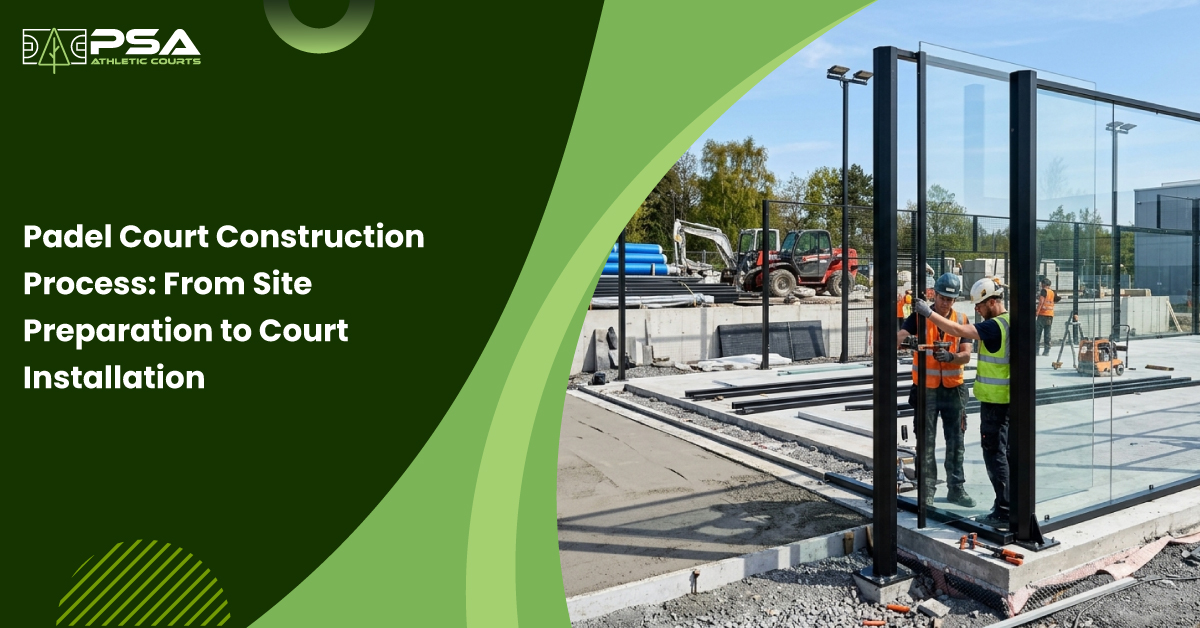
Building a padel court requires careful planning, precise engineering, and quality materials to ensure your court has long-term durability and professional-level playability.
While every court construction project varies based on location and site conditions, the construction process of all courts follows the key stages discussed below:
1. Site Selection & Planning
The projects start with the selection of the site of construction. The location you choose should have enough space for the court, surrounding clearance, lighting, and access areas. Your construction contractor will also evaluate other avenues like drainage, slope, and soil conditions before beginning the construction.
2. Ground Preparation
This second phase includes excavation, grading, compaction, and installing a stable foundation of your court. Ensuring proper drainage is vital here to prevent water damage and uneven surfaces.
3. Installing the Court Structure
After the base is complete, the court structure including the steel framework, tempered glass panels, fencing, and playing surface are installed. Precision is key here for safety and performance.
4. Lighting Installation
LED lighting systems are essential for facility owners including clubs and schools as they improve visibility for evening play while minimizing glare and shadows on the court.
5. Final Inspection & Safety Checks
As the last step, your padel court contractor will inspect everything before opening the court. This includes the court structure, surface quality, drainage, lighting, and safety features to ensure everything meets performance standards.
An expert padel court designer can help ensure you choose the right location and have the required space to build your court.
Best Surface Materials for a Padel Court
Choosing the right playing surface for your padel court is essential not just for court aesthetics but to ensure player comfort, great ball response, traction, and long-term durability of the court.
While the FIP endorses artificial turf (synthetic grass) for padel courts, there are many other surfaces like acrylic, concrete/ asphalt etc. that are commonly used to construct a padel court.
Let’s discuss these surfaces briefly:
Artificial turf
Artificial turfs are widely used for professional padel courts. These courts are generally made from Polyethylene (PE) for comfortable play and can be monofilament or fibrillated. An infill of silica is also added to these courts to ensure the filaments stand upright and the surface offers good ball bounce.
Synthetic Resin/ Acrylic
These are commonly used for multi-athletic courts or courts adapted from traditional tennis courts. It offers a durable surface with fast-paced gameplay that requires little maintenance. But this surface can be hard on players’ joints.
Concrete/ Porous Asphalt
These courts are generally preferred for most outdoor courts or recreational spaces as they offer durable and budget-friendly construction. Their porosity allows water to drain from the court after rain, meaning reduced delays after rain.
Indoor vs Outdoor Padel Court Construction
Now that we’ve covered the court surfaces, let’s take a look at how indoor and outdoor padel courts compare:

Padel Court Construction Costs
The cost of building a padel court can vary significantly depending on factors such as the location of court, site conditions, court type, surfacing materials, lighting systems, drainage requirements, and additional customization features.
Outdoor courts are generally less expensive than indoor facilities because they do not require enclosed structures or extensive building modifications. However, these courts often bring in additional costs for site grading, retaining walls, fencing upgrades, or installation of specialized weather protection systems.
Working with an experienced padel court builder can be a great help here as they will ensure accurate budgeting and that there are no unexpected construction expenses later in the project.
Common Padel Court Construction Mistakes to Avoid
While constructing a padel court is relatively easier with an experienced contractor around, some common construction mistakes can negatively affect the performance, safety, and lifespan of your court.
These common mistakes include:
- Poor site leveling and unstable foundations.
- Inadequate planning for drainage.
- Using low-quality glass or steel materials.
- Incorrect lighting placement causing glare and shadows.
- Choosing unsuitable surface materials for local climate conditions.
- Ignoring long-term maintenance requirements.
Partnering with a local court construction company like Pine State Courts is especially helpful as they plan your court around the local climatic conditions, soil quality, and help avoid most of these common problems.
How to Choose the Right Padel Court Contractor
Selecting the right contractor for constructing your padel court is one of the most important decisions in your entire project. An experienced padel court builder should understand not just the technical requirements but also the long-term performance demands of athletic courts.
When evaluating contractors, make sure that they have:
- Experience with sports court construction.
- Knowledge of official padel court specifications.
- Quality methods for installation and use quality materials.
- Drainage and climate adaptation expertise.
- Custom design capabilities.
- Warranty coverage and maintenance support.
- Previous project portfolio and client reviews.
A reputable contractor will guide you through every stage of the process, from planning and design to installation and long-term maintenance recommendations.
Conclusion
As the popularity of padel continues to grow across the U.S., more schools, clubs, and homeowners are investing in constructing padel courts.
Whether you are expanding your athletic programmes, creating new revenue opportunities for your sports club, or want to add a recreational space in your backyard, quality construction is important. This ensures long-term performance of your court and a great player experience.
We, at Pine State Courts, specialize in high-quality athletic court construction throughout New England. We’ve helped many clients transform their facilities and backyard with durable padel courts tailored to their specific needs, space, and budget.
Contact us for a site visit and start your construction planning today.
Frequently Asked Questions
1. How much space is needed for a padel court?
A padel court requires a playing area that is 65.6 ft long and 32.8 ft wide but a total space of around 2153 sq. ft is needed to account for court access, the structural framework, and circulation space between two adjacent courts
2. How long does padel court construction take?
A padel court construction project can take around 3 to 5 weeks to complete. This time depends on the extent of site preparations required, the curing time of the surface you choose, and if there are any weather delays.
3. What is the average cost of a padel court?
The cost of a padel court is highly variable and depends on different factors like the accessibility of site, the extent of site work needed, the materials you choose to build with, and whether you add any lighting. Any customization you add to the court also contributes to the overall cost.
4. Can padel courts be installed indoors?
Yes, padel courts can be installed indoors. They are generally preferred as they offer year-round play and protect the court from external elements.
5. What is the best surface for a padel court?
Artificial turf is generally preferred and even endorsed by the FIP for constructing padel courts. These offer court ball bounce with a sand infill and are also safe for players’ joints. Other options include synthetic resin/ acrylic courts and porous asphalt/ concrete courts.
6. How often should a padel court be maintained?
A padel court requires regular maintenance including daily cleaning, weekly brushing of the turf, and monthly inspections of the courts’ net, glass panels, and fencing. Annual or semi-annual deep cleaning and refurbishment is also essential to ensure long-term durability and playability.
7. Are padel courts suitable for cold climates?
Yes, padel courts are suitable for cold climates if they are built indoors or if the outdoor court has a protective canopy overhead.
DOWNLOAD OUR FREE GUIDE
Ready to build your dream court?
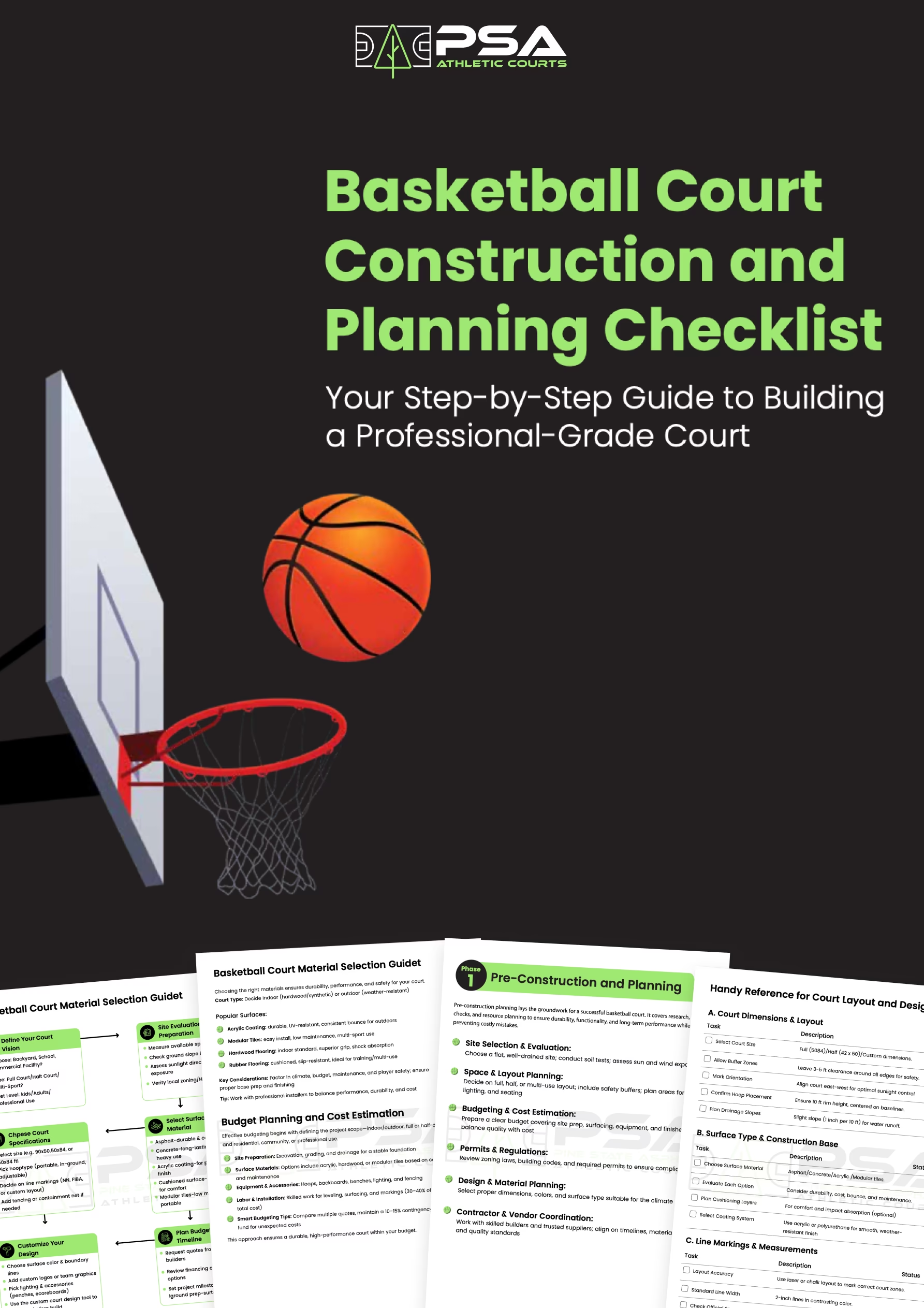
Download our FREE Basketball Court Construction & Planning Checklist and get the step-by-step roadmap to building a professional-grade court—from budget planning to final touches.
No guesswork, just results.