
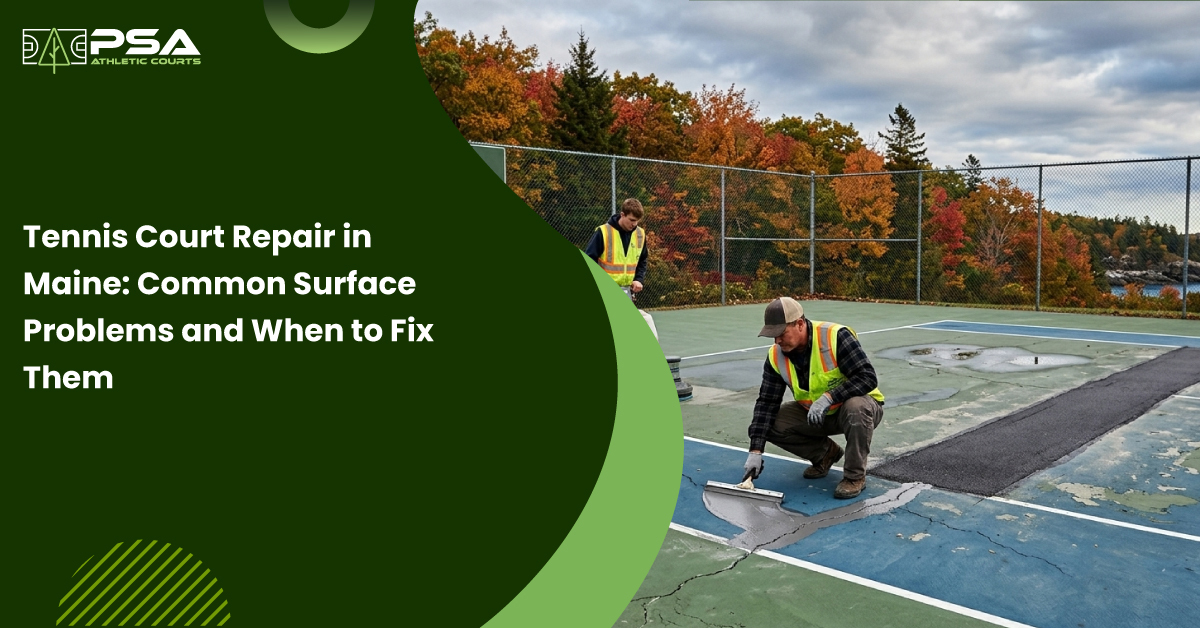
A tennis court can look fine at the end of one playing season and show noticeable damage after the winter season is over. You may notice small cracks reopening, low areas on the court that hold water, or worn out surface coatings. All this can be a result of repeated exposure to moisture, snow, temperature changes, and everyday play.
But this does not mean that the entire tennis court needs to be resurfaced or rebuilt. In many cases, addressing a problem while it’s still localized can prevent more extensive damage later.
In this Pine State Courts’ guide, we’ll look at such common tennis court surface problems that court owners in Maine encounter. We’ll discuss when repair makes sense and when the condition of your court points toward resurfacing or more extensive reconstruction.
What Causes Tennis Court Surface Damage in Maine?
Even the most carefully planned and well built tennis courts fall victim to damage over the course of their life. Maine’s climate especially tests these courts through its freeze thaw cycles, heavy rainfall, and snow.
Let’s discuss these factors in detail:
Freeze-Thaw Cycles
Rain and melting snow seep into the microscopic pores and minor cracks present on your court surface. When temperatures in Maine drop below freezing, this trapped water expands, forcing the cracks to widen and deepen, causing severe cracking, shifting, and eventually the failure of your court’s foundation.
Moisture and Poor Drainage
Inadequate slopes or clogged systems leave standing water (birdbaths) on the court. This prolonged pooling breaks down the protective acrylic coating and causes bubbling or blistering when the Sun heats the surface.
UV Oxidation
Intense sunlight in summer oxidizes the asphalt pavement. This process dries out the acrylic top coat, fades colors, and reduces the pavement's flexibility, making it brittle and prone to splitting.
Accumulation of Organic Debris
Your court’s surrounding trees drop leaves, needles, and organic debris that trap moisture against your acrylic court surface. This damp environment accelerates stains, softens the coating, and promotes growth of slippery mold, mildew, and algae on your court.
Common Tennis Court Problems that Require Repair
Noticing imperfections, cracks or worn out areas on the court does not mean that you need to address the entire court. The appropriate repair depends on the size and location of the damage, how quickly it is developing, and whether the underlying pavement or drainage system is involved.
Let’s discuss some common problems that can arise on your tennis court:
Cracks in the Tennis Court Surface
Cracks are among the most common problems on tennis courts. Hairline cracks may initially appear minor but water can enter through them and contribute to further deterioration. This is particularly important in Maine because of its repeated freeze-thaw cycles.
Surface Peeling and Flaking
Peeling, flaking, or areas where the acrylic coating has deteriorated can affect both the appearance and traction of your tennis court. These problems can result from normal surface aging, moisture, inadequate surface preparation, or other underlying conditions.
Drainage Problems and Standing Water
A tennis court should not have puddles on its playing surface after a normal rainfall. These persistent birdbaths may indicate low areas, drainage limitations, settlement, or other problems with the court system.
Potholes and Surface Breakdowns
Potholes and larger surface breakdowns can create unpredictable ball response and potential trip hazards. This compromises both safety and playability and indicates deterioration of the pavement and not just the acrylic surface, requiring immediate attention.
Uneven or Worn Playing Surfaces
A court can become uneven because of settlement, ground movement, frost-related movement, tree roots, or deterioration of the pavement system. You may notice this as low spots, raised areas, uneven texture, or changes in how the ball bounces.
You can also check our guide to learn some budget friendly tips for tennis court repair.
How Professional Tennis Court Crack Repair Works
Professional tennis court crack repair uses a multi-step process that cleans, stabilizes, fills, and resurfaces the court to prevent the damage from returning. But before these professionals start with the repair work they assess the condition of your court and check to what extent it’s been damaged.
Their tennis court crack repair process includes steps like:
- Assessing the court’s damage including cracks, unevenness, and drainage issues.
- Cleaning the court to remove accumulated dirt, debris, or organic matter.
- Fixing the drainage and leveling issues, if present.
- Filling deep cracks with sand/ foam backer and applying acrylic crack filler.
- Finishing the repair with acrylic resurfacer and matching color coat.
You can also check our guide on court resurfacing materials for indoor courts to learn your options if you own an indoor facility.
Tennis Court Repair vs. Resurfacing: What's the Difference?
Sometimes, these crack repairs may not be enough for your tennis court. If the cracks reappear even after repeatedly fixing them or your court has lost its traction and ball bounce, it’s time to resurface your tennis court.
The table below includes a general comparison of tennis court repair vs resurfacing to help you evaluate what your court needs:
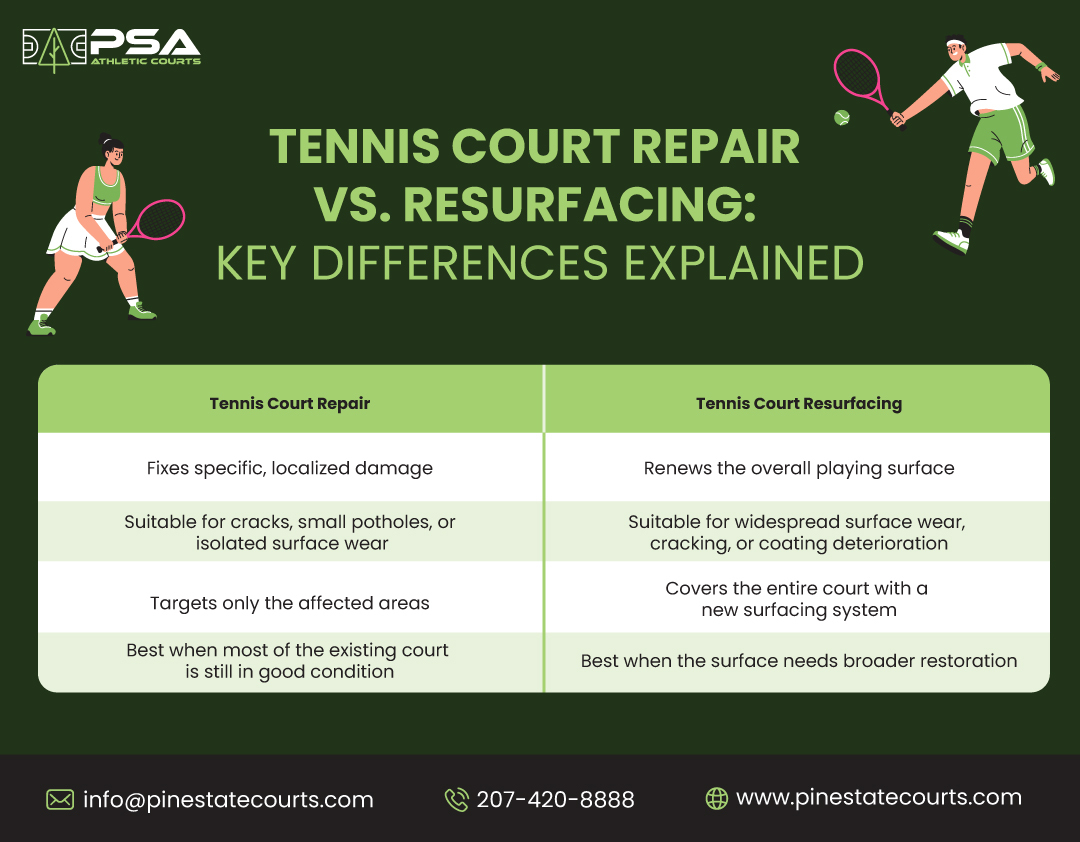
It is best to seek professional advice if you’re unsure about what your court needs. An annual inspection may also help you keep things in check and evaluate whether what you need is to repair the tennis court or resurface it.
You can also check our guide on the seven signs of tennis court resurfacing for deeper insights into when you need to go beyond repairing tennis courts.
How to Prevent Tennis Court Damage From Getting Worse
Professional repair can only do so much if you’re not maintaining your court for Maine’s weather. Regular maintenance not only helps you keep your court looking clean but it can also identify problems before they become more extensive.
You can start with a routine as simple as:
- Keeping your surface clean by removing leaves, pine needles, dirt, and other debris regularly, particularly during fall.
- Keeping your drainage areas clear so water can move away from the court instead of collecting on or around it.
- Repairing cracks you see on the court early so it doesn’t lead to widespread cracking over winter.
- Using only appropriate cleaning equipment and avoiding metal blades or aggressive methods for thawing that can damage the surface.
- Inspecting your tennis courts after winter to spot new cracks, raised areas, low spots, peeling, and other signs of freeze-thaw damage.
- Scheduling professional maintenance and annual court inspections.
At Pine State Courts, we offer seasonal maintenance programs that include spring cleaning and fall inspections to ensure your court is always ready to perform at its best.
When to Call a Tennis Court Repair Contractor in Maine
You can handle some maintenance tasks and minor repairs to your tennis court but pavement repairs, drainage problems, and significant surface deterioration requires a closer assessment.
If you notice that a crack keeps reopening, water continues to pool in the same area, the pavement is becoming uneven, or multiple surface problems are appearing at once, it’s time to get a tennis court repair contractor involved.
The contractor will look beyond the visible damage and determine whether the problem is limited to the surface or connected to the pavement, drainage, or surrounding site conditions.
At Pine State Courts, we start with an evaluation of your court before determining the appropriate scope of work. We offer tennis court repair and resurfacing services including acrylic surfacing, crack repair, finishing, and ongoing maintenance across Maine.
If you're seeing cracks, standing water, or other signs of deterioration on your court, contact Pine State Courts to assess your court and get a project-specific quote for repair or resurfacing.
Frequently Asked Questions
1. How much does it cost to repair a tennis court?
The cost to repair a tennis court depends on the scope of your work whether your court needs minor repair, or resurfacing and crack repair, or complete reconstruction.
2. How can I fix cracks on my tennis court?
You can fix the cracks on your tennis court by cleaning the gap, filling it with a specialized acrylic or rubberized compound, and smoothing the surface before applying a protective coating.
3. What is the average lifespan of a tennis court?
The average lifespan of a tennis court depends on its surface. It is 20 to 30 years for a hard court, 10 to 20 years for a clay court, and 5 to 10 years for a grass court.
4. How often should a tennis court be resurfaced?
You should resurface your acrylic or concrete tennis court every 4 to 8 years depending on its use and maintenance, clay courts need resurfacing every 1-3 years.
5. When should you repair a tennis court instead of resurfacing it?
If the damage is limited to only an isolated area of the court and the entire court is not damaged, it is wise to repair a tennis court instead of resurfacing it.
6. How often should a tennis court be inspected for damage?
In addition to your weekly and monthly inspections, you should call a professional for an annual inspection to assess the entire court for the extent of damage.
DOWNLOAD OUR FREE GUIDE
Ready to build your dream court?
Download our FREE Basketball Court Construction & Planning Checklist and get the step-by-step roadmap to building a professional-grade court—from budget planning to final touches.
No guesswork, just results.