
For a school district, a tennis court is not only a vital community asset but also a constant maintenance headache. Between shrinking budgets and the harsh freeze-thaw cycles of Maine, facility managers often find themselves caught in a cycle of temporary fixes and mounting safety concerns.
At Pine State Courts, we know the struggle of balancing "game-ready" performance with "budget-friendly" costs. With years of experience in building tennis courts, crack repair systems, and long-term maintenance, we’ve become the trusted partner for schools looking to protect their investment without breaking the bank.
We believe maintaining a championship-caliber facility shouldn't require an equally high budget. So, to help you navigate the complexities of tennis court repair, we’ve put together 9 budget-smart tennis court repair tips for school districts to keep their athletes safe and courts performing at their best.
Why Timely Tennis Court Repairs Save School’s Money
Repairing the tennis courts on time is essential not just to maintain the looks of your facility but also to ensure that these minor cracks don’t turn into costly replacements. Regular inspection and maintenance is thus important so you are always in loop about the condition of your court.
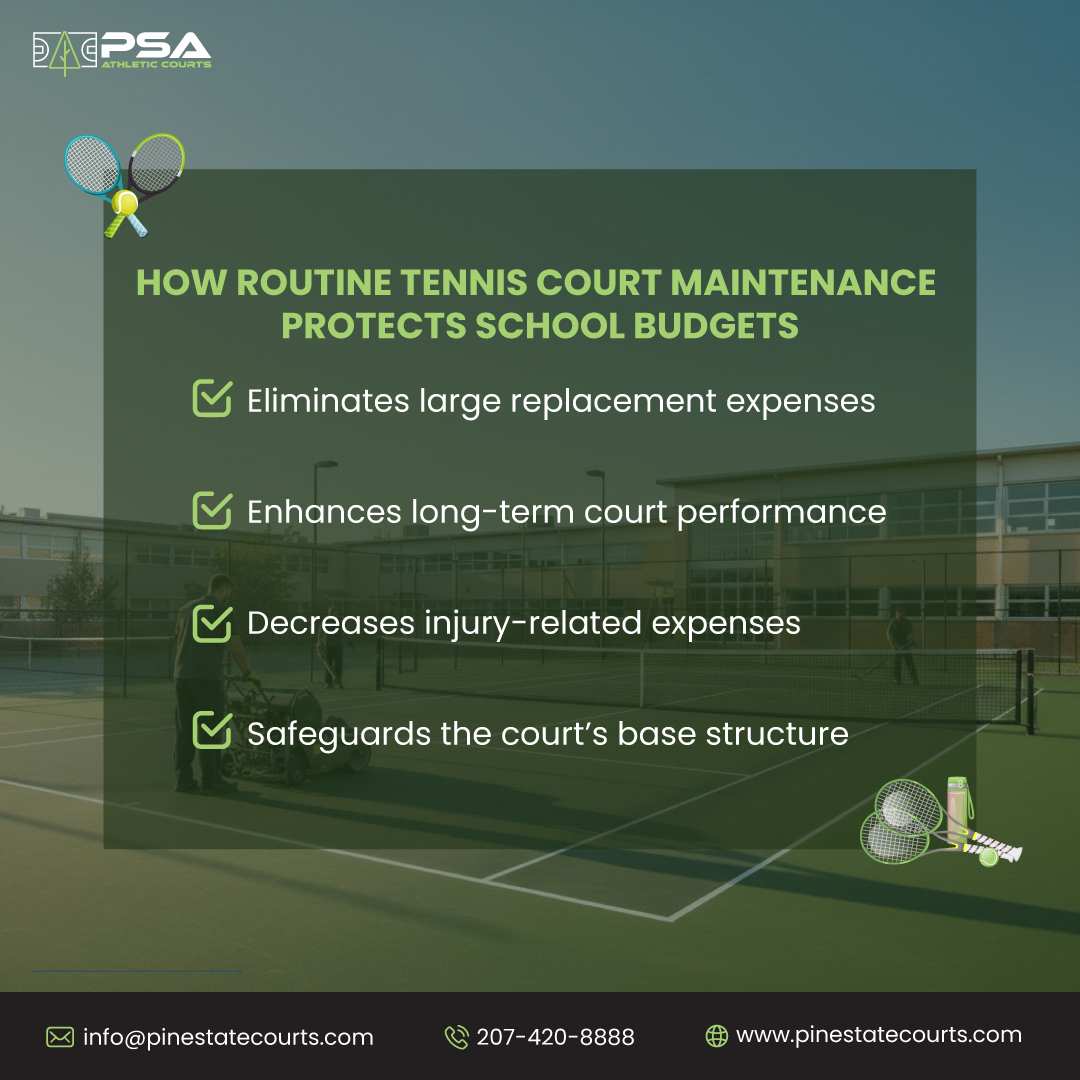
Here’s how timely tennis court repairs can save your school’s money:
It helps you avoid costly total replacement
Treating the cracks on your court early prevents them from widening any further. So, these minor cracks don’t require total, expensive court replacement later.
It maximizes your court’s lifespan
Regular resurfacing and maintenance add 5 to 8 years of life to the court.
It reduces the liability costs
Addressing cracks immediately prevents player injuries, avoiding potential legal costs associated with unsafe, damaged surfaces.
It lowers the maintenance costs over time
Frequent, minor upkeep of tennis courts prove to be significantly cheaper than the infrequent, major repairs.
It preserves the court’s infrastructure
Regular maintenance of your court keeps the structural integrity of its base intact, this prevents water from destroying the court’s foundation.
It is therefore wise to keep in touch with expert tennis court designers for assessing the court’s condition and getting it repaired well in time.
9 Budget-Smart Tennis Court Repair Tips for School Districts
School districts often find themselves at the crossroads of tight capital budgets and rising facility expectations. While the athletic directors and community members look for safe, high-performance, and well-maintained courts, the freeze-thaw cycles of Maine, quietly expand the small surface cracks into structural problems.
The good news? Investing in smart, strategic repairs can significantly extend the life of your courts without necessitating a costly full reconstruction. We have compiled a list of nine practical, budget-conscious strategies that school districts can implement right away.
This list is based on the industry best practices and Pine State Court’s experience spanning over two decades of tennis court construction and repair.
1. Start with a Professional Condition Assessment
Before allocating funds for repairs, it is wise to invest in a detailed court evaluation. This professional site assessment prevents over-scoping your project and ensures that your funds go where they are actually needed.
Getting this condition assessment done will bring the actual issues to the forefront. It will help identify:
- Structural vs. cosmetic cracking.
- Drainage or water pooling issues.
- Extent of surface damage.
- Base movement or settlement issues.
Many of these surface-level issues can be easily corrected without requiring replacement of the court surface.
Budget tip:
Contact your tennis court builder to perform a site evaluation. This assessment typically costs a fraction of even the minor resurfacing projects and will prevent unnecessary expenditures.
2. Address Hairline Cracks Immediately
Even the best tennis court surfaces will crack with consistent use and extreme weather conditions. While these hairline cracks may seem harmless at first but if left unaddressed, the water infiltration followed by freeze-thaw expansion can accelerate this deterioration, causing structural damage over time.
Early crack sealing is therefore essential to prevent these minor cracks for escalating further. It prevents moisture penetration, slows down the structural damage, and reduces trip hazards.
You can use specialized crack repair systems that allow slight movement while still preventing widening. This proves to be a far more affordable solution than letting the cracks spread unchecked.
3. Opt for Targeted Patch Repairs
Not every worn out or damaged court area requires full resurfacing. There are certain high-traffic zones in a court including baselines, service boxes, and net areas that often deteriorate faster than the rest of the court.
Targeted patch repair of these specific areas helps to restore their playability, addresses depressions or birdbaths, and corrects the minor delamination issues. This selective patch repair method not only preserves the functional areas of your court but also avoids replacing the sections that are still structurally sound.
Check out our expert guide on tennis court resurfacing to know the right time to resurface your tennis court.
4. Refresh Coatings to Restore Playability
The faded line markings on your court don’t just ruin its looks but also impact player performance. It creates confusion amongst players, affecting their gameplay. Fresh color coatings are thus important to enhance the aesthetics of your court and protect your asphalt or concrete base from UV exposure and moisture intrusion.
Expert tennis court builders suggest resurfacing acrylic coating systems every 4–8 years depending on your court usage. Getting this coating refresh on time improves traction and ball response, seals minor surface imperfections, and extends the life of your court.
Although you can do it yourself, it is better to consult an expert to ensure you are addressing the damage areas successfully.
5. Upgrade the Nets & Accessories instead of Full Renovation
Sometimes the court surface isn’t the real culprit, it is the worn nets, bent posts, faded lines, or damaged fencing that affect the player’s performance. Not only this, it can also make your facility look neglected no matter how perfect the tennis court surface looks.
It is therefore important to replace your nets, posts and anchors, windscreens, and court dividers on time. This can dramatically improve the safety and appearance of your court, especially when you need visible improvement before a tournament or community event, without tapping into capital budgets.
Check out our guide on the essential tools for tennis court installation to plan your next construction project swiftly.
6. Improve Surface Drainage & Slope
Poor drainage is one of the major causes of premature failure of tennis courts. Standing water accelerates the cracking, surface breakdown, and erosion of the court’s base. The humid temperatures and freeze-thaw cycles of Maine further worsen this situation.
Correcting the drainage issues in time is thus important to prevent minor issues from escalating further. Make sure to correct the minor slope inconsistencies, install perimeter drains, and repair low spots (birdbaths).
Even small grading corrections can help you prevent thousands of dollars that you would have to spend on long-term structural damage.
7. Bundle Repairs across Multiple Courts
If your district manages several courts across different schools, it is wise to bundle your projects. Talk to your tennis court builder about it as doing this will help you cut down the mobilization costs, equipment transportation fees, and material costs through bulk purchasing.
Moreover, contractors often offer a favorable pricing when the projects are grouped. This strategy proves to be useful for stretching your limited maintenance budgets further and ensures a consistent performance across all your facilities.
8. Apply Preventive Maintenance Measures Annually
When it comes to repairing a tennis court, preventive maintenance is often far less expensive than corrective repair projects. Conduct monthly and yearly assessments of your court. These routine inspections align with the best practices of facility management and significantly reduce the emergency repair situations.
Think of it as protecting your long-term capital asset rather than reacting to visible damage. Here’s what you should include in the annual maintenance plan of your tennis court:
- Cleaning the debris and organic build-up on the court surface.
- Inspecting the court for cracks and joints.
- Checking its drainage performance.
- Evaluating net tension and other hardwares of the court.
- Comparing the need for patch repair vs. resurfacing.
9. Establish a Multi-Year Capital Improvement Plan
When you manage a sports facility, it is not just the daily upkeep that matters, you should also plan for its longevity. This long-term planning is one of the most effective strategies you can make for your school district.
Laying out a 5-10 year capital improvement plan helps to forecast your resurfacing cycles, schedule crack repair systems, budget for eventual reconstruction, and avoid any surprise expenditures.
Working with experienced court professionals like Pine State Courts allows school districts to plan phased improvements instead of facing sudden six-figure reconstruction costs. Our proactive plan makes court maintenance a predictable operational expense instead of a costly burden.
Contact our tennis court experts for a site assessment and customize your court construction or resurfacing project.
Tennis Court Repair vs. Full Reconstruction: Cost Perspective for Schools

Now that we have covered the nine ways you can ensure your facility always remains in top condition, let’s dive a bit further into the repair and reconstruction costs. Understanding the financial difference between the two is essential for school administrators to make an informed decision.
But before we discuss the cost comparison, let’s first see when you need what: Tennis court repair vs. full reconstruction.
You need tennis court repair or resurfacing, when you have:
- Faded line markings
- Minor cracks on the court
- Waterpooling during rainy season
- Inconsistent ball bounce
- Frequent tripping or slipping issues
- Lost grip or traction
Full reconstruction is typically necessary only when:
- Your asphalt base has failed
- There are extensive structural movements
- Drainage cannot be corrected with surface work
- Cracking issues have reached the base
Coming to the cost comparison, tennis court resurfacing and repair work can cost you around $15,000 to $20,000 while full reconstruction could cost over $100,000. It is therefore wise to know your requirements in advance. Consult an expert tennis court builder to know exactly what you need.
In many cases, strategic crack repair systems and resurfacing can extend court life by several years before full reconstruction becomes unavoidable.
Conclusion
As a school district, you don’t necessarily need a high budget to ensure your courts are well maintained and offer great performance at all times. What you actually need is timely intervention, strategic planning, and informed decision-making.
Start with professional assessments, address cracks early, improve the drainage, and commit to annual preventive maintenance, following these steps can significantly extend the lifespan of your court while minimizing your liability risks.
At Pine State Courts, we’ve seen first-hand how smart maintenance planning saves schools thousands over the years, especially in challenging climates like Maine. We ensure your well-maintained courts become a safe and high-performing surface for your students and a long-term investment for your district. Book your resurfacing project with us today.
Frequently Asked Questions
1. How often should school tennis courts be inspected?
In addition to the monthly walkthroughs, school tennis courts should be inspected annually to check for any drainage, cracking, safety, and performance issues.
2. What is the most cost-effective tennis court repair option for schools?
The most cost-effective tennis court repair option for schools is selective patch repair of the damaged areas and acrylic resurfacing, this repair can extend to the slope and court drainage depending on the court’s condition.
3. How long does tennis court resurfacing last for school facilities?
For high-use school facilities the tennis court resurfacing can last for 4 to 5 years while for facilities with low usage, it can last for around 7 to 8 years.
4. Is resurfacing better than rebuilding a school tennis court?
Yes, in most cases resurfacing is better than rebuilding a school tennis court especially when the court’s foundation is structurally sound, it extends the court’s life by 5 to 10 years. In case the foundation is damaged, rebuilding is necessary to restore the court.
5. What causes cracks in school tennis courts?
Cracks in school tennis courts are caused by a number of factors including aging of the asphalt base, poor sub-base construction, lack of maintenance, extreme weather conditions, and freeze-thaw cycles that further widen these cracks.
6. Can schools repair tennis courts during the academic year?
Yes, schools can repair tennis courts during the academic year depending on their tournament schedule, budget and contractor availability. It is generally suggested to undertake repair and resurfacing works in summer to allow proper curing.
7. How can school districts extend the life of their tennis courts?
School districts can extend the life of their tennis courts by maintaining a strict cleaning and maintenance schedule. Regular inspections and resurfacing every 4 to 8 years (depending on court usage) further helps to enhance the court’s longevity.
8. When should a school consider full tennis court reconstruction?
Schools should consider full tennis court reconstruction only when the foundation of the court is damaged, crack repairs don't work, and there’s severe drainage or waterpooling issues. Full reconstruction becomes necessary after 15 to 20 years when resurfacing fails to improve the court’s condition.
DOWNLOAD OUR FREE GUIDE
Ready to build your dream court?
Download our FREE Basketball Court Construction & Planning Checklist and get the step-by-step roadmap to building a professional-grade court—from budget planning to final touches.
No guesswork, just results.