
Tennis is a sport that thrives on precision, the perfect bounce, the clean lines, and the smooth rhythm of play. But when cracks begin to spread across your court, that precision is often compromised. Not just this, it also affects the safety of players and depreciates the value of your court.
If this is something that you are struggling with presently, then you have come to the right place. Through this guide, Pine State Courts breaks down why cracks appear and how you can repair them effectively with their expert tennis court repair tips. So, let’s begin!
Common Causes of Tennis Court Cracks
With the constant footfall and vigorous plays, a tennis court is bound to be a victim of wear and tear. However, amongst the outdoor and indoor courts, it is the outdoor courts that face much more severe deterioration. This is because of the external environment that takes a toll on these courts.
Apart from this there are many other factors that contribute to crack formation. Here’s a list of some common factors that add to it:
Unstable subgrade
The foundation of the tennis court is the essence of the court. The compacted soil beneath the surface if not properly composed or compacted enough, or has sloping issues, can lead to an unstable subgrade. This is one of the common causes of tennis court cracks.
Temperature fluctuations
The outdoor tennis courts are regularly exposed to external elements i.e. Sun, wind, or rain, and freeze-thaw cycles. These fluctuations in weather and temperature lead to the contraction and expansion of the court surface, which is a prime culprit behind the appearance of cracks on the court.
Humidity and rain
Water has the inherent tendency to infiltrate any open space, and when the micropores present on the surface of the court fall victim to humidity and rain, it can easily compromise the integrity of the court. This along with the freeze thaw cycles lead to expansion of tiny cracks.
Drainage issues
The water logging or drainage issues on the court doesn’t just hamper any scheduled matches but also degrades the court surface and over time the court’s foundation. Standing water tends to soften the subgrade and accelerates cracking, it also leads to bubbling of the surface, and its peeling.
Wear and tear with aging
Even the best constructed courts aren’t immune to the wear and tear with age. The constant footfall, UV exposure, and vigorous plays all have their role in breaking down the surface, making it more vulnerable to cracks.
Check out Tennis Court Maintenance for expert advice on keeping your court in top playing condition year-round.
When It’s Time to Repair Your Tennis Court
Even though those tiny cracks may seem harmless at first but if neglected, they can turn into a bigger issue later on. It is therefore better to deal with them right away. Here are some telltale signs that indicate your court is ready for tennis court resurfacing or court crack repair:
- Players slip more often on the court.
- Faded or barely visible court lines.
- Standing water after a rain shower.
- Small depressions in the court surface.
- Spreading of the surface cracks or peeling areas.
- Inconsistent ball bounce.
- Reduced traction or grip.
Remember if you spot one or more of these issues, it is time for you to act quickly.
Effective Methods to Repair Tennis Court Cracks
Repairing the cracks on a tennis court isn’t a tough nut to track but one that requires sound knowledge of the court materials. Also, the exact method of tennis court crack repair depends on the size and depth of the crack.
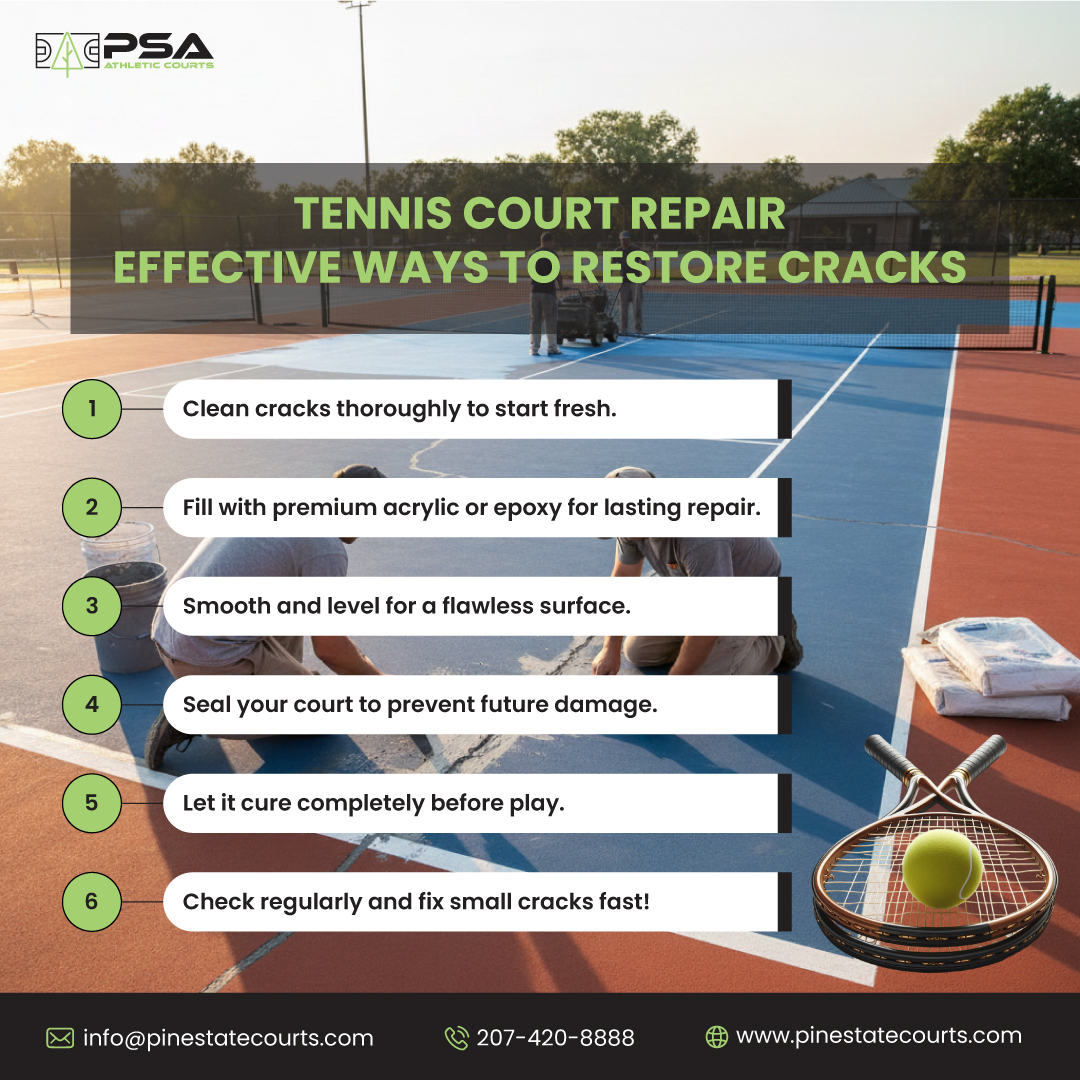
Here’s a general step-by-step guide to fix those cracks:
Step 1: Inspect the surface for extent of damage
Before starting any repairs, it’s important to inspect the court surface to understand the extent of the damage. If the issues go beyond minor cracks, it’s best to bring in a professional who can assess the surface and determine whether you’re due for tennis court resurfacing.
Step 2: Clean the cracks
Next, clean the surface to remove dirt and debris accumulated on the court surface. Make sure that the crack and the surrounding court surface is completely dry before applying any filler.
Step 3: Repair the cracks based on their size
For minor cracks or cracks that are not too deep, move in with an acrylic filler. Use a fiberglass or rubberized crack filler for large cracks, it is also better that you consult a professional for any major repair work and get it right in the first try.
PRO-TIP:
When in doubt, get a professional to put eyes on your court. Most reputable contractors offer free estimates, so you get expert feedback with zero risk. It removes all the guesswork and gives you real clarity on what your court actually needs — and it’s a great value.
Step 4: Apply the resurfacer and paint lines
The final step in the repair process is to apply an acrylic resurfacer once the filler is dry to get a smooth finish. Paint those faded lines and fix color coatings and your court is as good as new and ready to play.
Read Tennis Court Manchester: Construction, Surfacing & Maintenance to learn how proper surfacing and maintenance protect your court investment.
Trusted Solutions and Materials for Tennis Court Repair
When it comes to choosing the right tennis court repair products and trusted solutions, you are better off with help from Pine State Courts. Our court repair experts will help you with any repairs or resurfacing work your court might need and as we use only the best tennis court repair products, your court’s good health is here to stay for years to come.
Here’s a few things you should be on the lookout for materials to fix that court:
- Flexibility to handle regular expansion and contraction).
- UV resistance.
- Waterproofing abilities.
- Compatibility with acrylic court coatings.
- Long-term durability.
Although you may be put off by the cost of professional-grade products, it is wise to note that they deliver significantly better results and a longer-lasting surface.
Proactive Maintenance to Extend Your Court’s Lifespan
A tennis court is nothing if it is not maintained properly, this not only keeps it in its best shape but also helps attract more players and boost property value. Afterall who doesn’t love to play on a shining court. Regular tennis court maintenance also tends to boost the court's lifespan.
Here are a few proactive maintenance for your tennis court:
- You can not do without regular cleaning, it is a must to make sure that the accumulated debris or dirt doesn’t destroy the court surface.
- Weekly or monthly inspections of the court are essential to spot any issues early on and prevent any expensive repairs later.
- As soon as you see any issue, address it promptly. Those spills and minor cracks aren’t just sore sight but warning bells so get them fixed.
- Protecting the court from freeze-thaw cycles is yet another crucial process. Clear away the snow regularly and cover the court with tarp if not in use.
- Apply UV coatings to prevent the surface from Sun damage and to help retain the court’s color and texture.
With these maintenance tips in your arsenal, your court is bound to have a crack-free, smooth, and even playing surface. It won’t just look good but allow players to perform at their best too.
Takeaway
While tennis court cracks are a common issue, they are not something that you should ignore. Fixing it at the right time with the right materials and following a regular maintenance regime can help your court stay in its top shape for a long time.
Whether you are dealing with minor cracks or more serious surface damage, Pine State Courts is always here with reliable guidance and even better solutions to make sure your court always performs well.
Frequently Asked Questions
1. What is the best way to repair cracks in a tennis court?
The best way to repair cracks in a tennis court involves using an acrylic filler for minor cracks and rubberized or fiberglass for major ones. Talk to an expert if your court has multiple cracks, any drainage or color fading issues.
2. How to repair fine cracks?
To repair the fine cracks, clean the crack first and then use an appropriate filler based on the size of the crack. Apply a primer and resurfacer next for a smooth and even finish.
3. How to seal a tennis court?
To seal aka “resurface” a tennis court, start with clearing out the crack of any dirt or debris. Use a filler next to fill the crack, allow it to dry. Then use a resurfacer to smooth out the surface, and color coatings or paint for an even look.
4. How much does it cost to repair a tennis court?
The cost depends on the condition of the court — things like cracking, drainage issues, base movement, and how much surface prep is needed. Since these factors can vary a lot, the easiest way to get a real answer is to have a reputable contractor take a look. Most offer free estimates, so you get clear guidance without guessing.
5. How to use acrylic patch binder?
To use acrylic patch binder, start by preparing the surface by cleaning it thoroughly. Apply a diluted "tack coat" primer if recommended, then mix the binder with sand and cement according to the manufacturer's instructions. Finally, apply the patch mix with a straight edge or trowel and allow it to dry.
6. Are tennis courts expensive to maintain?
Tennis courts aren’t necessarily expensive to maintain, surfaces like acrylic have low maintenance needs. While others like clay and grass require higher and more frequent maintenance.
DOWNLOAD OUR FREE GUIDE
Ready to build your dream court?
Download our FREE Basketball Court Construction & Planning Checklist and get the step-by-step roadmap to building a professional-grade court—from budget planning to final touches.
No guesswork, just results.