

Maine's winter conditions put outdoor pickleball courts through a demanding cycle of snow, freezing temperatures, moisture, and spring thaw. At the same time, an indoor facility brings its own considerations, including building costs, heating, ventilation, lighting, and available ceiling height.
The right choice therefore between an indoor or outdoor court construction depends on how you plan to use your facility, how much the year-round availability matters to you, and what your site can realistically support.
In this guide by Pine State Courts, we will be breaking down these factors and some others that you should consider before choosing between indoor and outdoor pickleball court construction in Maine.
What to Consider before Choosing an Indoor or Outdoor Pickleball Court
Before we start the discussion about which among - indoor or outdoor pickleball courts is the better option for your facility in Maine, let’s take a look at some important factors that you must consider.
Beyond the playing surface, your facility itself can have just as much influence on the long-term performance and operating costs of your pickleball court. You must consider factors like:
- Weather and climate - How the local weather conditions can affect court usability, surface performance and long-term durability.
- Year-round court availability - How important it is for your facility to offer consistent playing time through winter.
- Site and space requirements - Whether your property can accommodate the court layout, surrounding playing area, drainage needs or an enclosed facility.
- Construction and operating costs - Consider the difference between the initial investment and the ongoing costs for maintaining and operating the court.
- Surface performance and maintenance - How the court surface will respond to moisture, temperature changes, regular play, and the maintenance required to keep it in good condition.
- Facility use and programming - Whether your courts will be primarily used for recreational play or to support leagues, lessons, tournaments and other year-round programming.
- Long-term investment - Which option makes more sense for your facility based on the expected usage, maintenance requirements, and the length of the playing season.
You can also check our guide on pickleball court construction for sports facilities to get a detailed insight into planning court construction.
Indoor Pickleball Court Construction in Maine
Indoor pickleball courts can provide something that’s particularly valuable in Maine - predictability. With an indoor court, your players won’t have to wait for the snow to melt, rain to stop or temperatures to become comfortable.
You can schedule leagues, lessons, and tournaments without building your calendar around the weather. Besides building a sports facility with indoor pickleball courts, you can also convert your warehouse, add a court to a recreation building or gymnasium. Your pickleball court designer can help you make the best use of your indoor space.
Benefits of an Indoor Pickleball Court
The list of benefits that you get from building an indoor pickleball court in your sports or athletic facility includes:
- Year-round play - An indoor court provides reliable court access even during Maine's snow, rain and freezing temperatures.
- Weather protection - Indoor facilities keep players and the playing surface protected from precipitation and extreme outdoor conditions.
- Consistent playing conditions - With greater control over temperature, lighting and other playing conditions, an indoor court offers more consistent play.
- More programming opportunities - It is easier to run leagues, lessons, and tournaments throughout the year.
- Reduced weather-related surface exposure - It limits direct exposure to snow, rain, UV, and temperature fluctuations.
Challenges of Indoor Pickleball Courts
The benefits we discussed previously don’t mean that you should choose an indoor court. Building an indoor facility comes with its own challenges, which include:
- Higher upfront investment - Besides the costs for court installation, you also need to find a suitable building or enclosed space.
- Higher operating costs - Consider heating, ventilation, lighting and other ongoing expenses for your facility.
- Space requirements - The building must provide adequate court clearance, circulation space, and appropriate playing conditions.
- Building modifications - Converting your existing space may require you to upgrade your flooring, lighting, HVAC, acoustics or accessibility.
- Operating demands in winter- Maintaining a comfortable indoor environment during Maine's colder months can increase your energy costs.
When Is an Indoor Court the Better Choice?
An indoor facility is generally worth considering when year-round court access is central to your business model. It makes sense for facilities that expect significant winter demand, run organized leagues or lessons, host tournaments, or want to build a membership model that depends on consistent court availability.
It is also worth considering when you already own or have access to a suitable building that can be adapted for pickleball.
Outdoor Pickleball Court Construction in Maine
Outdoor courts remain an attractive option for parks, recreation facilities, clubs, homeowners' associations, and seasonal facilities. These courts offer the chance to use your outdoor space to build a space for players to play and the local community to interact.
But the freeze-thaw cycles and extreme weather conditions of Maine require special considerations during court construction. We’ll discuss this in later sections.
Benefits of an Outdoor Pickleball Court
The benefits of building an outdoor pickleball court in Maine include:
- Lower construction complexity - It can be simpler to build an outdoor court when you have suitable land or an existing site infrastructure.
- Lower operating costs - An outdoor court does not require heating or year-round indoor building systems.
- Natural playing environment - It gives players an open-air experience during Maine's warmer months.
- Flexible site options - It can be incorporated into parks, recreation facilities, clubs, and existing outdoor sports complexes.
- Good seasonal value - It works well for facilities focused primarily on spring, summer and fall programming.
Challenges of Outdoor Pickleball Courts
Beyond the benefits of an open-air playing field and flexible site options, the outdoor pickleball courts come with their own challenges. These include:
- Seasonal limitations - Snow, freezing temperatures, and wet conditions can significantly reduce your court’s availability.
- Freeze-thaw exposure - Repeated temperature changes can contribute to pavement deterioration when water enters cracks or other weak areas.
- Drainage requirements - Poor grading or drainage can leave moisture around the court and contribute to surface problems.
- Weather-dependent maintenance - Snow, moisture, debris, and seasonal changes require additional attention.
- Less predictable programming - Weather can interfere with any leagues, events, or play scheduled during peak or shoulder seasons.
When Is an Outdoor Court the Better Choice
Outdoor courts can be the better fit if your facility is focused on spring, summer and fall use, and does not require dependable winter programming, or if you have suitable land.
They can also make sense for municipalities and recreation facilities where the goal is to provide accessible community courts rather than operate a year-round commercial pickleball business.
If you’re considering using your backyard space to build your court? Check our guide on backyard pickleball court installation for more details on how a pickleball court construction company can help you with this project.
Indoor vs. Outdoor Pickleball Courts: Key Differences
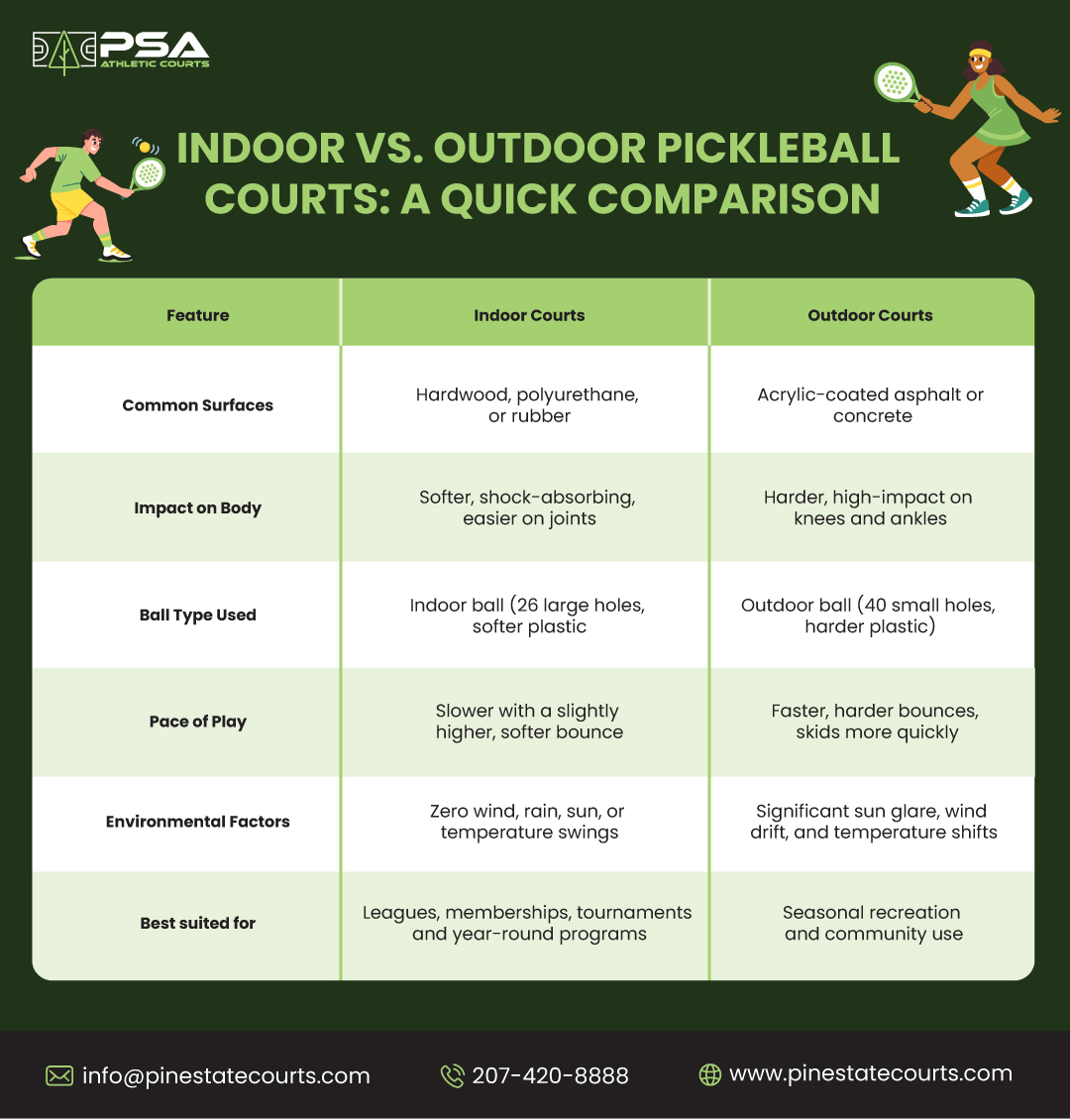
Indoor and outdoor pickleball courts differ mainly in their playing surfaces, environment, and the equipment required for optimal play. The table below includes the major differences between indoor and outdoor courts :
How Maine's Climate Influences Your Pickleball Court Choice
When you’re working with a pickleball court builder, Maine's climate should be a major part of your design discussion from the beginning. This discussion will affect everything from how the base is prepared, the surfacing materials you choose, and the court’s maintenance requirements.
Here’s what you should consider in regards to Maine climatic conditions when building your pickleball court:
1. Snow and Freeze-Thaw Conditions
Maine's winter conditions can be demanding for outdoor pickleball courts, especially the spring freeze-thaw can make the court vulnerable to damage. Besides snow sitting constantly on the court, water can enter pavement cracks or other weaknesses, freeze and expand, contributing to further deterioration as the temperatures fluctuate.
That’s why the pavement system and underlying base of your court needs to be properly designed for local conditions. Indoor courts, on the other hand, avoid direct snow and freeze-thaw exposure to the playing surface, although the building and surrounding site still need to be designed for Maine's winter conditions.
2. Drainage and Moisture Management
Maine receives precipitation throughout the year, and changing climate patterns are also bringing more intense precipitation events. For outdoor courts, this makes drainage and grading especially important.
Your court should drain water efficiently, while the surrounding site should prevent runoff from collecting around the pavement. For indoor courts, you need to invest in HVAC, dehumidification, and vapour barriers for moisture management.
3. Seasonal Court Availability
An outdoor court in Maine is unlikely to provide the same predictable playing schedule as an indoor facility but this does not necessarily make them a poor investment. It simply means your facility's business or programming model needs to account for the seasonal limitation.
Maine's winters are warming and becoming shorter overall, but winter weather remains significant, and snowfall and freezing conditions still vary considerably by region.
If you’re evaluating pickleball court construction companies, you can check our guide on how to choose a pickleball court contractor in Maine.
Long Term Investment and Maintenance Considerations
After weighing down the merits and demerits of indoor and outdoor pickleball courts and the initial construction cost of this project, you should consider how the court will perform, what it will cost to maintain and how often it can realistically be used over the years.
Here’s what you should keep in mind:
- Surface lifespan - Consider how the surface you’ve selected will handle regular play, moisture, temperature changes and other conditions, and when resurfacing may be required.
- Routine maintenance - Factor in regular cleaning, surface inspections, line maintenance, crack repairs and other work needed to keep the court playable.
- Weather-related upkeep - Outdoor facilities may require additional maintenance after winter, including checking for surface damage, drainage issues and areas affected by freeze-thaw cycles.
- Operating expenses - Indoor facilities should account for ongoing heating, ventilation, lighting and building maintenance costs. Outdoor facilities generally have fewer building-related expenses.
- Future usage - Consider whether your facility's expected demand will justify the investment and whether the court can support future leagues, tournaments, lessons or expanded programming.
Which Pickleball Court Option Is Best for Your Facility?
From our discussion so far, it’s clear that there is no single answer for every Maine facility. For someone looking for year-round play an indoor facility may be the right choice, for someone who wants seasonal recreation and is looking to make the most of their existing outdoor space, an outdoor court may be the better fit.
Choose indoor pickleball courts if:
- Year-round play is essential for you.
- You plan to operate leagues, lessons or tournaments throughout winter.
- You have access to a suitable existing building or the budget for new construction.
- Consistent court availability is important to your business model.
Choose outdoor pickleball court if:
- Your primary season is spring through fall.
- You already have suitable land.
- You are building courts for community or recreational use.
- You want to avoid the cost and complexity of constructing and operating a full indoor facility.
If your budget allows for it, you can also consider a combination of indoor and outdoor courts. It will provide you outdoor capacity during the warmer months while maintaining your winter programming indoors.
Why Professional Pickleball Court Construction Matters
It isn’t just the decision of indoor vs outdoor pickleball that matters but how you choose to build your court matters too. Getting a professional builder for your construction can make all the difference.
Your pickleball court construction company will help you with:
- Structural Foundation and Base Integrity - Professional builders ensure correct grading, soil compaction, and select the right structural foundation between concrete or asphalt. This prevents shifting and major cracking caused by Maine’s freeze-thaw cycles.
- Drainage and Slope Control - Builders will ensure a precise slope of 0.8% to 1% to ensure fast water runoff without negatively impacting gameplay or causing puddles.
- Consistent Playability and Ball Bounce - They’ll pick the right surfacing and specialized acrylic coatings to deliver uniform traction and reliable ball reactions across the entire court.
- Player Safety and Joint Protection - Their secure even grading and precise surface texture to minimize trip hazards, offer proper traction, and reduce undue stress on players' joints.
- Long-Term Durability - They’ll utilize advanced techniques like post-tension concrete compresses slabs with steel cables to prevent structural cracking and extend the lifespan of your court.
Conclusion
For a pickleball facility in Maine, the decision between indoor and outdoor courts comes down to more than just budget or player preference. Other factors like climate, programming, site conditions and long-term operating costs play their part too.
An indoor court provides reliable year-round access, while an outdoor court can be a practical and cost-effective choice for seasonal recreation when the site is properly designed for Maine's weather.
Whichever option you choose, the most important decision is working with the right pickleball court construction company. At Pine State Courts, we understand the importance of proper planning, drainage, surface selection, site preparation and Maine-specific design considerations. Our courts are built to perform well and last for years. Get in touch with us to discuss your project.
Frequently Asked Questions
1. How does Maine's winter weather affect outdoor pickleball courts?
Maine's winter weather can cause severe freeze-thaw damage, structural cracking, and degrade the surface of your outdoor court over time.
2. Is indoor pickleball court construction more expensive than outdoor construction?
Yes, indoor pickleball court construction is more expensive than outdoor construction as you need to add a building shell before installing the court. You also need to invest in climate control and specialized indoor lighting.
3. Is an indoor or outdoor pickleball court better for Maine?
If your goal is to ensure year-round play then indoor pickleball courts are definitely the better option for Maine. As indoor facilities remain protected from the freeze thaw cycles, extreme weather conditions, and rain, they are also more durable.
4. Can existing recreational space be converted into an indoor pickleball court?
Yes, you can easily convert your existing recreational space into an indoor pickleball court. You just need to ensure you have the right dimensions for the playing field and additional surrounding area, and the right ceiling height.
5. What site preparation is needed for an outdoor pickleball court?
To build an outdoor pickleball court, the site preparation includes clearing, leveling, and grading a minimum 30x60 foot area to ensure that you have proper drainage and structural stability. You should also make sure that the court should be oriented along a north-south axis.
6. Can Pine State Courts build both indoor and outdoor pickleball courts?
Yes, Pine State Courts can build both indoor and outdoor pickleball courts. We can offer court design, surface selection, installation, finishing, and ongoing maintenance based on your space and playing needs.
DOWNLOAD OUR FREE GUIDE
Ready to build your dream court?
Download our FREE Basketball Court Construction & Planning Checklist and get the step-by-step roadmap to building a professional-grade court—from budget planning to final touches.
No guesswork, just results.