

The popularity of Pickleball in the U.S. doesn’t seem to slow down any time soon. But this rising popularity hasn’t deterred the strong home base of Tennis, which is why many homeowners in the New Hampshire region are often confused about which to pick.
While the choice really depends on the sport that easily fits your lifestyle, other factors that homeowners often compare are space requirements, construction costs, maintenance needs, and durability. If you too are planning to add a pickleball or tennis court to your backyard, then this blog is for you.
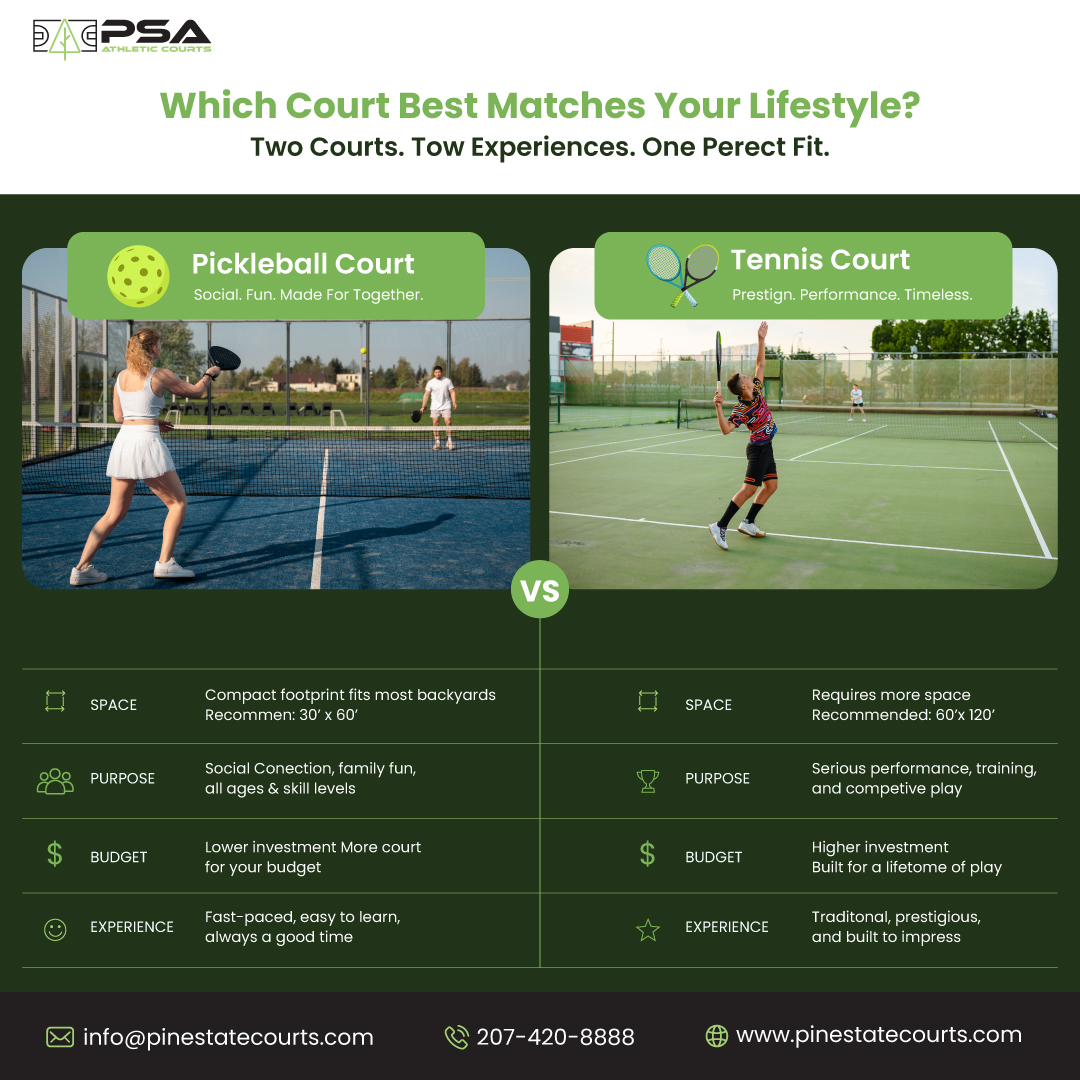
Here’s a quick overview of pickleball court vs tennis court for easy reference:

We’ll discuss all these factors in detail in this Pine State Courts’ guide, so you can make the right pick for your backyard space.
What NH Homeowners Care about Most before Installing a Court
Installing a backyard court isn't as simple as choosing a sport and starting construction. From uneven terrain and drainage requirements to freeze-thaw cycles and long-term maintenance, there’s a lot NH homeowners should take into account before starting their project.
Here’s a list of common factors homeowners evaluate:
- The amount of usable property space often determines what type of court is practical. Slopes, trees, patios, pools, and local zoning requirements can all affect where a court can be installed.
- New Hampshire's freeze-thaw cycles, snow, and moisture can impact the court’s performance over time. Proper construction and drainage are essential for long-term durability.
- Budget is another important factor. Construction costs vary based on factors like site preparation, drainage requirements, fencing, lighting, and surface materials.
- The courts’ use - recreational vs professional usage also influences the choice of game and the quality of your build.
- Depending on the municipality, permits, setback requirements, lighting restrictions, and noise considerations may also influence the court design and its placement.
Working with an experienced local court builder ensures your project complies with local regulations from the start and is built for reliable play and long term durability.
You can also check out our guide if you’re planning to build a tennis or pickleball court in Boston.
How Pickleball Court vs Tennis Court compare for NH Homeowners
Now let’s look at a detailed breakdown of how the two most popular athletic courts, tennis vs pickleball compare for homeowners in the New Hampshire region.
Round 1: Space & Backyard Compatibility
The first major consideration that goes into both tennis court construction and pickleball court construction is how much space is needed to build the court. The size of a tennis court is considerably larger than pickleball so that almost four pickleball courts can fit in the space of one tennis court.
Why Pickleball Wins for Smaller Properties
One of pickleball's biggest advantages is its compact size. The size of a regulation pickleball court is 30 ft by 60 ft.
As this court requires significantly less space, homeowners have more flexibility when it comes to planning pickleball court construction. These smaller courts often fit comfortably into suburban backyards where a full-size tennis court construction may not be practical.
This smaller footprint also reduces site preparation requirements, making installation simpler and potentially more cost-effective. Pickleball surely wins for homeowners who want to maximize recreational value without dedicating a large portion of their property to an athletic court.
You can also check our detailed guide on outdoor pickleball court dimensions and layout for this project.
When Tennis Makes Sense
The size of a tennis court is much larger, 60 ft by 120 ft including runoff space, but it’s not the wrong choice. It makes sense to build a tennis court if you have a larger property and regularly play tennis.
Instead of struggling to find good facilities near you, having a dedicated court in your backyard is an experience that's difficult to match. For many homeowners, a tennis court is a recreational asset as well as a premium property feature.
For serious players, there's simply nothing better than having a regulation-style tennis court steps away from their house.
To learn more about how big a tennis court is, you can check out our detailed guide and plan your backyard project.
Round 2: Cost Breakdown - Which Court Is More Affordable
The cost of construction is another vital differentiator. It depends on a lot of factors like the size of the court (tennis vs pickleball and singles vs doubles), the extent of site preparations you need, and the quality and quantity of materials you choose to build with.
Pickleball Court construction Costs overview
In most cases, pickleball courts are more affordable to build than tennis courts as their smaller dimensions typically require less excavation, fewer construction materials, smaller surface areas, and reduced fencing requirements.
But it goes without saying that other factors like grading, drainage, lighting, and site accessibility can still influence and add to your overall project costs.
Tennis Court Construction Costs overview
Tennis courts cost significantly higher because of their huge space requirements. This larger footprint of a tennis court generally requires more extensive site preparation for construction along with increased material and labor requirements.
You’ll also need more material like asphalt or concrete for surfacing and require larger fencing systems. While the initial investment is often higher, many homeowners view a tennis court as a long-term recreational feature that provides value for years to come.
Not sure what to choose? The best way to understand the potential costs of your construction project is to have a professional evaluate your property and project goals. At Pine State Courts, we hold expertise in building professional and recreational courts that maximize the utility of your space. Contact us to get a free quote today.
Round 3: Maintenance in New Hampshire Weather
The climatic conditions of New Hampshire are often plagued with snowy winters, spring moisture, and harsh freeze-thaw cycles. Taking this weather into consideration is vital to ensure that your court is built to withstand these extreme temperature fluctuations and remains playable for years to come.
Whether you're building a pickleball court or a tennis court, quality installation should include:
- Proper grading
- Effective drainage systems
- Durable surfacing materials
- Construction methods designed for local climate conditions
Besides this, regular court maintenance including, routine cleaning, occasional crack repair, and periodic resurfacing keeps your courts looking and performing their best.
When built correctly, both tennis and pickleball courts can provide decades of enjoyment with manageable maintenance requirements.
Round 4: Which Sport Will Your Family Actually Use More?
This may be the most important factor and the sport your family loves to play is a clear winner. But if you are planning to introduce a new sport to your kids, pickleball can be an easy pick for young kids and tennis for competitive players.
Why Families Love Pickleball
Pickleball is incredibly popular among families because it's easy to learn and can be enjoyed by players of all ages.
Your family including grandparents, parents, teenagers, and younger children can often play together without a steep learning curve. The social nature of this game makes it perfect for gatherings, neighborhood events, and casual weekend recreation.
Why Tennis Still Has Loyal Fans
Tennis offers a different playing experience altogether. Many players enjoy its competitive nature, strategic depth, and physical challenge.
For homeowners who play tennis regularly or participate in leagues, having a private court can increase convenience and their practice time. It can also enhance the value of your property significantly because its popularity still continues to grow even after the introduction of several easy games like pickleball and padel.
Ultimately, the best court between tennis and pickleball is the one that your family will use consistently.
The Best Long-Term Investment for Your Property
When it comes to picking tennis court vs pickleball court, the answer isn't the same for every homeowner.
Pickleball May Be the Better Investment If:
- You have limited space in your backyard
- You want lower construction costs
- You value multi-generational family activities
- You enjoy social recreation
Tennis May Be the Better Investment If:
- You're a dedicated tennis player
- You have a larger property
- You prefer traditional court sports
- You want a full-size dedicated playing surface
At Pine State Courts, we also offer a multi-athletic court design that accommodates both tennis and pickleball court, providing you with maximum flexibility without sacrificing functionality.
Expert Recommendation by Homeowner Type
As an experienced court builder, we often help homeowners make this decision based on how they plan to use their space instead of simply building a court that’s been trending lately.
You should choose pickleball court construction if:
- Your priority is recreation
- You want the participation of your whole family
- Your available space is limited
- You prefer a lower-cost project
You should choose tennis court construction if:
- Tennis is your primary sport
- You have adequate space available
- You want a dedicated athletic feature
- Competitive play is important to you
Still not sure? An experienced court builder can evaluate your property's layout, drainage conditions, available space, and recreational goals to help you make the right pick for your family. Get in touch with Pine State Courts to discuss more about your project.
Takeaway
Building a backyard court is a major decision for any homeowner. For NH homeowners the choice often falls between picking tennis vs pickleball.
This decision comes down to the lifestyle of your family, your backyard space, your construction budget, and the maintenance costs of the court. Working with a local expert also helps to ensure that your court complies to the local regulations and is built to withstand extreme weather conditions.
At Pine State Courts, we offer construction, maintenance and resurfacing of tennis, pickleball, basketball, padel, and multi-athletic courts in New Hampshire, Maine, Vermont, and Massachusetts. Talk to us to discuss what’s possible for your property.
Frequently Asked Questions
1. Does a pickleball court add value to your house?
Yes, a pickleball court adds value to your house as it provides a recreational space for your family bond over a match and allows your family to stay active and healthy. It also boosts the value of your house as it's a great asset for players or a family with kids.
2. Do pickleball courts decrease property values?
Whether pickleball courts decrease property value or increase it depends on the quality of your build, proximity to neighbours (noise issues), and the lifestyle of your buyers.
3. Does a tennis court add value to your house?
A tennis court can add value to your house if your family has an active lifestyle, you are a dedicated tennis player. It can also boost the value of your property.
4. Can a tennis court be used as a pickleball court?
Yes, a tennis court can be used as a pickleball court. You can add temporary line markings and use a portable net to use the same space for both.
5. Do people use tennis courts for pickleball?
Yes, people do use tennis courts for pickleball as a single tennis court can fit up to four pickleball courts. Many homeowners also built multi-athletic courts to maximize the utility of their space.
6. Can a tennis court be converted into a pickleball court?
Yes, a tennis court can be converted into a pickleball court because of the significantly smaller size of a pickleball court. When planned by an expert court designer, four pickleball courts can be built in the space of a single tennis court.
7. Which court is easier to maintain in New Hampshire weather?
The New Hampshire weather consists of snowy winters, spring moisture, and freeze-thaw cycles. Acrylic hard courts built on asphalt/ concrete base can withstand this type of weather and resist cracking.
8. What is the best surface for outdoor courts in NH?
The best surface for outdoor courts in NH is an acrylic coated asphalt or concrete court. It is a durable surface with great traction and ball bounce that can withstand the harsh freeze-thaw cycles of this region.
9. Which court requires more backyard space?
A tennis court with proper runoff space requires an area of 60 ft by 120 ft which is significant for a backyard space. Other sports in contrast like basketball, pickleball and padel courts require much less space.
DOWNLOAD OUR FREE GUIDE
Ready to build your dream court?
Download our FREE Basketball Court Construction & Planning Checklist and get the step-by-step roadmap to building a professional-grade court—from budget planning to final touches.
No guesswork, just results.