

If you’re planning to build or upgrade a sports facility in Boston, you’ve probably run into a question that most facility owners struggle with “What to build- tennis vs pickleball court in Boston?”
A few years ago, this wouldn’t even be up for a debate as tennis was the go-to sport for most of Boston. But with the popularity of pickleball, a lot of things have changed and it has become a common sight in our local parks, clubs, and even existing tennis courts.
The right choice between the two isn’t about which sport is “better” but what works best for your space, your players, and your long-term goals. If you too are struggling with this decision then this Pine State Courts’ guide will help you out. We will list the ten key factors you should consider before choosing between tennis vs pickleball in Boston.
1. Popularity of Tennis vs Pickleball in Boston
There’s no denying that pickleball is growing fast and Boston is no exception to that. Its participation across the US has surged to millions with tens of thousands of new courts being added in just a few years.
About one-third of the tennis courts in Boston too have pickleball lines added to them. That being said, tennis isn’t disappearing. It still has a larger overall player base nationally and locally, and remains a major part of schools, clubs, and competitive programs.
Your choice depends upon whether you want a fast-growing community engagement (Pickleball) or need structured athletics and tradition (Tennis).
2. Court Size Comparison: Tennis vs Pickleball Dimensions
Another important deciding factor between the two sports is the size of the court. A standard tennis court for doubles play measures 78 ft x 36 ft which is significantly larger than a compact pickleball court that’s 44 ft x 20 ft.
In fact, you can fit up to four pickleball courts in the space of a single tennis court. This is beneficial as more courts mean more players will play in your facility at the same time, they’ll face shorter wait times, and a higher overall activity.
Pickleball in Boston can be advantageous as even with limited space you could still generate significant revenue. Read out our guide on how big a pickleball court is for a detailed breakdown of the pickleball courts’ dimensions and check if your space is enough to build one.
3. Installation Costs: Tennis Courts vs Pickleball Courts in Boston
Cost is often where this decision starts to become practical. Through the previous size comparison, it’s clear that building a full tennis court would require more materials, a bigger surface area, and more infrastructure.
Pickleball courts in comparison are typically less expensive to install, especially if you work with an existing surface. In many cases, a tennis court can be easily converted into pickleball courts. This lower upfront cost is also one of the reasons why pickleball has expanded so quickly.
For a step-by-step breakdown of building a high-quality court, explore our Pickleball Court Construction Guide for Parks & Sports Facilities.
4. Maintenance Requirements and Long-Term Costs
Most facility owners forget to take maintenance into consideration when comparing their options and let’s be honest it can be a costly mistake. Tennis courts, because of their size, generally require more surface maintenance and resurfacing work.
Pickleball courts on the other hand being smaller, can be more cost-efficient per court. However, they often experience more concentrated wear in high-use areas due to frequent play. In this case, the tennis courts hold up better as player movement is spread out over a larger area.
In Boston, where weather adds another layer of stress through freeze-thaw cycles, proper construction and drainage matter more than what sport you choose. Check out our guide on pickleball court resurfacing to learn more about your court repair and resurfacing requirements.
5. Player Demographics and Target Audience
Pickleball has built its growth on its ease of accessibility. Since it’s easier to learn, less demanding physically, and highly social, it easily becomes popular among adults and older players, as well as beginners who want to get into a sport quickly.
Tennis, on the other hand, attracts players who are more invested in structured play like youth programs, school teams, and competitive athletes.
So, if your goal is to engage your community and host casual play then pickleball will draw-in a higher participation. But if you want to support organized athletics or long-term player development then tennis is a clear winner.
6. Space Utilization and Multi-Court Flexibility
In a thriving city like Boston, space is of utmost importance. As pickleball courts are smaller, your facility can host more players simultaneously and rotate games more, leading to an overall high utilization of your facility space.
This isn’t to say that tennis courts in Boston don’t perform well, much of the local crowd is still partial towards tennis. Flexible layouts containing both tennis and pickleball are also becoming increasingly popular.
You can use color-coded lines and portable nets to convert your tennis court into a pickleball court and maximize the utility of your space.
7. Revenue Potential: Tennis vs Pickleball Facilities
From a business perspective, the difference between tennis and pickleball depends on how you use your space.
Pickleball naturally supports higher turnover as more players can use the space in less time and the games are shorter and social. This creates great opportunities for leagues, open play sessions, and community events.
Tennis, on the other hand, tends to generate revenue through lessons, memberships, and competitive programming. Even though it's a more traditional model, it is also a more stable one.
8. Noise Levels and Community Impact
One factor that often gets overlooked until it becomes a problem is noise. Pickleball produces a distinct “pop” sound when the paddle hits the ball which can be a problem in residential areas.
Tennis is relatively quieter, making it easier to build courts in neighborhoods without major pushback. In Boston, where courts are often located near homes and public spaces, this can influence your planning decisions more than you can expect.
If you still want to go with pickleball courts, consult expert pickleball court designers to help you plan for noise reduction.
9. Climate Suitability: Boston Weather Consideration
Boston’s climate adds its own set of challenges to this decision. The cold winters, moisture, and freeze-thaw cycles - all impact court surfaces. Both tennis and pickleball courts therefore require proper construction, drainage, and materials that meet recommended pickleball court surfacing specifications to withstand these conditions.
Needless to say, there isn’t a major difference between the two sports in terms of climate suitability. But what matters most is how well your court is built and maintained over time, investing in quality construction upfront can go a long way to protect your investment.
10. Future Growth Trends: Tennis vs Pickleball in Boston
If you look ahead, pickleball shows no signs of slowing down. Its rapid growth across the country is continuing and Boston is already experiencing increased demand for courts and playing space, highlighting the future of pickleball facility development in the region.
At the same time, tennis continues to hold its position. It has a long history, strong institutional support, and a consistent player base that isn’t going away.
The choice therefore isn’t about choosing one sport over the other but designing facilities that can adapt as the demand evolves.
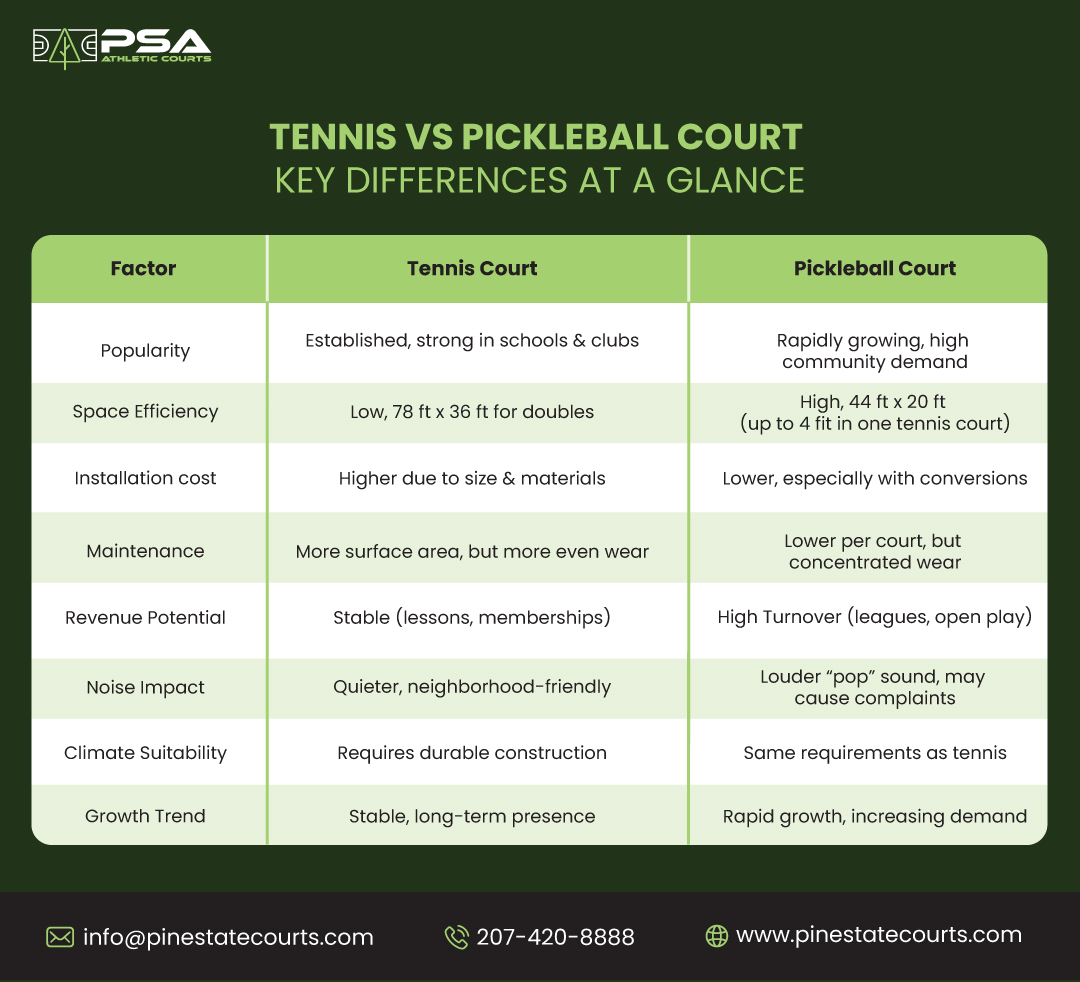
Tennis vs Pickleball: Quick Comparison Table
Let’s sum up our discussion through a simple tennis vs pickleball comparison table:
Which Court Should You Choose in Boston?
At the end of the day, the decision comes down to your audience, your space, and how you want the facility to function five or ten years from now and not just today.
If you want to support organized programs, school athletics, or competitive play, tennis is a strong and reliable choice. But if you want to build community engagement, maximize the usage of your space, and adapt to the current demand, pickleball has a clear advantage.
In many cases, the most effective solution is not choosing one over the other but building hybrid courts that support both sports and offer flexibility for future expansion too.
Conclusion
Boston is at an interesting point when it comes to recreational sports. Pickleball is growing quickly and changing how courts are used, while tennis continues to provide structure and long-term stability.
The facilities that succeed won’t be the ones that pick a side but the ones that understand how to balance both - using space efficiently, serving different audiences, and planning for what comes next.
Pine State Courts can help you make smarter decisions and build professional courts that perform well while providing flexibility for the future. Contact us to book a site visit.
Frequently Asked Questions
1. Is pickleball more profitable than tennis in Boston?
Pickleball has a higher revenue potential per square feet as compared to tennis due to its small size. But tennis courts still generate profits from structured coaching, league play, and tournaments.
2. Can a tennis court be converted into pickleball courts?
Yes, a tennis court can be easily converted into pickleball courts by using portable nets and temporary tape, or you can also add permanent line markings. Four pickleball courts can thus fit in the space for one tennis court.
3. Which court requires less maintenance in Boston weather?
Hard courts made of asphalt or concrete topped with acrylic coating perform best in Boston weather due to their durability. They can better withstand the harsh freeze thaw cycles and moisture as compared to grass or clay courts.
4. What is the average cost to build a pickleball court in Boston?
The average cost to build a pickleball court in Boston ranges from $30,000 to $50,000. This cost goes higher as a robust sub-base is required to handle the freeze thaw cycles. Additional amenities like fencing, lighting, and seating also add to the cost.
5. Are pickleball courts noisier than tennis courts?
Yes, pickleball courts are generally noisier than tennis courts due to the distinct “pop” sound that the plastic paddles make when a ball hits. As this sound travels further it makes the sport more disruptive.
DOWNLOAD OUR FREE GUIDE
Ready to build your dream court?
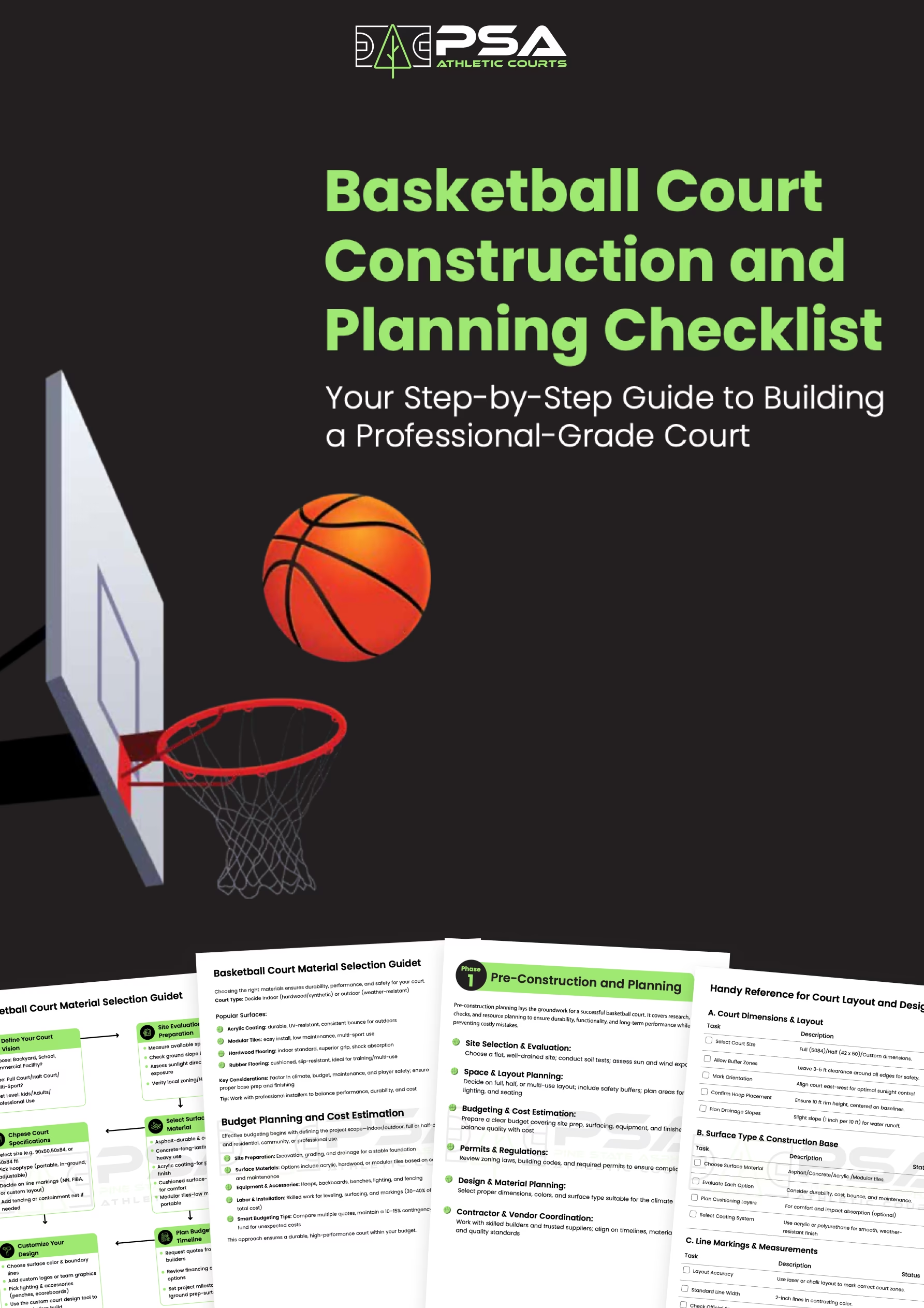
Download our FREE Basketball Court Construction & Planning Checklist and get the step-by-step roadmap to building a professional-grade court—from budget planning to final touches.
No guesswork, just results.