
You can have a well-maintained pickleball court with quality surface and net but if the court lines are difficult to see or incorrectly positioned, the players will notice the difference. For schools, recreation centres, and sports facilities, proper pickleball court striping is an important part of making the playing area usable, safe, and ready for regular play.
In this article by Pine State Courts, we'll look at how pickleball court striping works, which colours and materials you should consider, and the step by step process for creating a professional court with regulation pickleball court layout and striping.
What Is Pickleball Court Striping and Why Does It Matter?
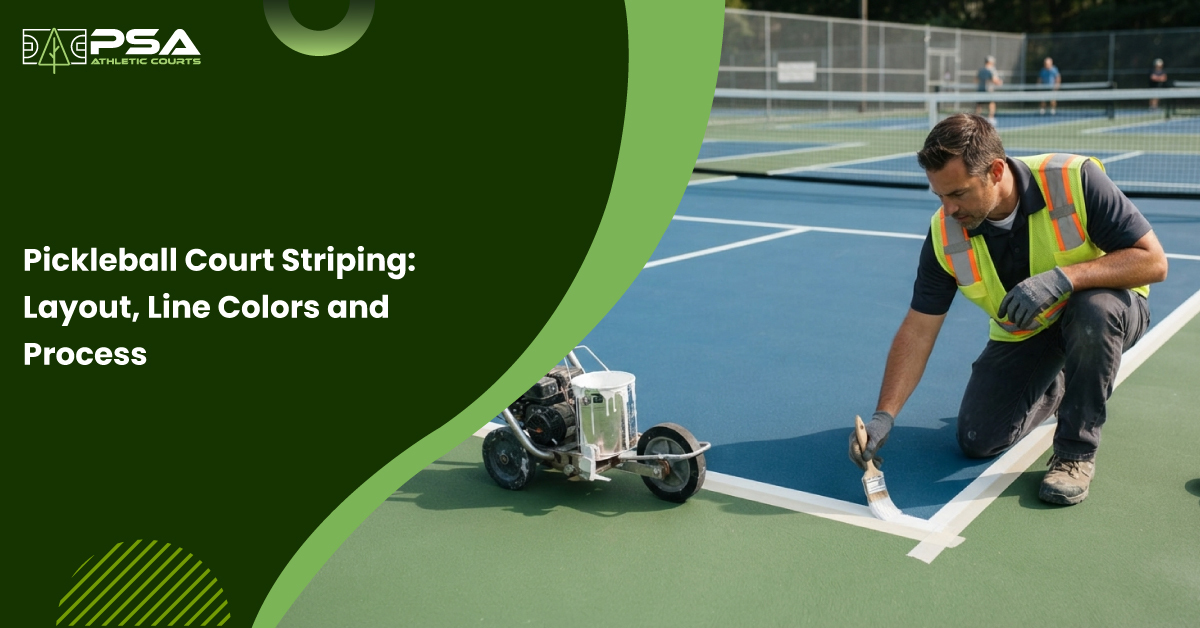
Pickleball court striping is the process of painting the official boundary and zone lines onto a pickleball court. This process includes marking, masking, and painting the playing surface - baselines, sidelines, centerlines, and the non-volley zone.
Striping the pickleball court is important to ensure:
- Game Accuracy and Fairness - Proper markings ensure regulated service boxes, fair out-of-bounds rulings, and compliance with USA Pickleball standards. Any errors can disrupt gameplay and cause boundary disputes.
- Player Safety and Flow - Crisp, high-contrast pickleball lines speed up the decision-making, reduce sudden hesitation/ confusion during fast rallies, and help players avoid collisions from the surrounding walls or fences.
- Surface Integrity and Ball Bounce - Professional striping uses textured acrylic line paint that bonds directly into the court coating. This prevents slippery wet lines or erratic ball bounces caused by thick paint or peeling tape edges.
- Visual Clarity on Multi-Sport Courts - Using distinct, contrasting colors when painting pickleball lines onto existing tennis or multi-use courts prevents confusion between different sports markings.
For facility owners, good striping also reduces the need for frequent corrections and helps keep courts ready for organised play.
Pickleball Court Layout and Striping Plan
Before you start striping the court, its layout needs to be measured and marked accurately. Even a small measurement error can affect service areas and the position of the non-volley zone.
The best approach is to prepare a pickleball court layout and striping plan before work begins, particularly for multi-athletic courts where the pickleball court would share space with another sport.
Where Each Line Goes
A standard pickleball court has several lines, each defining a specific part of the playing area. These include the baselines, sidelines, non-volley zone lines, and the centerline. When striping a pickleball court, you should start with the net line (a temporary line that marks where the net would be placed) and then work outward so every right angle stays square.
After marking the net line, square the outer perimeter of the court including the two sidelines and baselines, mark the two non-volley zones next, and finally mark the four service courts, two on each side, divided by the centerline.
For more details about the exact dimensions of each zone and court lines, check our guide to “How Big Is a Pickleball Court?”
Standard Line Width and Placement
Every painted or taped line on a pickleball court is 2 inches wide and is considered in bounds during play. This means you paint the baselines and sidelines inwards in the 20 x 44 foot court layout. The non-volley zone lines are placed inside the 7-foot kitchen mark, and the centerlines are centred directly on the 10-foot midpoint.
Pickleball Court Line Colors and Visibility
As per the official USA Pickleball rules, all playing lines must be in a single, uniform color that clearly contrasts with the court surface. White color serves as the tournament standard for pickleball court striping.
Choosing Contrasting Colors for Court Lines
High contrast between the playing surface and boundary lines is important to reduce eye strain and prevent disputed line calls.
Here are some tips for picking the right pickleball court line colors and improving visibility:
- Follow official rulebook standards - Make sure all lines on a pickleball court are of the same color.
- Prioritize crisp white for outdoor courts - White color offers the highest contrast against dark blue, forest green, and terra-cotta acrylic surfaces under both bright sunlight and overhead stadium lighting.
- Use bold colors for multi-sport gyms - When striping pickleball court lines over a light maple hardwood floor, standard white blends into the wood grain. You can instead choose royal blue, dark green, red, or black colors. This also helps to separate the pickleball court from yellow or white basketball markings.
- Avoid low-contrast pairings - Skip yellow lines on light gray concrete, or light blue lines on teal courts, as these wash out in direct mid-day glare.
Line Visibility on Different Court Surface
The surface of your pickleball court also influences how well the painted lines stand out and how long they remain visible. On acrylic courts, line paint is generally selected to work with the existing coating system. For asphalt and concrete courts, additional surface preparation or compatible primers may be required before painting.
For indoor pickleball courts, lighting can also affect line visibility. Glare, shadows, and overlapping markings may make certain color combinations harder to distinguish. As a facility owner, you should assess these conditions before finalising the striping plan.
Step-by-Step Pickleball Court Striping Process
Striping a pickleball court takes about 4 to 6 hours of active work plus the curing time. Following a clear process in sequence yields a court that looks professional and prevents paint bleed, crooked angles, and premature peeling.
Here’s a step-by-step pickleball court striping process:
Step 1 - Prepare the Court Surface
Start by cleaning your court surface to ensure that your line paint bonds properly and holds up to heavy foot traffic. Also address any surface imperfections and allow the court to dry completely for at least 24 hours before laying down the chalk lines.
Step 2 - Choose the Right Paint and Materials
Match your paint to your court surface so the lines do not flake or turn slippery when wet. Use 100% acrylic textured athletic line paint for outdoor asphalt and concrete courts, or water-based floor paint (or low-residue vinyl tape) for indoor hardwood gyms.
Step 3 - Measure and Mark the Court Boundaries
A regulation pickleball court measures 20 feet wide by 44 feet long, with 2-inch-wide lines included inside the total outer dimensions. Start by outlining the outer perimeter including sidelines(20 feet each) and baselines (44 feet each).
Verify that the court is square, mark the non-volley zones (7 feet from the net line) and centerline (10 feet from the sideline, extends from the baseline to the Non-volley zone).
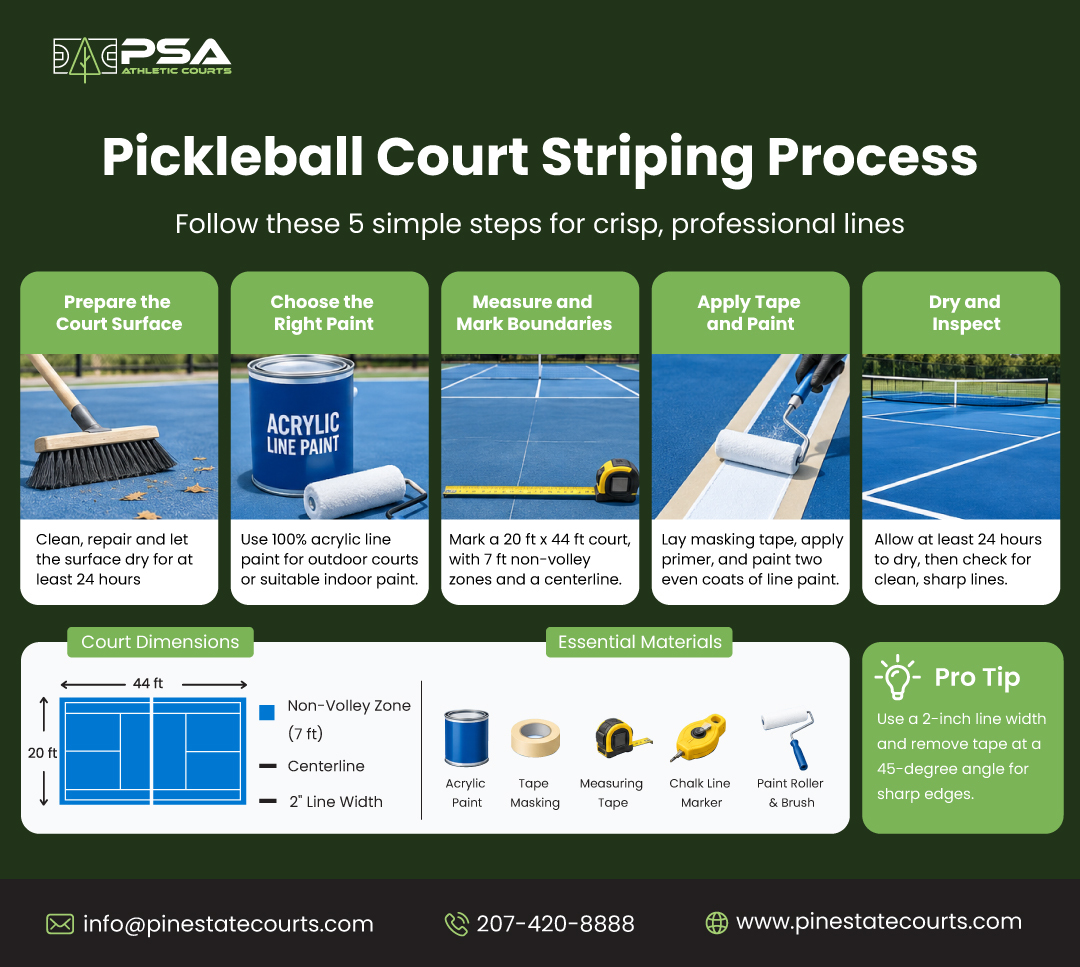
Step 4 - Apply the Masking Tape and Court Paint
Lay down two parallel strips of a masking tape exactly 2 inches apart along your chalk lines and press the edges down firmly. Apply a thin coat of clear acrylic primer inside the taped lines to prevent the paint from bleeding into surface grooves.
Apply two coats of line paint, allowing each to dry, and then carefully peel back the masking tape at a 45-degree angle so the edges stay sharp without chipping.
Step 4 - Allow the Paint to Dry and Do a Final Inspection
Give the fresh lines adequate cure time (at least 24 hours) before opening the court to foot traffic and ball play. Walk the perimeter to check for any paint bleed, missed spots, or stray tape fragments, you can use a small detail brush for quick touch-ups.
Striping New Courts vs Restriping Existing Courts
Striping a new pickleball court is a more straightforward process as you can plan the layout from the beginning. Restriping an existing court however, requires a closer assessment.
If the existing surface is cracked or deteriorating, simply painting over it will not solve the underlying problem. You need to address the surface issues first, it may require pickleball court repair or a full resurfacing, to ensure a clean and professional look.
Check out our guide to Pickleball Court Resurfacing to learn more about the signs for resurfacing, its process, and the resurfacing costs.
Common Pickleball Striping Mistakes
Small mistakes during striping can affect how your pickleball court looks and performs. Some common pickleball court striping mistakes include:
- Skipping surface preparation - Dust, moisture, and loose coatings can lead to poor adhesion and premature peeling.
- Incorrect measurements - Poorly positioned lines create inaccurate service areas and court boundaries.
- Inconsistent line widths - Uneven markings can affect their visibility and make the court look unprofessional.
- Poor colour contrast - Lines that blend into the playing surface are difficult to follow during fast rallies.
- Using unsuitable paint - Ordinary paints may not adhere properly or provide the texture required for athletic surfaces.
- Painting in unsuitable weather - Rain, low temperatures or excessive moisture can interfere with drying and curing.
Pickleball Court Striping Cost Factors
The cost of a pickleball court striping project depends on factors like the size of your pickleball court (single vs multiple courts), the condition of the playing surface, and the amount of preparation required prior to painting lines.
The type of acrylic line paint, primers, and other materials you select can also affect the project cost along with the labour costs in your area. Therefore, when you’re budgeting for this project, consider the condition of the entire court rather than just line painting alone.
Pickleball Court Striping in Maine and New England
Outdoor pickleball courts in Maine and across New England experience changing weather conditions throughout the year. Rain, humidity, temperature fluctuations and winter freeze-thaw cycles can affect court surfaces and the longevity of painted markings.
For facility owners, choosing suitable materials and planning the work around seasonal conditions are important parts of maintaining clear, durable lines.
Managing Moisture and Freeze-Thaw Conditions
Outdoor courts face the brunt of rain and snow directly, and painting over a damp surface can interfere with adhesion. Also, water entering any existing cracks on the surface can contribute to further deterioration during freeze-thaw cycles.
So, before striping, inspect the court for cracks, standing water, and drainage problems, and complete the necessary repairs before applying new coatings. Make sure to plan your outdoor striping projects around suitable weather windows.
Choosing Materials for Seasonal Durability
As outdoor court markings need to withstand regular play and exposure to the elements, you should choose compatible acrylic line paints and primers. Follow the manufacturer’s recommendations for application temperature and curing, and make sure the product offers resistance to regular wear and outdoor exposure.
Regular inspections after winter can also help to identify fading, peeling or surface damage before the playing season gets started.
Get Professional Pickleball Court Striping From Pine State Courts
Clear and accurately positioned court lines can make a difference to how the players use your facility. Beyond enhancing the professional look they also ensure player performance and safety.
At Pine State Courts, we understand the practical requirements of building and maintaining sports facilities in Maine and across New England. From court preparation to surface finishes and striping, our team can help you plan a court that meets your facility's needs. Contact Pine State Courts to discuss your pickleball court project.
Frequently Asked Questions
1. How much does it cost to get a pickleball court painted?
The cost for getting a pickleball court painted professionally can be anywhere $4,000-$7500 depending on the size of your court, the painting materials you choose, and the extent of preparation work required for your court surface.
2. How to paint lines for a pickleball court?
To paint clean and accurate lines for a pickleball court, you should start by ensuring the surface is clean and dry, then measure the court dimensions carefully and mask the chalked lines. Apply a suitable primer and paint next, and allow it to touch dry and then remove the masking tape.
3. How wide are the painted lines on a pickleball court?
The painted lines on a pickleball court should be 2 inches wide as per the USA Pickleball guidelines.
4. What paint do you use for pickleball courts?
For outdoor courts, 100% acrylic athletic paint is preferred for its durability while water-based floor paint is used for indoor hardwood floors.
5. What is the best color for a pickleball court?
The best color for a pickleball court is the one that balances ball visibility, glare reduction, and heat absorption (for outdoor courts). The classic combination is a blue playing surface paired with a green or gray out-of-bounds area.
6. How often should pickleball court lines be repainted?
Pickleball court lines should be repainted every 4 to 8 years, depending on the usage level, weather conditions, and the surface conditions. This timeline often coincides with the pickleball court resurfacing cycles.
7. Can you stripe pickleball lines on a tennis court?
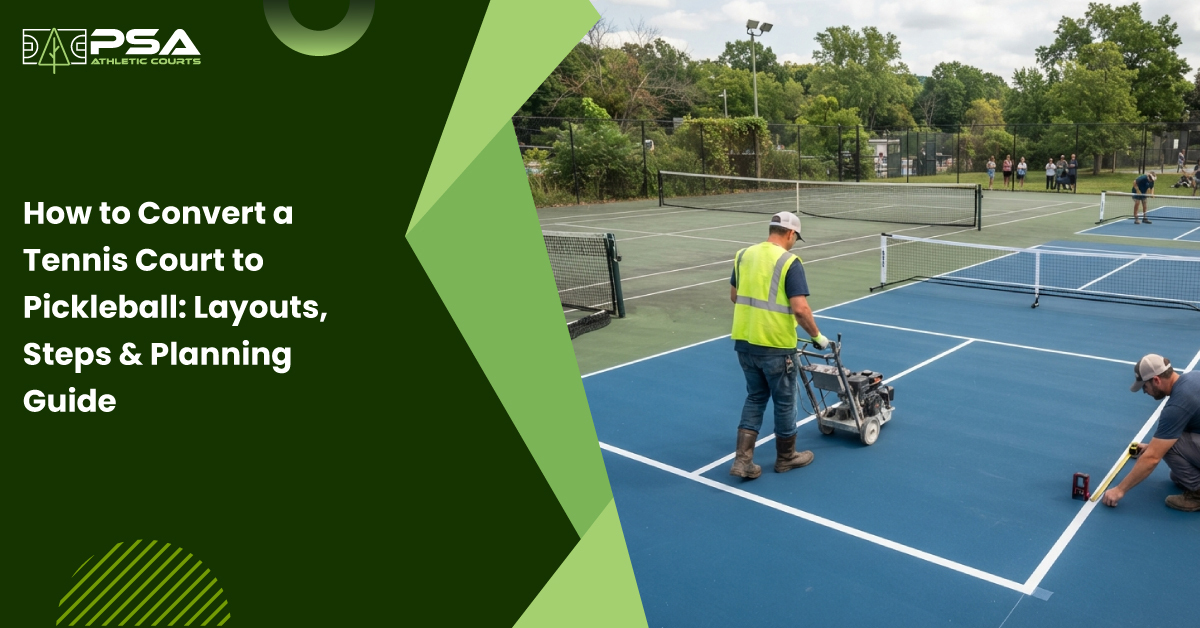
Yes, you can stripe pickleball lines on a tennis court. With portable nets, these blended lines will allow players to play both pickleball and tennis.