For facility owners looking to make better use of their existing court space, a project to convert tennis court to pickleball court, can be a practical way to accommodate the growing demand without starting from the ground up.
But before you start this tennis court to pickleball conversion project, it’s worth looking beyond the court markings. You need to consider other factors like the available space, court orientation, surface condition, fencing, and player movement for it to work well.
In this Pine State Courts’ guide, we’ll cover “how to convert a tennis court to pickleball” through different layout options, conversion steps, and key considerations to help you plan this project with confidence.
How to Convert a Tennis Court to Pickleball?
A full tennis court with surrounding clearance measures 60 x 120 ft, while a regulation pickleball court measures 20 ft by 44 ft. This allows you to convert a tennis court into one central pickleball court, or two side-by-side courts (positioned parallel to the tennis net), and up to four multi-courts (arranged in a 2x2 grid).
You can choose either of these three, tennis court to pickleball conversion layouts, depending on whether you want to preserve tennis play or maximise the player capacity for your facility.
Why Convert a Tennis Court to Pickleball?
Tennis court to pickleball conversion provides a great opportunity to utilise your underused spaces to increase facility traffic and revenue.
The benefits of this project to convert tennis court to pickleball court includes:
- Effective utilization of space as up to 4 pickleball courts can fit inside the layout of 1 tennis court.
- Increase facility revenue and court usage with maximum utility of the available space.
- Meet the increasing demand for pickleball courts in public parks, clubs, and municipalities.
- Revitalises tennis courts that receive low traffic and turn them into active community hubs.
- Converting a tennis court to a pickleball court is highly cost-effective as compared to building pickleball courts from the ground up.
- Pickleball appeals to a broader demographic of players with its smaller court size, underhand serve, and slower ball speed.
How Many Pickleball Courts Can Fit on a Tennis Court?
You can fit one, two, or four regulation pickleball courts onto a single standard tennis court. A regulation tennis court playing area measures 36 ft by 78 ft, while the full fenced court with run-off space typically spans 60 ft by 120 ft.
And a standard pickleball court requires a playing area of 20 ft by 44 ft. So, the final count of pickleball courts that you can add in a tennis court depends on whether you want to preserve tennis play or maximise the player capacity.
Single-Court Conversion Layout
In a single court conversion layout, you can line a single pickleball court directly over the centre of the tennis court, using the existing tennis net as the divider. You also need to drop the net slightly to meet pickleball regulations of 34 inches (a tennis net sits at 36 inches in the centre). This is the fastest setup that leaves you with the maximum perimeter run-off.
Two-Court Conversion Layout
Placing two pickleball courts on one tennis court is the preferred method for many clubs and schools. This layout utilises each half of the tennis court to accommodate one pickleball court positioned crosswise (parallel to the tennis net).
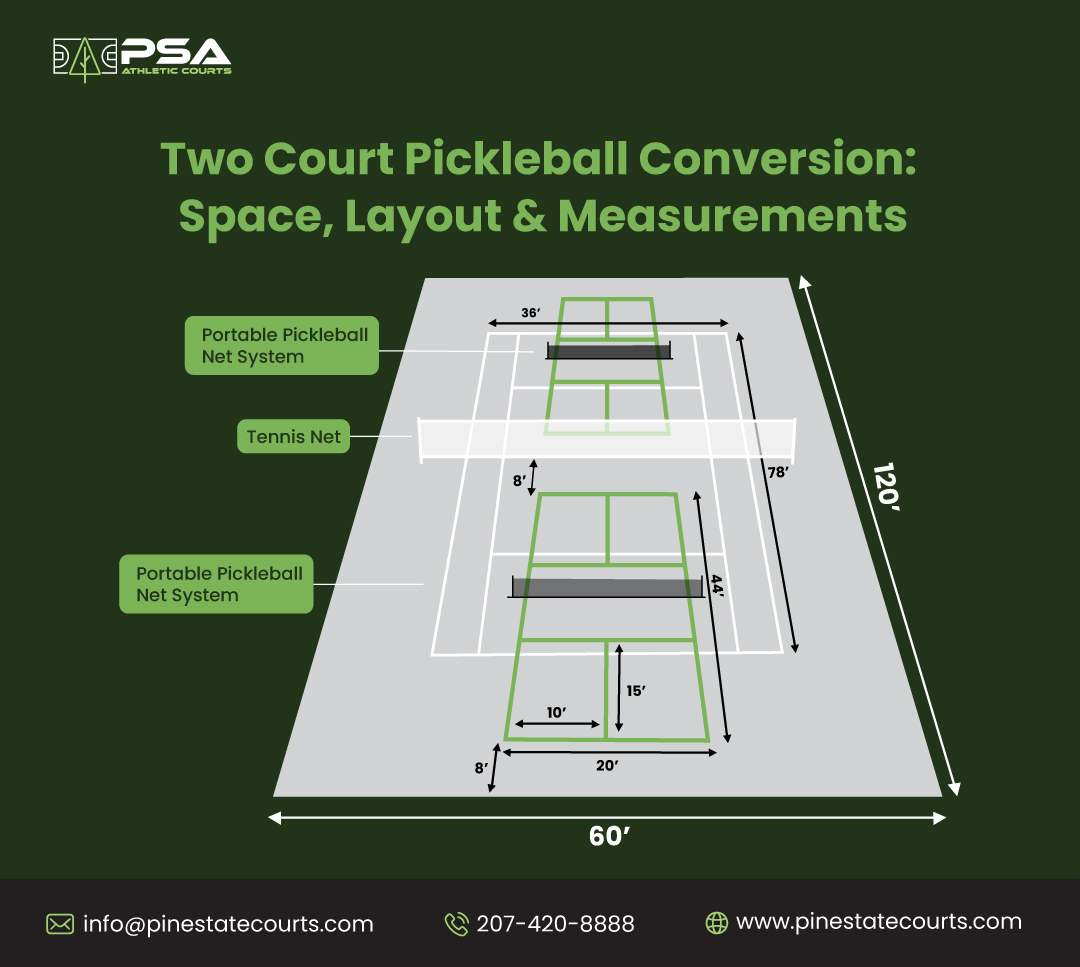
This allows you to keep your tennis active alongside pickleball by painting pickleball lines in a contrasting colour over the existing surface and using portable nets.
Four-Court Conversion Layouts
A full 60 x 120 ft tennis court can be divided into a 2-by-2 grid, placing two pickleball courts on each side of the original tennis net line. Each 20 x 44 ft pickleball court will fit inside a 30 x 60 ft footprint.
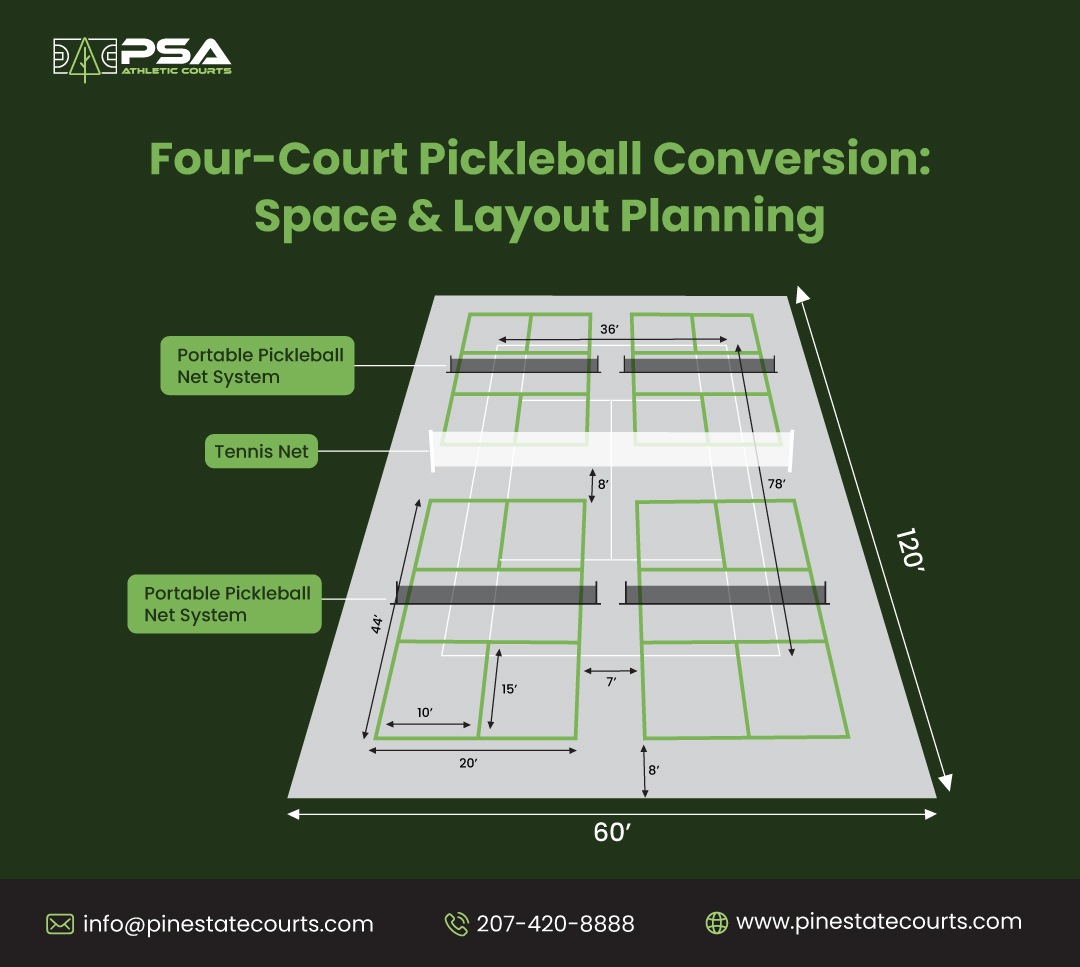
For this four-court tennis court to pickleball conversion layout, you also need to remove the original tennis net and posts permanently.
Steps to Convert a Tennis Court to Pickleball
Converting an existing tennis court into pickleball requires careful planning. You need to assess the playing surface, confirm the layout, and ensure the equipment meets pickleball requirements.
The steps below outline the entire process of tennis court to pickleball conversion to help you create a safe and functional court.
1. Evaluate the Existing Tennis Court
Start by inspecting your tennis court for cracks, uneven areas, surface wear, and drainage issues. These can affect ball bounce, player footing, and overall safety. Also, you need to measure the entire available playing area including the surrounding clearance. This will help you determine how many pickleball courts you can fit comfortably in the layout of your tennis court.
2. Prepare the Surface for Conversion
Address any surface damage before applying new court markings. Minor cracks and uneven areas may require patching, while extensive wear would require tennis court resurfacing. You should also check whether the existing asphalt or concrete base provides adequate traction and consistent ball bounce.
3. Choose the Right Pickleball Court Layout
The next step is to decide how many pickleball courts can be accommodated in the existing tennis court, based on its dimensions and available clearance. A single-court layout may suit dedicated play, while two or four-court arrangements can increase playing capacity. Also, consider whether the facility needs permanent pickleball courts or you want a dual-use setup that retains tennis.
4. Plan Pickleball Court Line Markings
Accurate line marking is essential for consistent gameplay. According to USA Pickleball, a standard pickleball court measures 20 ft × 44 ft, including boundary lines. Mark the baselines, sidelines, centreline, and non-volley zones on either side of the net. Use a contrasting colour to distinguish pickleball markings from existing tennis lines. This is especially important if you plan to accommodate both sports.
For more detailed information on the pickleball court layout, check out our guide on “How Big Is a Pickleball Court?”
5. Adjust Nets and Court Equipment
Pickleball nets measure 36 inches high at the sidelines and 34 inches at the centre, so you’ll need to adjust or replace existing tennis nets. You can install permanent net systems or use portable nets for shared courts depending on the layout you choose.
Permanent vs. Temporary Tennis Court Conversion
Not every facility needs a permanent pickleball setup. Your choice between a permanent, temporary, or shared-use conversion depends on how frequently the courts will be used, whether you still want to play tennis, and how much flexibility you need.
Here are the three approaches that you can consider:
Permanent Pickleball Court Conversion
A permanent conversion is suitable for facilities planning to dedicate their existing tennis court space to pickleball. This involves applying permanent pickleball line markings, installing fixed net systems, and removing/ modifying tennis equipment where necessary. This option works well for clubs, schools, and recreation centres expecting consistent pickleball use.
Temporary Pickleball Court Conversion
If you want to introduce pickleball without making permanent changes to your tennis court, a temporary setup is worth considering. You can use portable pickleball nets and removable court-marking materials to convert the space when needed and return it to tennis use afterwards.
Dual-Line (Shared-Use) Courts
Dual-line courts can accommodate both tennis and pickleball on the same playing surface. This involves retaining the existing tennis markings while adding pickleball lines in a contrasting colour, and using portable nets or adjustable net systems. This is a practical option for schools, community centres, and multi-athletic facilities.
Common Mistakes to Avoid When Converting Tennis Courts
Converting a tennis court without considering the practical requirements can lead to layout issues, unnecessary costs, and player safety concerns. Here are some common mistakes facility owners should avoid:
- Ignoring surrounding clearance - Just fitting pickleball court markings into the tennis court dimensions isn’t enough, you need to account for run-off space around each court.
- Overlooking surface damage - Painting new lines over cracked or uneven surfaces can affect the ball bounce and player footing. You should address the repairs before starting the conversion.
- Using confusing line colours - Closely matching tennis and pickleball markings can make it difficult for players to identify boundaries. Choose contrasting colours for shared-use courts.
- Incorrect net height - Tennis nets are higher than pickleball nets at the centre. Make sure the new setup meets official pickleball net specifications.
- Poor drainage planning - Existing drainage problems can affect your court usability and accelerate surface deterioration. Check for water pooling before proceeding
Is Your Tennis Court Ready for Pickleball Conversion?
Before committing to the project to convert the tennis court to a pickleball court, assess whether your existing tennis court can accommodate pickleball safely and efficiently. You should consider factors like the tennis and pickleball court dimensions, the existing surface’s condition, drainage, fencing and access, and future facility use.
Evaluating these factors early can help you determine the scope of work required and avoid any unexpected changes during construction.
Get Professional Help With Your Tennis Court Conversion
Converting a tennis court into pickleball courts requires careful planning, accurate measurements, and the right surface preparation. Whether you're considering a single-court setup, or a two/four-court layout, working with an experienced court contractor can help you make the most of your available space.
At Pine State Courts, we help schools, sports facilities, and recreational centres plan and build quality athletic courts. From evaluating existing surfaces to planning court layouts and line markings, our team helps you approach the entire tennis court conversion with confidence. Contact Pine State Courts to discuss your pickleball court conversion project.
Frequently Asked Questions
1. How much does it cost to convert a tennis court to a pickleball court?
Converting a tennis court to pickleball can cost you anywhere from $1,500 to $50,000, depending on whether you are just adding line markings or undertaking a full conversion project.
2. Can you play pickleball on a tennis court without converting it?
Yes, you can play pickleball on a tennis court without converting it by using a temporary chalk, or court markers to outline the pickleball court inside the tennis court layout and using a portable net.
3. Does a pickleball court add value to a house?
A pickleball court can add value to your house by appealing to buyers who play the sport or love doing outdoor activities.
4. Can a tennis court be used for both tennis and pickleball?
Yes, a tennis court can be used for both tennis and pickleball as a full 60 x 120 ft tennis court can easily fit two pickleball courts side-by-side or on opposite sides of the tennis net without taking it down. Or you can also fit 4 pickleball courts by removing the tennis nets.