
With over 100,000 active players nationwide, the popularity of padel has surely skyrocketed in the U.S. Facility owners are also riding this wave as over 1000 padel courts have been constructed across 31 states.
If you too are planning to build a padel court for your sports facility, school, or community center then it is vital to begin with an understanding of how big a padel court is.
In this guide by Pine State Courts, we will discuss everything about the official padel court dimensions and other planning requirements that you must know before building a court. But first let’s start with the basic question.
What Is the Standard Size of a Padel Court?
The International Padel Federation (FIP) is the official authority for padel courts. It has laid out that a standard padel court should be 65.6 ft long and 32.8 ft wide.
A tolerance of 0.5% in padel court dimensions is also allowed for competitive play. While courts that don’t meet these dimensions can still be used for casual play, it is generally recommended to play in a regulation-sized court if you are training for a match.
Understanding Every Section of the Court
The court size we discussed above is made of different sections that define the playing field of this doubles sport. A padel court consists of:
Court Lines
A padel court is divided into two equal parts by a net placed at the center. The service line is placed 22.8 ft away from the net on both sides of the court.
A central line running perpendicular to the service line divides the area between the net and service line into two equal service boxes. All these court lines are two inches wide and in a color that contrasts the court surface, preferably white or black.
Net dimensions
The net spans the entire width (32.8 ft) of the court and has a height of 3 ft at the posts and 2.9 ft in the center. It is suspended by a metal cable which is not more than 0.03 inches thick.
Court enclosures
The entire padel court is enclosed. The back walls are 13.1 ft high with the lower 9.9 ft made of any solid material (glass, brick, etc.) and the top 3.3 ft is a metal mesh.
The FIP allows two variations for side walls:
- A stepped down structure - the first 6.6 ft from the back wall are 13.1 ft high (9.9 ft glass + 3.3 metal mesh). The remaining drops to 9.9 ft (either all glass or a mix of glass and mesh).
- A straight even structure - similar to the back walls, the 13.1ft high side walls are made with lower 9.9 ft made of glass/ brick and top 3.3 ft of metal mesh.
Space Needed Beyond the Court Dimensions
Beyond the standard padel court dimensions in feet which is 65.6 ft X 32.8 ft, you should also consider additional space clearance. This extra space accounts for safe play, court entrance, and exterior glass wall mounts.
With this, the total recommended size of a padel court comes to be 72 ft X 39 ft. For facility owners, beyond the court an extra 9.9 ft - 16.4 ft space is recommended for player benches, spectator seating, and walkways.
Working with an expert padel court designer ensures that your court meets these regulatory standards, while still maximizing the utility of your space.
Indoor Padel Court Requirements
Building an indoor padel court offers year-round playability and protection from weather conditions, but it also comes with specific facility requirements. These include:
Ceiling Height
The indoor space must have a vertical clearance of 19.7 ft, however if you are building a new court, the FIP recommended clearance is 26.2 ft.
Lighting Requirements
Indoor courts require consistent, shadow-free lighting. The LED lights should be at least 300 lux (27.9 foot-candles) for casual play and 500 lux (46.5 foot-candles) for professional play.
Ventilation and Climate Control
Proper airflow is essential for player comfort and court longevity. Investing in HVAC systems is essential to regulate temperature, control humidity indoors, and prevent condensation on glass walls and court surfaces.
Flooring and Drainage Considerations
Although indoor courts are protected from rain, subfloor drainage and moisture control is important to prevent the court surface from damage and maintain consistent playing conditions.
Outdoor Padel Court Planning Guide
Outdoor padel courts can be a valuable addition to sports complexes, schools, and community recreation areas. However, environmental factors play a major role in the performance and durability of these courts.
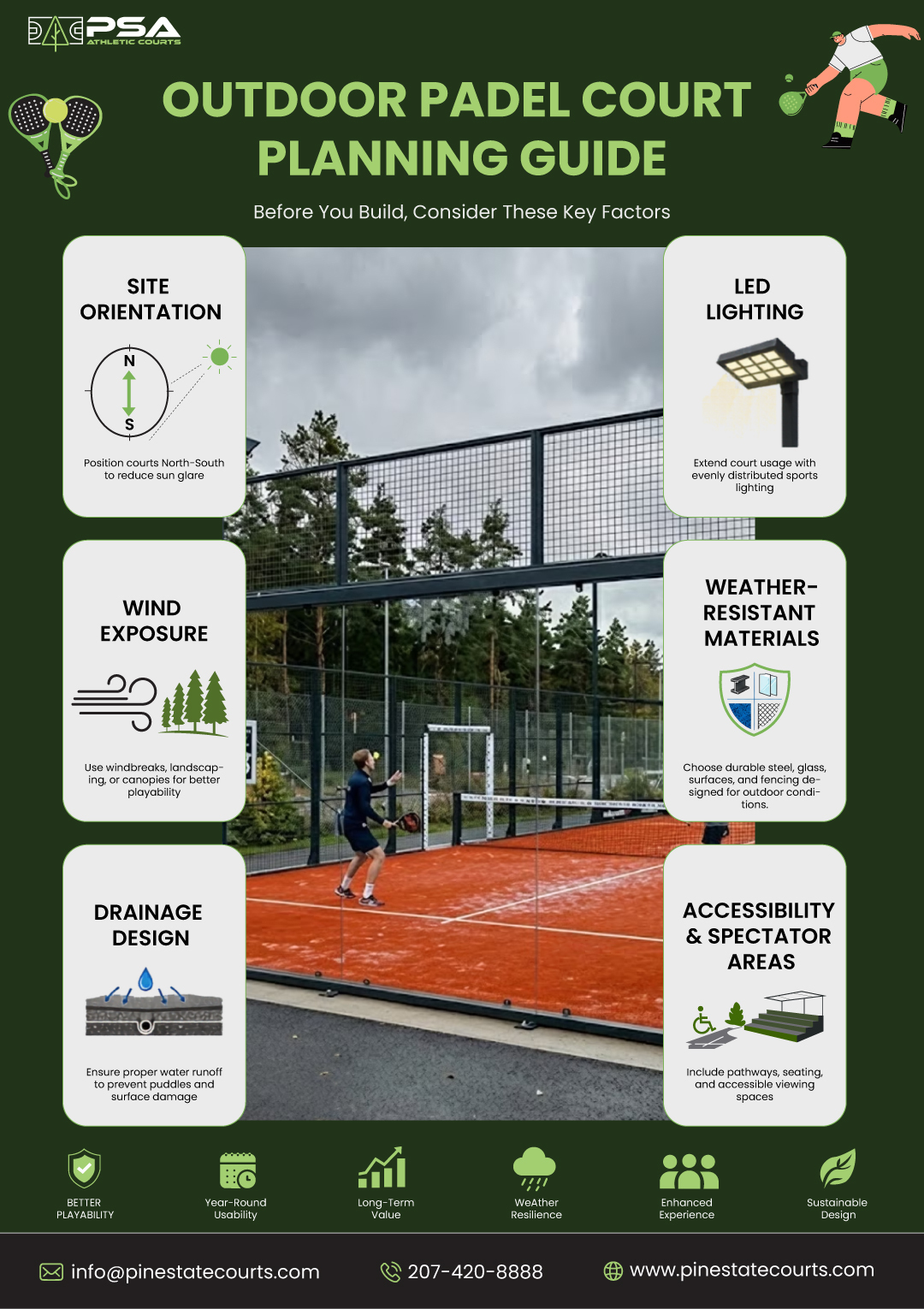
Here’s a list of factors that you should consider before building an outdoor court:
1. Site Orientation
Outdoor padel courts should be oriented North-South to minimize Sun glare during morning and evening play. This way players will have a better playing experience throughout the day.
2. Wind Exposure
Strong winds can affect the gameplay significantly. You can install windbreak fencing, landscaping barriers, or build canopies to improve playability.
3. Drainage Design
Proper drainage is one of the most important aspects of outdoor court construction. The surrounding area should be graded to direct water away from the court and prevent standing water after rain.
4. Lighting for Extended Play
To maximize your facility’s use, install LED sports lighting. Proper lighting placement ensures even visibility for players without glare.
5. Weather-Resistant Materials
Outdoor courts are frequently exposed to external elements. Using corrosion-resistant steel structures, durable glass panels, UV-resistant surface systems, and weatherproof fencing protects your court and boosts its longevity.
6. Accessibility and Spectator Areas
Plan for pathways, seating, viewing areas, and ADA-compliant access routes in advance. This additional space around the court improves safety, traffic flow, and the overall experience for players and spectators.
For a detailed breakdown, you can also check our padel court construction guide.
How Padel Court Dimensions Compare to Tennis Courts
A standard padel court is considerably smaller than a tennis court. A singles tennis court measures 78 ft by 27 ft and doubles court is 78 ft long and 36 ft wide. This size difference means you can fit two to three padel courts in the space of a tennis court.
This makes padel an attractive option for sports clubs, schools, and recreation centers who are looking to increase their court capacity. Beyond size, the two sports differ significantly in their court design.
Tennis is played on an open court, whereas padel courts are fully enclosed with glass walls and metal mesh fencing. Since players can use the walls during play, rallies in padel tend to be longer and more strategic, this creates a fast-paced and engaging experience for players of all skill levels.
Planning to convert your tennis court into a padel court? Contact Pine State Courts and discover what’s possible for your facility.
Can You Build a Padel Court at Home?
The compact size of a padel court means that you can easily build one in your home. Homeowners should plan for a minimum area of approximately 72 ft by 39 ft which includes the court and additional space for safety clearances, access points, and structural supports.
But before you start construction, it's important to evaluate your site for drainage, surface grading, local zoning requirements, and available overhead clearance. You should also consider additional features like lighting, fencing, spectator space, and landscaping to create a court that’s not only functional but visually appealing too.
Working with an experienced court builder ensures that your construction project meets regulation standards, maximizes your available space, and is built for long-term durability.
Key Construction Factors that Affect Padel Court Layout
While the official dimensions of a padel court makes the foundation of this project, there are several other construction factors that you should consider too. These can influence your final court layout and overall functionality of your facility.
These factors include:
Site Conditions
The available land, slope, soil stability, and drainage capabilities of your site can impact the court’s placement and construction requirements. A thorough site assessment is essential to identify potential challenges before your project begins.
Court Orientation
For outdoor courts, a North-South orientation is generally recommended to reduce sun glare and improve visibility for players throughout the day.
Access and Circulation
Players, spectators, and maintenance staff need safe and convenient access to the court. Plan in advance for walkways, entrances, seating areas, and equipment storage to improve the overall experience.
Placement of Lighting
Whether you build an indoor or outdoor court, lighting systems must be installed to provide even illumination. The light placement matters to avoid shadows or obstructing gameplay.
Future Expansion Plans
While designing the court layout it is always wise to keep future growth in mind. By leaving room for additional courts, spectator areas, or amenities, you can make future expansions easier and more cost-effective.
Common Design Mistakes to Avoid
Even if your court meets the FIP dimensions, certain planning mistakes can still negatively impact the playability, safety, and long-term maintenance of your court. Here are some common mistakes that you should avoid:
- Failing to provide adequate space around the playing area can create safety concerns and restrict movement of players.
- Poor drainage can lead to standing water, surface damage, and increase maintenance costs, especially for outdoor courts.
- Improper court alignment can expose players to excessive sunlight or wind, affecting both comfort and gameplay.
- Inadequate lighting may limit the use of your court during evenings and reduce visibility during competitive play.
- Not building your court to official standards can limit its suitability for competitive play and reduce your facility’s long-term value.
Takeaway
Building a pedal court often starts with a simple question - how big is a padel court? While a standard padel court measures 65.6 ft by 32.8 ft, beyond these padel court dimensions, other factors like site conditions, court orientation, drainage, and additional space clearance are vital too.
They facilitate comfortable, safe play and long term durability of your court. So whether you're planning an indoor or outdoor padel court, working with an experienced padel court builder is vital for your project’s success and the long term value of your facility.
At Pine State Courts, we can help you create a facility that meets official standards while maximizing the use of your available space. From new court construction to ongoing maintenance and resurfacing, our team provides end-to-end solutions tailored to your needs.
Frequently Asked Questions
1. How big is an official padel court?
An official padel court is 65.6 ft long and 32.8 ft wide. This space includes the playing field enclosed by glass walls and wire mesh, and a net at the center.
2. How much space is needed to build a padel court?
To build a padel court, in addition to the court that’s 65.6 ft long and 32.8 ft wide, you need to leave additional space for court entrance, lighting systems, and walkways. This makes the total space needed to build a padel court 72 ft long and 39 ft wide.
3. What planning do I need for a padel court?
Construction of a padel court requires planning for the local zoning and building permits, spatial dimensions, and site preparation. Working with a local court contractor makes it easy to meet these regulations.
4. How much does it cost to build a padel court in the USA ?
Padel court construction costs can vary in the U.S. depending on several factors like location, court type (indoor vs outdoors) court materials, and other additional features like lighting and seating.
5. What are the wall requirements for padel courts?
A padel court is surrounded by walls on all sides. The dimensions of back walls and side walls are:
- The back walls are 13.1 ft high with the lower 9.9 ft made of any solid material (glass, brick, etc.) and 3.3 ft high metal mesh on top.
- The side walls can have a staggered height with the first 6.6 ft from the back wall being 13.1 ft high (9.9 ft glass + 3.3 metal mesh) and remaining length being 9.9 ft high (either all glass/ glass + metal mesh).
- Another option for side walls is a uniform height of 13.1 ft, of which 9.9 ft is made of glass/ brick and 3.3 ft made of metal mesh.
6. Do you need planning permission to build a padel court?
Yes, you do need planning permission to build a padel court whether it’s for your commercial club or residential space. This includes planning permissions or building permits, and meeting noise and lighting regulations.
7. Does court orientation matter in padel court planning?
Yes, court orientation matters in padel court planning. A court oriented in North-South direction will protect the players from Sun glare and provide better playing experience throughout the day.
DOWNLOAD OUR FREE GUIDE
Ready to build your dream court?
Download our FREE Basketball Court Construction & Planning Checklist and get the step-by-step roadmap to building a professional-grade court—from budget planning to final touches.
No guesswork, just results.