
Basketball court dimensions in the U.S. vary depending on the level of play and the court’s intended use. From professional play in the NBA, NCAA, or high school to recreational, and backyard basketball courts, their size requirements can be quite different.
That’s why for any homeowner, school, athletic facility, and community organization planning to build a basketball court, knowing how big a basketball court in the US is, is an important first step. This will allow you to not only build a regulation basketball court but ensure you’re making the best use of your available space.
This guide by Pine State Courts will explain the standard basketball court size in the U.S. including NBA, NCAA, and high school courts. We’ll also share some practical design tips from our professional basketball court builders that you can use in your project.
Standard U.S. Basketball Court Dimensions (Quick Size Overview)
A basketball court built according to NBA and NCAA regulations measures 94 feet long and 50 feet wide, which equals about 4,700 square feet of playing area. These courts are used for professional leagues and college games.
However, not every court follows the same dimensions. Youth leagues, high schools, and residential courts often use slightly different sizes depending on the level of play and available space.
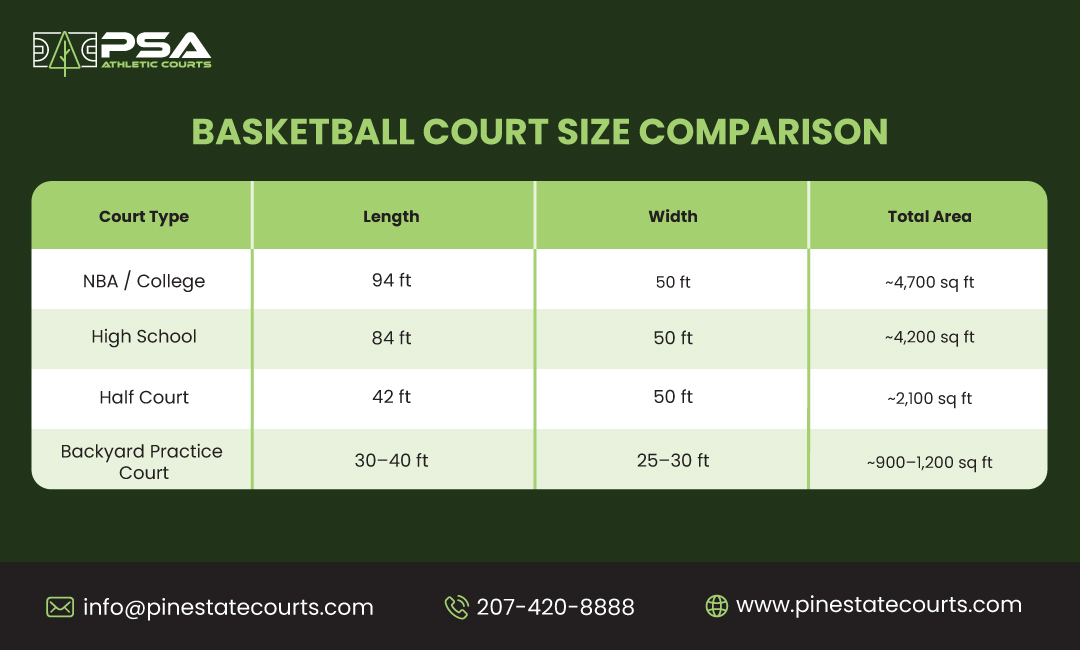
These measurements represent the playing surface, but real courts usually require additional space for safety areas, fencing, and walkways.
How Big Is a High School Basketball Court?
If you’re wondering how big a high school basketball court is, the standard size is 84 feet long by 50 feet wide.
High school courts are slightly shorter than professional courts but maintain the same width. This design keeps the game fast-paced while making it easier to fit courts inside school gyms.
Many school districts and recreational facilities choose this size because it balances:
- Realistic game play
- Efficient use of space
- Lower construction costs as compared to full professional courts
For facilities planning competitive play or tournaments, following high school dimensions is often the most practical choice.
How Big Is a Half Court Basketball Court?
Half courts are extremely popular for residential and training purposes. To answer your question “how big is a half court basketball court” a commonly used half-court layout measures about 50 feet by 42 feet, though backyard courts are often customized..
Some common sizes customized depending on the space available, include:
- Regulation half court - 50 by 42 ft.
- Compact half court - 45 by 35 ft.
- Backyard Practice Court - 30 by 30 ft.
Such half courts are ideal for shooting practice, one-on-one games, youth training, and smaller residential spaces. Also, as these half courts require less land and lower construction costs, they are one of the most popular choices for installing basketball courts in private spaces.
Why Court Size Is More Than Just Measurements
When planning a basketball court, the dimensions form only a part of the design process. Professional basketball court designers look at several other factors that affect how the court functions and feels during play.
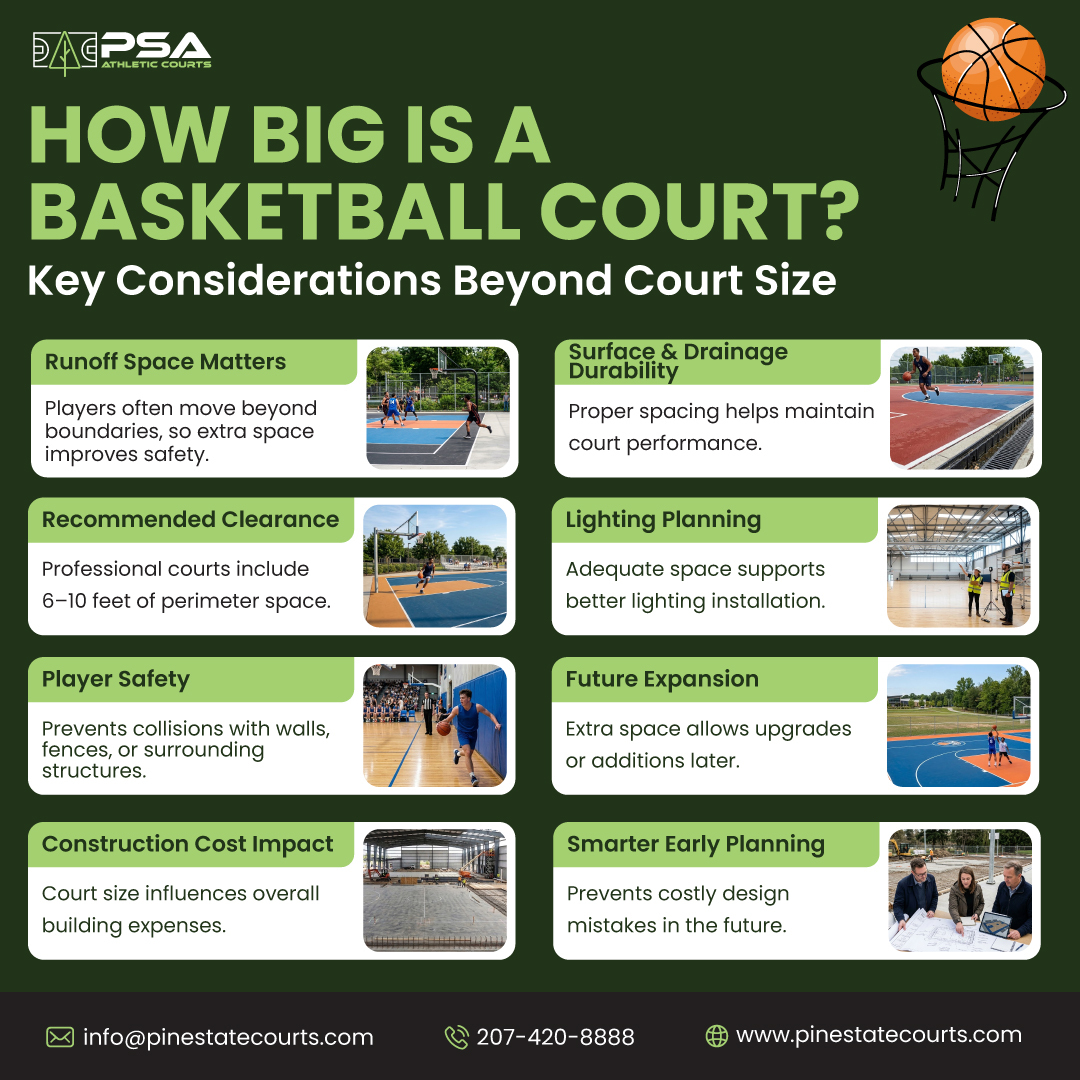
For example, players frequently move beyond the sidelines and baselines during games, so courts require considerations for runoff space and extra room surrounding the playing area to prevent injuries.
Most professionally designed courts hence include 6 to 10 feet of clearance around the perimeter. This extra space allows players to chase loose balls safely without running into walls, fences, or landscaping.
The court size decisions also affect:
- The cost of construction
- Durability of drainage and surface
- Lighting installation
- Future possibilities for expansion
Taking these elements into account early can prevent expensive design mistakes later.
Define the Purpose of Your Court Before Choosing the Size
Before deciding on dimensions, another factor that you must consider is how the court will be used, find the perfect court size by exploring this complete basketball court dimensions guide. Different playing environments require different basketball court layouts. Let’s discuss this further:
Residential Backyard Courts
Backyard courts are usually designed with space efficiency in mind. Many homeowners choose half courts or compact practice courts that provide plenty of playing opportunities without overwhelming their property.
Typical residential court sizes include:
- A shooting lane measures around 30 by 30 ft.
- A compact half-court for backyard measures 40 by 30 ft.
- A full, professional half-court measures 50 by 42 ft.
These backyard court designs work well for family games, developing skills among players, and casual recreation. Explore this detailed backyard basketball court size guide to choose the right dimensions and make a better decision for your space.
Schools and Educational Facilities
Schools generally require courts that support organized games and physical education programs. High school-size courts are often the standard because they accommodate competitive play while fitting inside the typical layout of a gymnasium.
These sports facilities may also include additional space for:
- Spectator seating
- Team benches
- Equipment storage
- Scoreboards and lighting
Proper planning here ensures that the court meets your athletic program needs for many years. You can contact Pine State Courts to build professional-grade courts that perform as well as they look.
Churches, HOAs & Community Spaces
Community courts often serve multiple purposes from a playing surface to a yoga or fitness training session, so flexibility becomes a priority. Many organizations install multi-use courts for this purpose so the courts support other sports such as pickleball or volleyball along with basketball.
These courts typically use modified dimensions to allow multiple activities within the same space while keeping the construction costs manageable.
Evaluate Your Property Before Choosing Court Size
Even if you know the ideal court dimensions, it is your property that influences what’s realistically possible for your space. Evaluating the site carefully is important to avoid costly adjustments later. Here’s what you should discuss with your basketball court builder:
Available Land Area
One of the first considerations when building a court is, how much of your property space is actually available for construction. Based on this you can decide which court to build, let’s simplify this:

The larger measurements mentioned in this table account for safety areas surrounding the court.
Safety Space for Runoff
As we discussed earlier, leaving adequate clearance around the court is one of the most important design factors not just for playability but for the safety of your players too.
Professional court installations typically include a space of:
- 6-10 feet beyond the sidelines
- 8-10 feet behind the baselines
Without this space, players risk colliding with fences, walls, or landscaping features during fast-paced play.
Drainage and Surface Slope
Outdoor basketball courts must also be designed to handle rainwater effectively. Builders usually incorporate a slight slope (about 1%) to direct water away from the playing surface.
Good drainage prevents puddles, protects court coatings, and helps extend the lifespan of the surface.
If you are noticing too many waterpooling issues in your court, it’s time to evaluate your need for basketball court resurfacing.
Choosing the Right Court Size Based on Use
Besides property considerations, different players and programs too require different types of courts. Understanding the main categories of courts usage can help you select the right option for you.
Let’s discuss this further:
1. Training-Focused Layout
Training courts are designed for developing skills of your players rather than hosting full games. These setups lay strong emphasis on shooting, ball handling, and footwork drills, etc.
Common sizes for training courts include:
- Shooting lane: usually 25-30 ft wide
- Practice half courts: 40-45 ft
These courts are often more affordable than professional basketball courts as they require less space and fewer materials to build.
2. Game-Play Layouts
Facilities that host organized games typically choose either a high school or full regulation court.
These court layouts provide:
- Standard game spacing
- Accurate three-point distances
- Full team play
They are common in school gyms, sports complexes, and competitive training facilities.
3. Multi-Athletic Court Designs
Many modern basketball court installations combine basketball with other sports. These multi-athletic courts maximize the value of the space by allowing different activities throughout the day.
Popular court combinations for multi-athletic courts include:
- Basketball and pickleball court
- Basketball and volleyball court
- Basketball and futsal court
Designing these courts requires careful planning so markings and dimensions work for multiple sports.
At Pine State Courts, we offer court design solutions for both professional basketball courts and multi-athletic courts. Book a site visit today.
4. Future-Proof Court Planning
Building a basketball court is a long-term investment, so it’s smart to think ahead when designing the layout. For example, some property owners build a half court initially but leave enough space to expand into a full court later. Some others install lighting systems to allow evening play or add fencing to improve safety.
Some future-proof planning that you can consider for your court include:
- Extra land for expansion
- Lighting infrastructure
- Seating or spectator areas
- Upgraded sport surfaces
Thinking about these features early can save both your time and money as your needs evolve with time.
Common Basketball Court Design Mistakes That Lead to Long-Term Regret
After all this planning, even the most well-intentioned projects can run into problems. These problems usually arise if important design details are overlooked. Here are a few mistakes that basketball court builders frequently see:
Not leaving enough space for safety
A court that fits tightly into a space may look fine on paper, but it can create safety risks during games.
Building the court too small
Most facilities build undersized courts to save space and budget, this limits game play and reduces the overall experience, especially as players improve and want more realistic dimensions.
Ignoring water drainage
Poor drainage can lead to water pooling on the court surface, causing long-term damage and slippery playing conditions.
Choosing the wrong surface for court
Outdoor courts are commonly built using concrete or asphalt bases, but surface coatings or modular sport tiles can be added to improve performance and comfort.
For a detailed input read our guide on the three basketball court surfaces that every facility director must compare.
Poor placement of the lighting setup
If night play is important for you then lighting should be planned early. Proper placement ensures even illumination across the entire court, so there are no dark zones.
Conclusion
By now you must know how big a basketball court is. You've also developed an understanding that this answer depends on the level of play and the purpose of your facility. To recap, a full professional court measures 94 by 50 feet, while a high school basketball court is 84 by 50 feet, and a half court typically measures about 42 by 50 feet.
However, choosing the right size amongst the three isn’t just about matching the official dimensions (NBA, YMCA, and NCAA). The best basketball courts are designed by keeping in mind the players who will use them, the available space, and the long-term goals of your facility.
At Pine State Courts, we consider everything from court size to safety space and future expansion opportunities to create a basketball court that delivers years of enjoyment and performance.
Frequently Asked Questions
1. What is the official size of a full basketball court?
The official size of a full basketball court is 94 ft. long by 50 ft.
2. How big should a residential backyard basketball court be?
A residential backyard basketball court should be at least 30 by 30 ft. for a half court, if you have a bigger space you can go for a full court (94 by 50 ft.) too.
3. How big is a high school basketball court?
A high school basketball court is around 84 ft. long and 50 ft. wide.
4. How big is a half court basketball court?
A half-court basketball court measures 42 ft. by 50 ft. For custom backyard half-court this size is usually 30 by 30 ft.
5. What permits are required to build a basketball court in Maine?
To build a basketball court in Maine, you need the local building or zoning permits. You may also be required to submit your site plan including lighting and fencing. You can contact your Code Enforcement Officer (CEO) to know the exact requirements.
6. How much does court size impact overall project cost?
The size of your court contributes a lot to your overall project cost. Full courts sometimes cost two to three times more than a half court construction.
7. How much extra space is needed around a basketball court for safety?
An extra space of around 6-10 feet around sidelines and 8-10 feet around baselines is required for the safety of players.
8. How big is a basketball court?
A basketball court generally measures around 94 feet by 50 feet (full court), while a half court measures 50 feet by 42 feet.
9. How big is an NBA basketball court?
An NBA basketball court is the same size as an NCAA basketball court which is 94 feet long and 50 feet wide.
10. What are the middle school basketball court dimensions?
The dimensions of a middle school basketball court are 74 feet by 42 feet.
DOWNLOAD OUR FREE GUIDE
Ready to build your dream court?
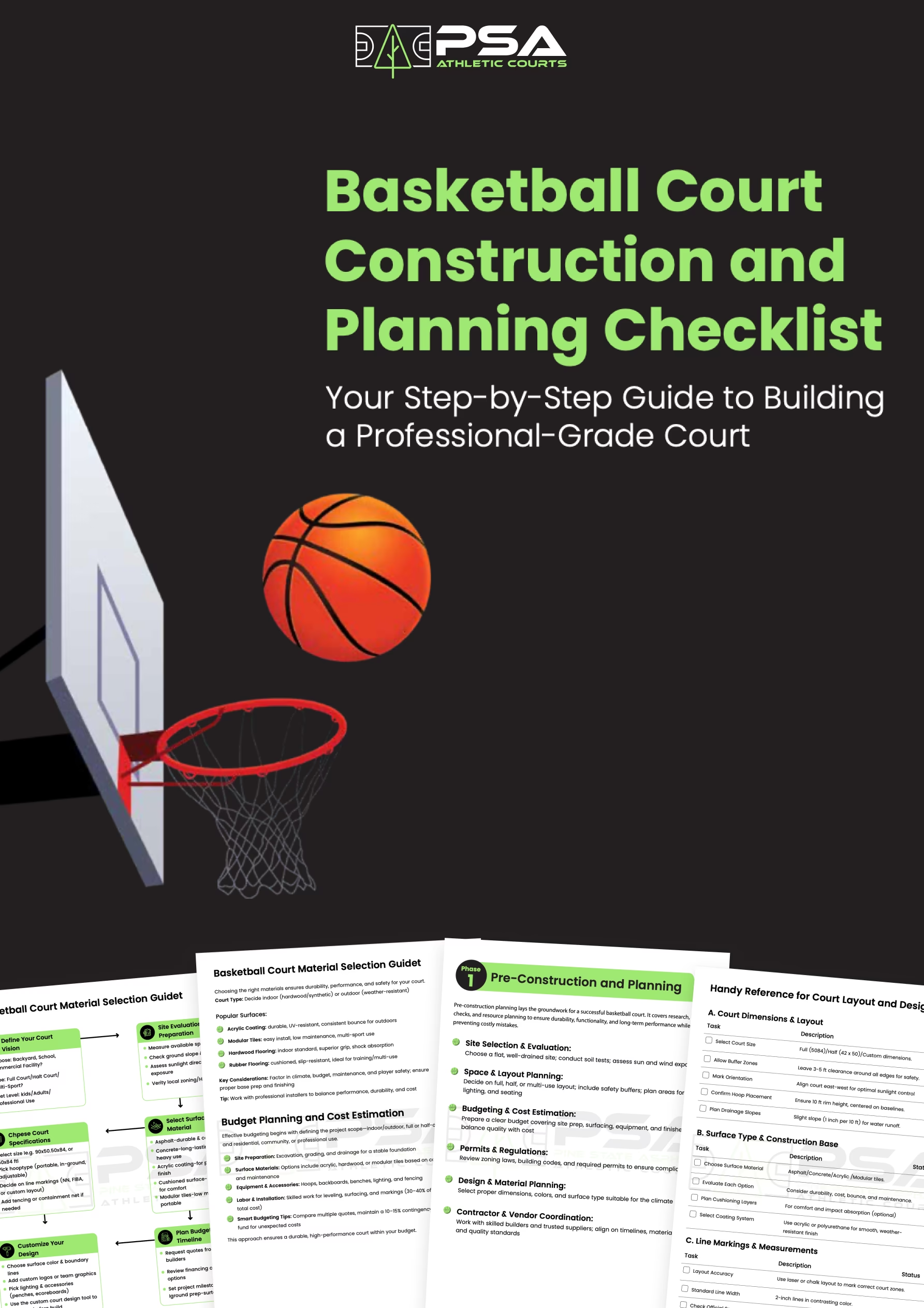
Download our FREE Basketball Court Construction & Planning Checklist and get the step-by-step roadmap to building a professional-grade court—from budget planning to final touches.
No guesswork, just results.