

Whether you manage an athletic court, a running track, or a parking area for your sports complex, the choice between commercial sealcoating and asphalt resurfacing is one that often comes up when its maintenance is considered.
Maintaining your asphalt surface isn’t just about keeping its appearance smooth and clean, it’s also about ensuring safety, performance, and long-term cost savings. The course of action you take: commercial sealcoating vs. asphalt resurfacing, can make a significant difference here.
But what exactly is the right choice? In this guide by Pine State Courts, we’ll break down how the two differ and help you make the right choice based on your court’s existing conditions and its usage.
Understanding the Difference Between Sealcoating and Asphalt Resurfacing
Facility managers often confuse commercial sealcoating with asphalt resurfacing and vice-versa as both help with the maintenance of asphalt surfaces. However, they differ significantly in terms of their application, purpose, cost, and the level of repair they provide.
Sealcoating is primarily used as a preventative maintenance treatment, whereas resurfacing is a corrective method of repair. Let’s discuss each maintenance method in detail.
What Is Commercial Sealcoating?
Sealcoating is applying a protective layer over your existing asphalt surfaces. This layer acts like a shield that protects your asphalt surface from elements like UV rays, water, oils, and chemicals, etc.
While sealcoating doesn’t really fix structural issues, by sealing the surface pores, it prevents moisture from penetrating your pavement (which causes cracking and structural damage over time). It therefore extends the life of your pavement and improves the visual appeal of your sports facility.
Sealcoating is best for:
- Surfaces with minimal cracks or wear
- Facilities needing quick maintenance
- Budget-conscious upkeep of the court.
What Is Asphalt Resurfacing?
Asphalt resurfacing (also called an asphalt overlay) involves application of a new asphalt layer (usually 1.5-2 inches thick) on top of the existing pavement. This process is typically used when your surface shows moderate wear, cracking, or has minor structural damage.
It therefore restores the structural integrity and provides a fresh, smooth surface. Asphalt resurfacing is generally applied for outdoor court resurfacing projects like tennis court and basketball court resurfacing.
To sum it up, asphalt resurfacing’s best for:
- Surfaces with moderate damage
- Areas showing fatigue cracking or potholes
- Facilities aiming for performance and longevity
If you’re planning to upgrade your outdoor athletic court, contact Pine State Courts for expert court design and construction solutions across Maine.
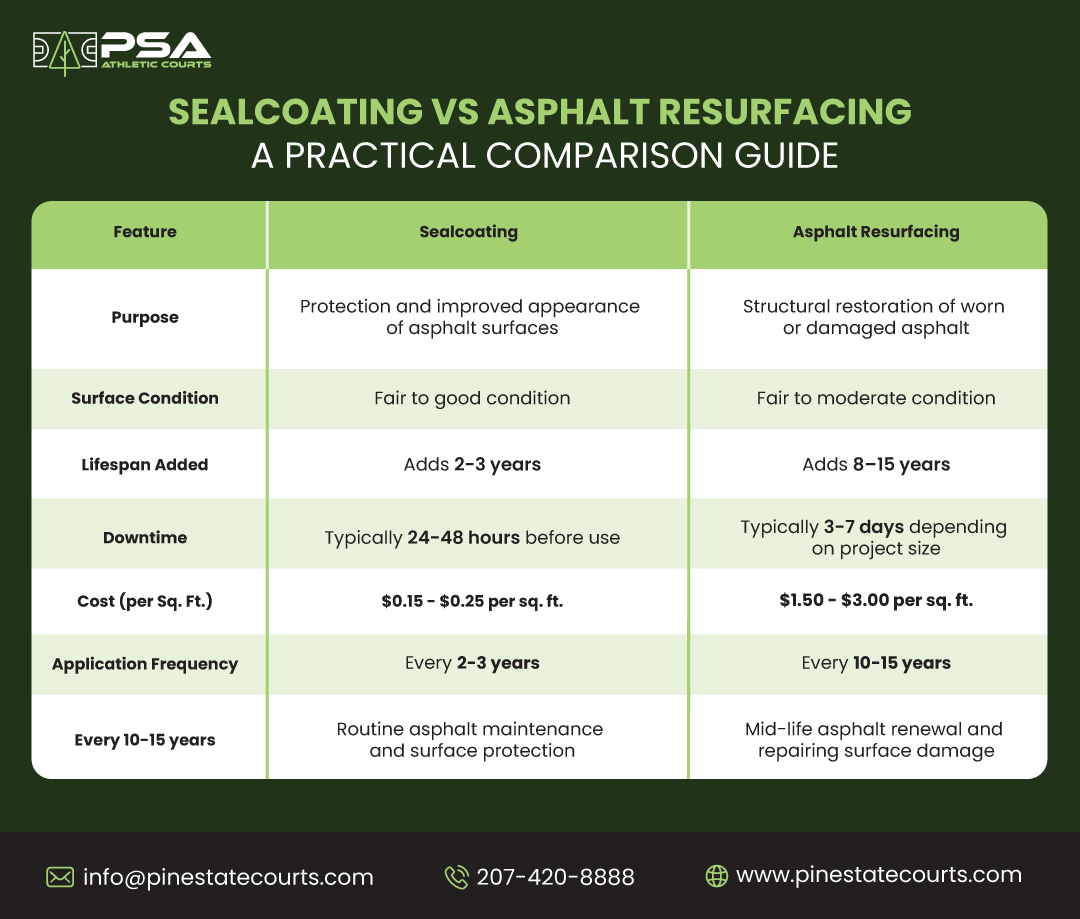
Sealcoating vs. Asphalt Resurfacing Comparison
Now you know that both sealcoating and resurfacing help to maintain asphalt surfaces but it is important to note that they are designed for treating two different stages of the pavement life.
Let’s understand this difference better through a table and see when each option is most appropriate for your commercial asphalt surfaces.
When Should You Choose Sealcoating?
Like we discussed earlier, sealcoating is great as a preventive option for asphalt maintenance. It is useful if your court surface shows light wear such as fading, minor hairline cracks, or loss of flexibility. Sealcoating thus gives your court a facelift and guards the damage from worsening further.
Choose sealcoating if:
- You’re maintaining an existing surface which is already in a decent shape.
- You want a low-cost annual or bi-annual strategy for maintenance.
- You need to ensure minimal disruption for your facility users.
When Is Asphalt Resurfacing the Right Choice?
If your asphalt surface has visible cracks, water damage, or surface warping issues, sealcoating won’t be enough to repair it. Resurfacing these outdoor courts proves to be a long-term solution here by strengthening the court base and replacing the top layer.
Choose resurfacing if:
- There are potholes, alligator cracks, or unevenness on your court.
- Your court surface is over 10 years old
Check out our guide on basketball court resurfacing to learn more about the resurfacing process and its cost.
Cost Comparison: Sealcoating vs. Resurfacing
Besides their process, cost is one of the biggest differences between commercial sealcoating and asphalt resurfacing. Sealcoating generally appears to be a more affordable option as it involves applying a thin protective layer rather than installing new asphalt.
Typical cost ranges include:
- Sealcoating: approximately $0.15 to $0.30 per square foot.
- Asphalt resurfacing: approximately $1.50 to $4.00 per square foot.
For asphalt resurfacing, factors like location, surface condition, and project scale, etc. affect this cost. Sports facilities with larger surface areas should also consider the preparation and downtime costs.
From this discussion it is clear that asphalt resurfacing requires a rather higher upfront investment but it is important to consider that it provides a longer-lasting solution for your damaged asphalt surfaces as compared to sealcoating.
How Long Does Asphalt Resurfacing Last?
The durability of your asphalt resurfacing depends on several factors, including your court’s traffic volume, the climatic conditions of your area, and your ongoing maintenance practices. In most cases, a resurfaced court can last 8 to 15 years before requiring major repairs.
Regular maintenance can significantly extend this lifespan. Here are some maintenance practices that you should consider to ensure lasting performance of your court:
- Seal the cracks on your court regularly.
- Ensure periodic applications of sealcoating.
- Ensure proper management of your court’s drainage.
- Routinely inspect your court surface and check for signs of damage.
- Promptly repair even the minor surface damages.
By implementing this regular maintenance plan, facility managers can maximize the durability of their resurfaced asphalt surfaces.
Check out our tennis court resurfacing guide to learn the right time to resurface your tennis court.
Which Option Is Best for Your Athletic Court Facility?
Although the cost factors and durability concerns matter, choosing between commercial sealcoating and asphalt resurfacing ultimately depends on the current condition of your court surface.
Sealcoating Is Better When:
- Your surface is under 5–7 years old.
- Your main concerns are the appearance and protection of your asphalt surface
- You are planning for seasonal maintenance.
Asphalt Resurfacing Is Better When:
- The court or lot is 10–20 years old.
- The safety and performance of your players is being affected.
- You want to avoid the cost of full repaving.
If you are still unsure, a professional inspection can help you determine the most appropriate solution. Design your custom court here with Pine State Courts and our team will help you choose the right solution and design a maintenance plan for long-lasting performance of your athletic court.
Cost Considerations
💰 How Much Does Asphalt Resurfacing Cost?
The average cost of asphalt resurfacing ranges from $1.50 to $3.00 per square foot, depending on the location, surface condition, and project scale. Sports facilities with larger surface areas should factor in preparation and downtime costs.
💰 Sealcoating Costs
Sealcoating is significantly cheaper at $0.15 to $0.25 per square foot and can be repeated frequently as part of a routine maintenance plan.
How Long Does Asphalt Resurfacing Last?
With proper care and drainage, resurfacing can last 8 to 15 years. It’s a smart investment for high-traffic sports facilities where surface performance and user safety are non-negotiable.
Final Thoughts
Both commercial sealcoating and asphalt resurfacing play their own important roles in maintaining commercial asphalt surfaces. While sealcoating protects your pavement from environmental damage, it is asphalt resurfacing that restores your worn out asphalt surface, improving their durability and performance.
For facility managers and commercial property owners, understanding when to use each of these two is essential for maintaining safe, attractive, and long-lasting court surfaces.
Need Help Deciding?
Both methods offer unique benefits sealcoating for ongoing protection, and resurfacing for long-term restoration. A professional assessment can help you make the best choice based on usage, budget, and surface condition.
Ready to Restore Your Asphalt Court or Facility?
Our experts specialize in both sealcoating and resurfacing services for sports courts, parking lots, and commercial properties. Contact us today for a free consultation and keep your facility looking and performing its best.
Ready to Restore Your Asphalt Court or Facility?
Contact our commercial asphalt experts for a site evaluation and custom quote.
📞 Call now or 📩 book your consultation online.
Frequently Asked Questions
1. What is asphalt resurfacing?
Asphalt resurfacing is the process of adding a new layer of asphalt over an existing surface to restore its strength and appearance without a complete replacement.
2. How much does asphalt resurfacing cost?
The average cost ranges from $1.50 to $3.00 per square foot, depending on the scope and site conditions.
3. How long does asphalt resurfacing last?
Properly installed and maintained resurfaced asphalt can last 8 to 15 years, depending on traffic and weather exposure.
4. How is resurfacing different from repaving?
Resurfacing adds a new layer over the old asphalt, while repaving involves tearing out and replacing the entire structure from the base up.
5. Is sealcoating enough for older sports facilities?
Sealcoating is best for well-maintained or newer surfaces. Older, cracked, or damaged asphalt often needs resurfacing or even repaving.
DOWNLOAD OUR FREE GUIDE
Ready to build your dream court?
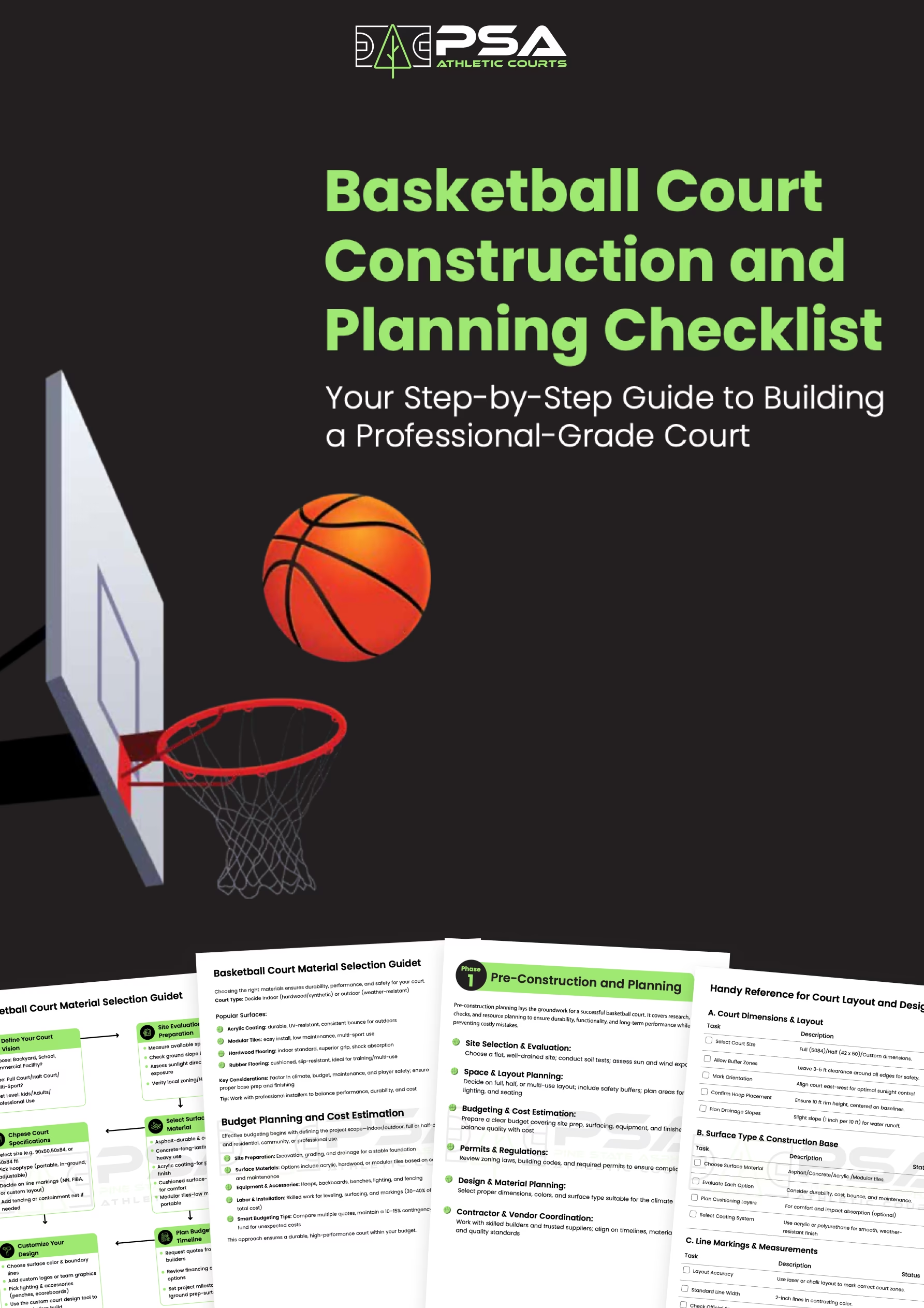
Download our FREE Basketball Court Construction & Planning Checklist and get the step-by-step roadmap to building a professional-grade court—from budget planning to final touches.
No guesswork, just results.